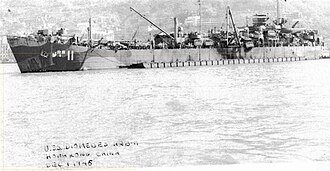
The USS Diomedes (ARB-11) was a United States Navy battle-damage repair ship built during the final months of the Second World War. Unlike the famous American battleships, aircraft carriers, cruisers and destroyers that fought major fleet actions across the Pacific, Diomedes performed a quieter but essential task: keeping damaged warships and landing craft operational. She belonged to the Aristaeus class, a group of repair ships created by converting Landing Ship, Tank (LST) hulls into floating repair facilities. Originally constructed as LST-1119, Diomedes was converted before entering full commission and received her new designation on 23 June 1945. Her wartime career was brief, but she reached the Pacific after the fighting had ended and subsequently supported American naval operations and occupation duties in East Asia. After leaving U.S. service, she received a second career in the West German Navy as Wotan (A513), remaining in service for decades. Her history illustrates an important but often overlooked aspect of naval warfare: the enormous logistical and engineering effort required to repair ships, restore damaged equipment and keep fleets functioning far from home.
From LST-1119 to USS Diomedes
The story of Diomedes began with the mass-production program for Landing Ship, Tank, or LST, vessels that had become one of the defining logistical ships of the Allied war effort. LSTs were designed to transport tanks, vehicles, troops and other heavy equipment directly onto beaches, making them indispensable to amphibious operations. As the war progressed, however, the U.S. Navy recognized that some LST hulls could be adapted for specialized support functions. The Aristaeus-class repair ships were one result of that decision. Rather than designing an entirely new repair vessel from the keel upward, the Navy converted suitable LST hulls into mobile workshops capable of accompanying fleets and providing repair services close to combat areas. The class notes indicate that the ARBs were originally ordered under LST contracts and were subsequently reclassified and fitted as battle-damage repair ships.
LST-1119 was laid down on 19 October 1944 at Seneca, Illinois, by the Chicago Bridge & Iron Company and launched on 11 January 1945, with Mrs. M. D. Hembree serving as sponsor. She initially entered partial commission on 23 January 1945 for the voyage to Baltimore, where her conversion into a battle-damage repair ship was completed. She was then commissioned as USS Diomedes (ARB-11) on 23 June 1945. This chronology is significant because it places the ship among the very last group of wartime auxiliary vessels to be completed as the Pacific War approached its conclusion.
The Meaning Behind the Name
The name Diomedes came from Greek mythology. Diomedes was the legendary king of Argos and one of the principal Greek heroes of the Trojan War, traditionally portrayed as an exceptionally capable warrior. The U.S. Navy selected numerous names from classical mythology for auxiliary vessels during the Second World War, and ARB-11 was the only U.S. Navy vessel to carry the name Diomedes. The name therefore connected a modern engineering and support ship with a figure associated with endurance, courage and warfare in the ancient world.
The Aristaeus-Class Concept
The Aristaeus class represented an ingenious wartime adaptation of existing shipbuilding resources. A conventional fleet repair ship was a large and specialized vessel, but the Navy needed repair capability that could accompany amphibious and forward-deployed forces. Converting LST hulls offered several advantages: the basic ships could be constructed quickly, their shallow draft allowed them to operate close to shore, and their spacious hulls could be adapted to carry workshops, machinery and repair equipment.
The concept was particularly valuable in the Pacific, where American forces advanced across enormous distances and frequently operated far from established naval bases. A damaged landing craft, patrol vessel or small warship could not always be sent thousands of miles back to Pearl Harbor, Australia or the continental United States. A battle-damage repair ship could instead provide maintenance near the operational area, reducing downtime and allowing valuable vessels to return to service much sooner. The ARB was consequently not simply a floating machine shop; it was part of the logistical infrastructure that made sustained naval operations possible.
Diomedes retained the basic dimensions and propulsion characteristics of her LST origins. She was approximately 328 feet long and 50 feet wide, with a relatively shallow draft of about 11 feet 2 inches. Two General Motors 12-567 diesel engines drove two shafts and twin rudders, producing a maximum speed of approximately 12 knots. These figures made her much slower than combat ships, but speed was not her primary purpose. Her value lay in her ability to carry personnel, tools, machinery and supplies while operating close to damaged vessels and forward bases.
A Floating Workshop for the Fleet
The defining feature of Diomedes was her repair mission. A battle-damage repair ship was designed to restore damaged vessels sufficiently for them to resume operations or reach a larger repair facility. The work could encompass machinery, electrical systems, hull structures, piping, weapons and other equipment. Such work required skilled personnel and specialized workshops rather than simply the cargo-handling equipment associated with a conventional transport.
This mission explains why a vessel such as Diomedes could be strategically important without firing many weapons. A destroyer damaged by enemy action might have to leave the combat zone if no repair facilities were available, potentially removing hundreds of crew members and a valuable warship from an operation for weeks or months. If repairs could instead be performed locally, the ship could return to duty much sooner. In large amphibious campaigns involving hundreds of vessels, this difference could have an enormous cumulative effect.
The design also reflected the realities of Pacific warfare. American forces frequently captured or established forward bases that lacked the permanent shipyards available in major ports. Mobile repair vessels helped bridge that gap. Ships like Diomedes could accompany the fleet, move between temporary anchorages and provide technical support wherever it was needed.
Defensive Armament
Although Diomedes was primarily an auxiliary rather than a combatant, she carried defensive weapons. Sources list her armament as two 40 mm guns and eight 20 mm guns. These weapons were intended principally for defense against aircraft and small surface threats rather than for engaging major warships. Her relatively light armament reflected the reality that her protection came primarily from operating within friendly-controlled areas and alongside larger naval forces.
Her crew numbered approximately 260 officers and enlisted personnel, a substantial complement for a ship of her modest dimensions. Much of that manpower was associated with the specialized work required to operate a mobile repair facility. Engineers, mechanics, electricians, welders, machinists and other skilled personnel were as important to the ship’s mission as her deck crew and sailors.
Service in the Pacific
Diomedes entered commissioned service on 23 June 1945, only a few weeks before the atomic bombings of Hiroshima and Nagasaki and Japan’s subsequent surrender. Consequently, she did not have the opportunity to participate in a major wartime battle in the Pacific. Nevertheless, the end of combat did not immediately eliminate the need for naval repair facilities. Thousands of American vessels remained deployed across the Pacific, while occupation forces had to establish bases and maintain an enormous fleet.
Diomedes arrived at Okinawa on 25 September 1945, several weeks after Japan’s surrender. Okinawa had been transformed into one of the most important American bases in the western Pacific after the bitter campaign there earlier in the year. From Okinawa, Diomedes proceeded to Hong Kong in October to begin her repair duties. Her arrival illustrates how quickly American naval support infrastructure was redirected from combat preparation toward occupation and postwar logistics.
Hong Kong and the China Coast
On 3 October 1945, Diomedes departed Okinawa for Hong Kong, where she provided repair services. Hong Kong was strategically important in the immediate postwar period because Allied forces were reestablishing control and communications across East Asia. The port also offered a useful base from which American naval vessels could support occupation and logistical operations.
Diomedes remained in the region into December. On 8 December she departed Hong Kong and called at Kiirun, Formosa, before proceeding to Taku, China, where she arrived on 19 December and continued repair work. These movements demonstrate the flexibility of a mobile repair ship: rather than remaining permanently attached to one naval base, Diomedes could move between ports where technical support was required.
Her work was representative of the enormous transition taking place within the U.S. Navy after the war. The wartime fleet had been designed around defeating Japan, but victory created a completely different set of requirements. Ships had to be maintained, redeployed, placed in reserve or prepared for eventual disposal. Occupation forces needed transport and logistical support, while American naval personnel had to maintain a global fleet during the uncertain early postwar period.
Return to the United States
Diomedes remained in the western Pacific into 1946. On 20 March 1946, she departed Taku and began the long journey back toward the United States. Her voyage included a stop at Pearl Harbor before she continued toward the Atlantic coast. She arrived at Charleston, South Carolina, on 28 May 1946, then proceeded to Jacksonville, Florida, arriving on 2 June. On 3 December 1946, she was placed out of commission and entered reserve status.
Her rapid movement from active service into reserve illustrates the enormous scale of postwar demobilization. During the war, the United States had constructed an extraordinary number of ships, ranging from aircraft carriers and battleships to landing craft and specialized auxiliaries. Once the immediate military emergency had ended, maintaining all of those vessels in active commission was neither necessary nor economical.
Diomedes had served only briefly under the U.S. flag, but her career nevertheless represented the final phase of the American wartime logistics system. She had been designed during a period when every available hull was potentially valuable, completed after the Pacific war had effectively ended, and then employed during the transition from combat to occupation.
A Second Career as Wotan
Diomedes’ story did not end with her retirement from the U.S. Navy. In 1961, she was transferred to West Germany, where she was renamed Wotan (A513). This gave the former American repair ship a remarkable second life in another navy nearly two decades after her construction. Ship records identify her transfer to West Germany in June 1961, while later records indicate that Wotan entered West German service in 1966.
The Bundesmarine, established in the 1950s as West Germany’s federal navy, required support vessels as it developed its own fleet within the NATO alliance. A relatively compact repair ship such as Wotan could provide useful technical and training capabilities without requiring the resources of a much larger fleet repair ship. Her continued existence also demonstrated the durable nature of wartime American auxiliary construction. A vessel built quickly for the final months of the Second World War could still find useful employment more than twenty years later.
Wotan reportedly remained in West German service until 23 August 1991, making her postwar career substantially longer than her American career. Records describe her subsequent use for training and public events associated with the Bundeswehr, although the precise circumstances of her final disposal are not clearly documented in the readily available sources.
Why USS Diomedes Matters
Diomedes is not remembered for a famous battle, a dramatic sinking or a major victory. Her importance lies elsewhere. She represents the vast support network that allowed the United States Navy to sustain operations across the Pacific. Modern naval warfare depends not only on combat ships but also on fuel vessels, ammunition ships, transports, repair ships, tugs, hospital ships and countless other auxiliaries. Without that infrastructure, even the world’s most powerful fleet cannot remain effective for long.
The Aristaeus-class vessels were particularly interesting because they demonstrated how wartime shipbuilding could be adapted to meet changing requirements. The Navy took a hull designed to put tanks and vehicles ashore and transformed it into a specialized repair facility. This approach saved design and construction time while providing a practical vessel for a pressing operational requirement. Diomedes was one of the later examples of that wartime philosophy.
Her postwar career adds another layer to her historical significance. The transfer to West Germany and transformation into Wotan meant that the ship effectively bridged three different eras: the final months of the Second World War, the American postwar occupation period and the Cold War development of the West German Navy. Few ships of her size and relatively humble original purpose could claim such a long and varied institutional history.
Technical Specifications of USS Diomedes
The following figures describe Diomedes in her U.S. Navy configuration as an Aristaeus-class battle-damage repair ship. Some sources differ over the exact builder designation because the ship originated as LST-1119 and was subsequently converted, but contemporary and shipbuilding records identify the hull with the Chicago Bridge & Iron Company at Seneca, Illinois.
| Specification | USS Diomedes (ARB-11) |
|---|---|
| Class | Aristaeus class |
| Type | Battle-damage repair ship |
| Original designation | LST-1119 |
| Builder | Chicago Bridge & Iron Co., Seneca, Illinois |
| Laid down | 19 October 1944 |
| Launched | 11 January 1945 |
| Initial commissioning | 23 January 1945 |
| Converted/reclassified | Diomedes (ARB-11) |
| Full commission | 23 June 1945 |
| Length | 328 ft (100 m) |
| Beam | 50 ft (15 m) |
| Draft | 11 ft 2 in (3.40 m) |
| Light displacement | 1,781 long tons |
| Full-load displacement | About 3,700 long tons |
| Propulsion | 2 × General Motors 12-567 diesel engines |
| Propeller shafts | 2 |
| Rudders | 2 |
| Maximum speed | About 12 knots |
| U.S. crew | Approximately 260 officers and enlisted personnel |
| Armament | 2 × 40 mm guns; 8 × 20 mm guns |
| Primary role | Battle-damage repair and fleet support |
| Pacific arrival | Okinawa, 25 September 1945 |
| Hong Kong service | October–December 1945 |
| China service | Taku, December 1945–March 1946 |
| U.S. decommissioning | 3 December 1946 |
| Transferred to West Germany | 7 June 1961 |
| West German name | Wotan (A513) |
| West German commission | 20 January 1966 |
| West German decommissioning | 23 August 1991 |
| Final fate | Not clearly documented in available records |
Conclusion
The USS Diomedes (ARB-11) was a small but highly practical component of the American naval machine during the final stage of the Second World War. Born as LST-1119 and converted into an Aristaeus-class battle-damage repair ship, she represented the Navy’s determination to provide repair capability wherever its forces operated. Although she arrived in the Pacific too late to experience major wartime combat, her service at Okinawa, Hong Kong and Taku placed her within the vast logistical effort that followed Japan’s surrender.
Diomedes’ most remarkable feature was ultimately the longevity of her career. Her American service ended in 1946, but fifteen years later she was transferred to West Germany and became Wotan, continuing to serve into the final decade of the Cold War. Her history is therefore a useful reminder that naval history is not only about battleships and famous engagements. Behind every fleet operation were repair ships, engineers and technicians whose work restored damaged vessels and kept fleets moving. Diomedes was one of those ships, and her unusual transition from wartime American auxiliary to long-serving West German support vessel makes her a particularly interesting example of the practical side of twentieth-century naval history.
_at_anchor_in_Hong_Kong_Harbor,_1_December_1945.jpg)