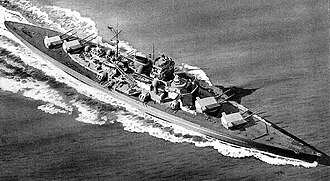
The German battleship Tirpitz was the largest and most powerful capital ship ever completed for the German Kriegsmarine and the sister ship of the famous Bismarck. Commissioned in February 1941, she spent most of the Second World War in Norwegian waters, where her mere presence forced Britain and its allies to devote substantial naval and air forces to watching and containing her. Unlike Bismarck, Tirpitz never achieved a comparable operational breakthrough in the Atlantic, but that does not mean she was strategically unimportant. Her ability to threaten the Arctic convoys carrying supplies from Britain and the United States to the Soviet Union made her a persistent concern for Allied planners. British forces launched repeated attacks against her, including submarine operations, carrier-aircraft strikes and eventually enormous raids by heavy bombers. After being severely damaged by British midget submarines in September 1943 and repeatedly attacked from the air in 1944, Tirpitz was finally overturned and sunk by RAF Lancaster bombers at Tromsø on 12 November 1944. Her career became an unusual chapter in naval history: a battleship that spent relatively little time fighting enemy warships directly but nevertheless absorbed immense Allied resources simply because commanders could not ignore the threat she represented.
The Construction of Tirpitz
Tirpitz was conceived during Germany’s rapid naval expansion of the 1930s. The German navy had entered the decade far behind the major naval powers in the number and size of its modern warships, and the construction of Bismarck and Tirpitz represented an attempt to create a new generation of large capital ships. German naval planners wanted vessels capable of operating over long distances while combining substantial firepower, armor protection and speed. At the outbreak of the Second World War, however, Germany’s battleship force remained extremely small. The U.S. Naval History and Heritage Command notes that Bismarck and Tirpitz were still under construction when war began, while Germany’s broader surface fleet was nowhere near the size of the Royal Navy.
Tirpitz was laid down at the Kriegsmarinewerft shipyard in Wilhelmshaven in October 1936 and launched on 1 April 1939. She was named after Grand Admiral Alfred von Tirpitz, the architect of Imperial Germany’s pre-First World War naval expansion. The ship was commissioned on 25 February 1941, several months after Bismarck had entered service. Her completion represented the culmination of German battleship construction, but by the time she became operational, the strategic circumstances of the war were already making large surface ships increasingly difficult to employ. Germany lacked the global network of bases enjoyed by Britain, while Allied aircraft, submarines and reconnaissance capabilities were steadily improving.
A Sister Ship to Bismarck
Tirpitz belonged to the Bismarck class, and her basic design closely followed that of her sister ship. She carried eight 38 cm guns in four twin turrets, with two turrets forward and two aft. The main battery was supported by twelve 15 cm guns, sixteen 10.5 cm anti-aircraft guns and numerous smaller anti-aircraft weapons whose number and arrangement changed during the war. The ship also carried reconnaissance aircraft, allowing her to extend her visual scouting range far beyond the limits of observers positioned aboard the battleship itself. Contemporary U.S. Navy identification material described Tirpitz as a 35,000-ton battleship approximately 817 feet long, with a beam of 118 feet and a speed of around 30 knots.
Like Bismarck, Tirpitz combined heavy armament with extensive protection. Her main armored belt was approximately 320 mm thick in its strongest sections, while the main gun turrets and other vital areas received substantial armor protection. The ship was also divided into numerous compartments and incorporated extensive underwater protection intended to reduce the consequences of torpedo and mine explosions. These features made Tirpitz a formidable surface combatant even though her wartime career would rarely give her the opportunity to demonstrate her full fighting capability against an opposing battleship.
Tirpitz and the Norwegian Strategy
Tirpitz’s wartime role was determined largely by geography. After Germany occupied Norway and Denmark in 1940, Norway provided a chain of bases from which German naval forces could operate against Allied shipping in the North Atlantic and Arctic. The northern Norwegian coastline was particularly important because Allied convoys passed through the Arctic Ocean on their way to the Soviet Union. These convoys transported tanks, aircraft, ammunition, vehicles, fuel and other supplies needed by the Soviet war effort.
Tirpitz therefore became a potential threat to the Arctic convoy system. The British could not simply assume that she would remain in port indefinitely. If she sortied into the Norwegian Sea or Barents Sea, she could potentially attack convoys or force Allied escorts to concentrate around the battleship rather than the merchant ships. Her presence also created the possibility that other German naval units could operate under her protection. By late 1943, the German battleship Tirpitz, the battlecruiser Scharnhorst and other German naval forces were based in northern Norway, and the Royal Navy maintained substantial forces to prevent a German breakout into the Atlantic.
The “Fleet in Being”
Tirpitz became a classic example of the naval concept known as a fleet in being. A warship does not necessarily have to attack enemy ships to influence naval strategy; the possibility that it might attack can force an opponent to keep forces nearby to deter or intercept it. Tirpitz’s existence therefore had consequences far beyond the number of Allied vessels she actually sank.
This situation was particularly important for Arctic convoys. Britain needed to protect merchant ships traveling to the Soviet Union, but it also had to consider the possibility of a German surface attack. Battleships, cruisers, destroyers, submarines and aircraft could all be assigned to surveillance and interception duties. U.S. Naval History and Heritage Command records that Allied forces were required to maintain substantial naval strength in the north partly because Tirpitz and other German surface ships could threaten the convoy route.
Tirpitz’s Operations in Norway
Tirpitz did not spend the war completely inactive. Her movements were carefully planned around opportunities to threaten Allied forces while minimizing exposure to British attacks. One of her most significant operations came in September 1943, when she participated in a German attack on Spitsbergen, the Arctic island now known as Svalbard. The operation involved Tirpitz, Scharnhorst, Lützow and a number of destroyers. German forces shelled Allied positions and temporarily landed troops, destroying installations before withdrawing.
Although the Spitsbergen operation was limited in strategic effect, it demonstrated that Tirpitz could still operate as part of a powerful surface formation. More importantly, the sortie exposed the battleship to the attention of Allied intelligence and provided an opportunity for Britain to attempt a direct attack.
The X-Craft Attack
On 22 September 1943, British X-Craft midget submarines attacked Tirpitz in Altafjord. The operation was extraordinarily hazardous because the small submarines had to travel to northern Norway and penetrate heavily defended waters. Several of the craft were lost or failed to complete their missions, but others successfully placed explosive charges beneath the battleship.
The resulting explosions caused serious structural damage. Tirpitz was not sunk, but her propulsion machinery and other systems were damaged badly enough to keep her out of operational service for many months. According to Naval History and Heritage Command, the attack put Tirpitz out of action until the following year.
Repairing the Battleship
The damage illustrated one of the central problems of operating a major warship in confined Norwegian waters. Tirpitz possessed enormous firepower, but she was a large and relatively vulnerable target when anchored in a fjord. Her movement was restricted by geography, while Allied intelligence gradually became better at locating her. Repairing such a ship also required specialized facilities, engineers, spare parts and considerable time.
After the X-Craft attack, German personnel worked to restore Tirpitz’s operational capability. The ship eventually returned to a condition in which she could move under her own power, but the strategic environment had become increasingly unfavorable. Allied air power had expanded dramatically, and British planners were determined to eliminate the battleship rather than allow her to remain a permanent threat to the Arctic convoy route.
Operation Tungsten
One of the most famous attacks on Tirpitz occurred on 3 April 1944, when British carrier aircraft launched Operation Tungsten. Aircraft from carriers including HMS Victorious and HMS Furious attacked the battleship while she was at anchor in Altafjord. The raid achieved multiple bomb hits and caused extensive damage and casualties.
The attack was significant because it demonstrated that carrier aircraft could strike a heavily defended battleship inside a Norwegian fjord. Tirpitz’s anti-aircraft defenses could inflict losses, but they could not prevent the attacking aircraft from reaching the target. Repairs once again took months, forcing Germany to devote considerable resources to keeping the battleship operational. The repeated attacks also reinforced the idea that Tirpitz’s location in Norway was not sufficient protection against Allied air power.
The Final Attacks on Tirpitz
By the autumn of 1944, Allied planners had developed methods for attacking Tirpitz from greater distances using heavy bombers. The battleship was moved from Altafjord toward Tromsø, where German authorities hoped that shallower water would provide some protection and allow the ship to serve as a floating coastal artillery battery if necessary.
British bombers subsequently carried out several major raids. In September 1944, Operation Paravane inflicted additional damage, while further attacks followed in October and November. The decisive attack came on 12 November 1944 during Operation Catechism, when RAF Lancaster bombers armed with very heavy bombs attacked Tirpitz at Tromsø. Several bombs struck the ship, producing catastrophic damage. Tirpitz capsized in the shallow water, killing approximately 1,000 members of her crew.
The Sinking at Tromsø
The final destruction of Tirpitz was different from the sinking of Bismarck. Bismarck had been destroyed during a surface engagement in the Atlantic after being disabled by an aerial torpedo, whereas Tirpitz was ultimately eliminated while anchored in Norway after a prolonged campaign involving submarines, carrier aircraft and heavy bombers. The contrast demonstrates how naval warfare had changed between 1941 and 1944. Aircraft had become an increasingly decisive means of attacking even the largest and most heavily protected warships.
The wreck of Tirpitz remained in Norwegian waters after the war and was eventually dismantled. Salvage operations continued for years, and portions of the ship were recovered and reused. The surviving remnants remain associated with the Norwegian coastline and the extraordinary sequence of attacks that brought down one of the most famous battleships of the Second World War.
The Legacy of Tirpitz
Tirpitz occupies an unusual place in naval history because her importance cannot be measured simply by her combat record. Unlike many famous battleships, she did not participate in a long series of major fleet battles. Instead, her strategic value came largely from the threat created by her presence. British commanders had to consider what might happen if Tirpitz escaped from her Norwegian base and attacked an Arctic convoy, and this uncertainty influenced the deployment of Allied naval forces throughout much of the war.
Her career also provides a striking illustration of the changing relationship between battleships and air power. When Tirpitz was designed, the battleship remained the centerpiece of many naval strategies, combining armor and heavy guns into a mobile fortress. By 1944, however, long-range aircraft, carrier aviation, submarines and improved reconnaissance systems could attack such a ship repeatedly from multiple directions. Tirpitz’s heavy armor made her difficult to destroy quickly, but it did not make her immune to sustained aerial attack.
The ship’s history also demonstrates the enormous resources required to maintain a modern battleship. Every major attack demanded repairs, specialized labor and logistical support, while German forces had to provide aircraft, fighters, anti-aircraft defenses and naval units to protect her. The Royal Navy, meanwhile, repeatedly committed significant resources to locating and attacking the battleship. Tirpitz therefore became both a weapon and a strategic liability: powerful enough to demand attention, but increasingly difficult to use effectively as Allied control of the surrounding seas and skies expanded.
Technical Specifications of Tirpitz
The exact figures for Tirpitz vary between sources depending on whether standard, full-load or wartime displacement is being quoted. The table below provides commonly cited specifications and reflects the ship’s basic configuration rather than every wartime modification. U.S. Naval History and Heritage Command contemporary identification material lists Tirpitz at 35,000 tons, 817 feet in length, 118 feet in beam and approximately 30 knots.
| Specification | Tirpitz |
|---|---|
| Class | Bismarck class |
| Type | Battleship |
| Builder | Kriegsmarinewerft, Wilhelmshaven |
| Laid down | 2 November 1936 |
| Launched | 1 April 1939 |
| Commissioned | 25 February 1941 |
| Length overall | Approximately 251 m |
| Beam | Approximately 36 m |
| Draft | Approximately 9.9–10.2 m |
| Standard displacement | About 42,000 tonnes |
| Full-load displacement | Approximately 50,000 tonnes |
| Propulsion | 12 boilers and 3 geared steam turbines |
| Shafts | 3 |
| Power | Approximately 150,000–160,000 shp |
| Maximum speed | Approximately 30–31 knots |
| Main armament | 8 × 38 cm guns in 4 twin turrets |
| Secondary armament | 12 × 15 cm guns in 6 twin turrets |
| Heavy AA armament | 16 × 10.5 cm guns in 8 twin mounts |
| Light AA armament | 3.7 cm and 2 cm anti-aircraft guns |
| Aircraft | Arado Ar 196 floatplanes |
| Main belt armor | Up to approximately 320 mm |
| Turret face armor | Up to approximately 360 mm |
| Primary wartime base | Northern Norway |
| Major operations | Arctic/Norwegian operations; Spitsbergen raid |
| Final attack | Operation Catechism |
| Sunk | 12 November 1944 |
| Location of loss | Tromsø, Norway |
Conclusion
The German battleship Tirpitz was a remarkable product of pre-war naval engineering and one of the most heavily protected and heavily armed warships of the Second World War. Her eight 38 cm guns, powerful machinery, substantial armor and high speed gave her the theoretical capabilities expected of a modern battleship, while her presence in northern Norway created a persistent threat to the Allied Arctic convoy system. Yet Tirpitz’s career was defined less by spectacular battles than by deterrence, concealment, repair and repeated Allied attacks.
From the British X-Craft raid in 1943 to Operation Tungsten and the final Lancaster attacks in 1944, the battleship became the target of an extraordinary campaign. The effort required to neutralize her illustrates the strategic importance the Allies assigned to the possibility of a German surface breakout. Ultimately, Tirpitz never achieved the kind of Atlantic commerce-raiding career envisioned for Germany’s large surface ships. Instead, she became a powerful fleet in being, tying down Allied forces until modern air power finally destroyed her at Tromsø.
In this respect, Tirpitz’s historical significance extends beyond her guns and armor. Her career captures the transition from the age of the battleship toward a form of naval warfare in which aircraft, submarines, reconnaissance and coordinated air-sea operations increasingly determined the fate of even the largest surface warships. She was the last major German battleship to survive into 1944, and her final destruction marked the end of Germany’s hopes of using a capital ship to influence the Arctic maritime war.
