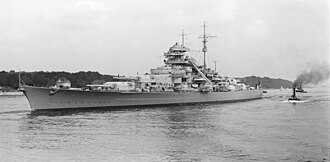
The German battleship Bismarck was one of the most famous warships of the Second World War and arguably the most recognizable capital ship ever constructed for the German Kriegsmarine. Built during Germany’s rapid naval expansion in the 1930s, Bismarck represented an enormous investment in armor, firepower, speed and engineering. She was the lead ship of the two-vessel Bismarck class, followed by her sister ship Tirpitz, and was designed to operate as a fast battleship capable of engaging enemy warships while also threatening Allied merchant shipping. Bismarck entered service in August 1940, but her operational career lasted less than a year. Her first major combat sortie, Operation Rheinübung, became one of the most famous naval episodes of the Second World War. In May 1941, Bismarck and the heavy cruiser Prinz Eugen broke into the North Atlantic, where they encountered the British battlecruiser HMS Hood and battleship HMS Prince of Wales in the Denmark Strait. Hood was destroyed within minutes, but Bismarck was damaged and subsequently subjected to an enormous British pursuit. After an aerial torpedo attack disabled her steering, Bismarck was caught by British battleships and cruisers on 27 May 1941 and sank after a prolonged engagement. Only 110 of the approximately 2,200 men aboard survived.
Origins of the Bismarck Class
The development of Bismarck was closely connected with Germany’s naval rearmament during the 1930s. Following the restrictions imposed on Germany after the First World War, the German navy initially had severe limitations on the size and type of warships it could build. Adolf Hitler’s government increasingly ignored those restrictions as it pursued military expansion, while agreements such as the Anglo-German Naval Agreement provided a temporary framework for German naval construction. The Kriegsmarine envisioned a fleet containing battleships, battlecruisers, cruisers, destroyers and submarines, although Germany never came close to matching Britain’s Royal Navy in overall numbers. When the Second World War began in September 1939, Bismarck and Tirpitz were still under construction, illustrating how incomplete Germany’s surface fleet remained.
Bismarck was laid down at the Blohm & Voss shipyard in Hamburg in July 1936 and launched on 14 February 1939. She was commissioned on 24 August 1940. The ship was named after Otto von Bismarck, the nineteenth-century Prussian statesman who played the central role in the unification of Germany. Her enormous size and imposing appearance reflected the ambitions of the German naval program. Although international naval treaties nominally established displacement limits for battleships, Bismarck was substantially larger than the 35,000-ton treaty figure. U.S. Naval intelligence later estimated her loaded displacement at close to 50,000 tons.
A New Generation of German Battleship
Bismarck was conceived as a fast battleship rather than simply a heavily armed ship intended for line-of-battle engagements. Her design emphasized a combination of speed, armor protection and long-range firepower. Eight 38 cm guns formed the main battery, arranged in four twin turrets. Two turrets were positioned forward and two aft, giving the ship a powerful broadside and allowing her to engage targets over extremely long distances. The 38 cm guns fired shells weighing roughly 800 kilograms and had a maximum range of approximately 23.6 miles under suitable conditions.
The secondary armament consisted of twelve 15 cm guns mounted in six twin turrets, supplemented by sixteen 10.5 cm anti-aircraft guns in twin mounts and numerous smaller 37 mm and 20 mm weapons. Bismarck also carried four reconnaissance aircraft, which provided an important scouting capability during operations at sea. Her combination of heavy guns and high speed made her a formidable opponent for most contemporary cruisers and a serious threat to battleships that lacked comparable protection or firepower.
Armor and Engineering
One of Bismarck’s most impressive characteristics was the extensive armor protection incorporated into her design. The main armored belt was approximately 320 mm thick in its strongest sections and protected a substantial proportion of the waterline. Behind the main belt were additional structural and torpedo-defense systems intended to limit flooding and protect the machinery and magazines. The main turrets also received very heavy armor, while the ship’s armored deck provided protection against shells arriving at steep angles. U.S. naval intelligence assessed that the armor belt could withstand extremely heavy gunfire and noted the extensive subdivision and underwater protection built into the hull.
Bismarck’s propulsion system was equally ambitious. Three shafts were driven by geared steam turbines supplied by twelve high-pressure boilers. During trials, the ship achieved a maximum speed of approximately 32.5 knots, an extraordinary figure for a battleship of her size. This speed gave German commanders the theoretical ability to choose engagements against slower ships and withdraw from unfavorable situations. Her large fuel capacity also gave her the endurance needed for operations far from German-controlled waters, although practical operational range was affected by fuel consumption, weather and the need to maintain high speeds.
Size and Internal Protection
The ship’s enormous dimensions were reflected in her internal organization. Bismarck was approximately 251 meters long and had a beam of around 36 meters. Her hull was divided into numerous watertight compartments, while longitudinal subdivision and a double-bottom arrangement contributed to her resistance to underwater damage. The design placed great emphasis on keeping the propulsion system and ammunition magazines protected even after the ship had sustained serious damage.
This emphasis on survivability became particularly important during Bismarck’s final battle. The ship continued to fight after suffering numerous hits and remained afloat for a considerable period despite extensive damage. The circumstances of her loss have nevertheless generated considerable historical debate, particularly concerning the respective effects of British gunfire, torpedo attacks and deliberate German scuttling measures. Contemporary U.S. Navy accounts recorded that the ship was eventually scuttled by her surviving crew as British forces continued their attack.
Bismarck’s Short Operational Career
After entering service in August 1940, Bismarck spent several months working up and training in the Baltic region. Her first and only major combat operation came in May 1941, when she sailed as part of Operation Rheinübung, a German attempt to send major surface ships into the Atlantic against Allied commerce. Bismarck was accompanied by the heavy cruiser Prinz Eugen, while other German ships were involved in supporting the operation. The objective was to disrupt Allied shipping and place pressure on the maritime supply system that sustained Britain.
The German force departed in May 1941 and moved northward toward the Denmark Strait. British reconnaissance aircraft detected the ships, and the Royal Navy began assembling forces to intercept them. The British response eventually brought Bismarck and Prinz Eugen into contact with HMS Hood and HMS Prince of Wales. What followed became one of the most famous naval battles of the war.
The Battle of the Denmark Strait
On 24 May 1941, Bismarck and Prinz Eugen engaged the British force in the Battle of the Denmark Strait. Hood was one of the world’s most famous warships and had been commissioned in 1920. Although heavily armed, she was more lightly protected than a modern battleship because of her battlecruiser origins and subsequent modernization. Prince of Wales was a newer battleship that had only recently entered service and was still experiencing technical and crew-training difficulties.
The German ships concentrated their fire on Hood. After several salvos, Bismarck’s shells struck the British battlecruiser and a tremendous explosion tore through the ship. Hood sank within minutes, and only three men survived from her crew of more than 1,400. The destruction of Hood was an enormous shock to Britain and immediately transformed Bismarck from a dangerous raider into the primary target of a massive Royal Navy pursuit.
Bismarck herself was not undamaged. Prince of Wales scored hits that caused flooding and, critically, damaged fuel-storage areas. The damage reduced Bismarck’s ability to continue the original commerce-raiding mission, and German commanders decided that she should head toward the French Atlantic coast for repairs. Prinz Eugen separated from Bismarck and continued independently for a short time before eventually reaching Brest.
The Pursuit of Bismarck
The British response to the destruction of Hood was enormous. Warships across the Atlantic were ordered to search for Bismarck, while aircraft attempted to locate and attack the German battleship. British forces needed to prevent her from reaching the safety of occupied France, where repairs could have restored her to operational condition.
The decisive moment came on the evening of 26 May. A force of Fairey Swordfish torpedo bombers launched from the aircraft carrier HMS Ark Royal attacked Bismarck. One torpedo struck the battleship and damaged her steering arrangements, leaving the rudder jammed. Bismarck retained propulsion, but without effective steering she could no longer maintain a reliable course toward France. The ship was effectively trapped in the Atlantic while British surface forces converged on her position. U.S. Naval History and Heritage Command records the rudder damage as the event that prevented Bismarck from escaping her pursuers.
The Final Battle
During the night of 26–27 May, British and Polish destroyers repeatedly attacked Bismarck with torpedoes. By the morning, the British battleships HMS King George V and HMS Rodney had reached the area and opened fire. Cruisers and destroyers also participated in the final operation. Bismarck’s main guns returned fire, but the ship’s combat effectiveness deteriorated as her fire-control systems, communications and superstructure were damaged.
The final battle lasted for hours. British shells progressively destroyed the exposed parts of the ship while additional torpedoes struck her hull. Despite the punishment inflicted on her, Bismarck remained afloat for an unexpectedly long time. Eventually, her crew opened the sea valves and took other measures intended to prevent capture. The battleship finally sank approximately 300 nautical miles west of Ushant, France. Of the approximately 2,200 people aboard, only 110 were rescued.
Why Bismarck Became So Famous
The historical fame of Bismarck cannot be explained simply by her technical characteristics. Her actual operational career was extremely short, but the dramatic sequence of events surrounding her first sortie created an enduring naval legend. The sinking of Hood gave Bismarck an extraordinary reputation almost immediately, while the subsequent British pursuit became one of the most extensive naval hunts of the war.
Bismarck also became an enduring subject of naval analysis because her final battle raised questions about the relative importance of armor, firepower, damage control, air power and naval reconnaissance. Her armor allowed her to absorb substantial punishment, while her powerful guns made her dangerous even when heavily damaged. Yet her fate also demonstrated that a battleship’s survival depended on more than armor and guns. Aircraft reconnaissance, carrier aviation, torpedoes, radar, communications and coordinated fleet operations could determine the outcome of an engagement involving even the most heavily protected surface ship.
Discovery of the Wreck
The wreck of Bismarck was discovered in 1989 by an expedition led by American oceanographer Robert Ballard. It rests at a depth of approximately 4,790 meters in the Atlantic Ocean. The discovery allowed researchers to examine the surviving remains of one of the twentieth century’s most famous battleships and provided additional evidence for studying the circumstances of her loss.
The wreck’s location and condition have contributed to continuing historical and technical research into Bismarck’s final battle. The ship’s sinking remains the subject of detailed studies because historians continue to examine how much damage was caused by British gunfire and torpedoes and how much resulted from deliberate scuttling by the German crew.
Legacy of the German Battleship Bismarck
Bismarck’s career lasted only from August 1940 until May 1941, but those months produced a legacy far greater than her time in service would suggest. She represented the peak of German battleship construction and combined enormous size with heavy armor, eight powerful 38 cm guns and a speed exceeding 30 knots. Her operational history, however, also illustrated the strategic limitations of Germany’s surface fleet. A single battleship could disrupt Allied naval operations and force a major response, but it could not overcome Britain’s extensive network of bases, aircraft, cruisers, battleships and intelligence resources.
The destruction of Bismarck also demonstrated that the battleship was increasingly vulnerable when operating without adequate air and reconnaissance support. Her final mission began as an attempt to attack commerce but rapidly became a struggle for survival after the Battle of the Denmark Strait. Once her steering system was disabled, her considerable speed ceased to provide the tactical advantage that had been central to her design.
Today, Bismarck remains one of the most studied warships of the Second World War. Her story combines engineering ambition, naval strategy and combat experience in a remarkably concentrated period. She was powerful enough to destroy one of Britain’s most prestigious warships in minutes, yet vulnerable enough to be isolated and ultimately overwhelmed only three days later. That extraordinary contrast is central to understanding both Bismarck’s historical importance and the rapidly changing nature of naval warfare in the early 1940s.
Technical Specifications of Bismarck
The figures below summarize commonly cited characteristics of Bismarck. Displacement figures vary depending on whether standard, operational or deep-load displacement is being used; contemporary U.S. Navy intelligence, for example, estimated her loaded displacement at close to 50,000 tons.
| Specification | Bismarck |
|---|---|
| Class | Bismarck class |
| Type | Battleship |
| Builder | Blohm & Voss, Hamburg |
| Laid down | 1 July 1936 |
| Launched | 14 February 1939 |
| Commissioned | 24 August 1940 |
| Length overall | Approximately 251 m |
| Beam | Approximately 36 m |
| Draft | Approximately 9.9 m at deep load |
| Standard displacement | About 41,700 tonnes |
| Full/deep-load displacement | Close to 50,000 tonnes |
| Propulsion | 12 boilers and 3 geared steam turbines |
| Shafts | 3 |
| Power | Approximately 150,000–160,000 shp |
| Maximum speed | Approximately 30–32.5 knots |
| Main armament | 8 × 38 cm guns in 4 twin turrets |
| Secondary armament | 12 × 15 cm guns in 6 twin turrets |
| Heavy AA armament | 16 × 10.5 cm guns in 8 twin mounts |
| Light AA armament | 37 mm and 20 mm weapons |
| Aircraft | Up to 4 × Arado Ar 196 |
| Main armor belt | Up to approximately 320 mm |
| Turret face armor | Approximately 360 mm |
| Maximum speed on trials | About 32.5 knots |
| Combat operation | Operation Rheinübung, May 1941 |
| Sunk | 27 May 1941 |
| Wreck depth | Approximately 4,790 m |
Bismarck’s story ultimately illustrates the extraordinary power and limitations of the battleship at the beginning of the Second World War. She was among the most heavily armed and protected warships of her era, yet her operational career showed that even an exceptionally powerful battleship could be isolated by reconnaissance, attacked by aircraft and disabled by a relatively small number of successful torpedo strikes. Her destruction became one of the defining naval episodes of 1941, while the ship herself became an enduring subject of naval history. From her construction in Hamburg to the Battle of the Denmark Strait and her final hours in the North Atlantic, Bismarck’s brief career remains one of the clearest examples of the dramatic transition taking place in naval warfare during the Second World War.
