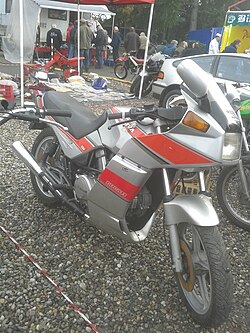
Cagiva Alazzurra: The Italian Sport-Touring Motorcycle With Ducati DNA
The Cagiva Alazzurra is one of those motorcycles that becomes more interesting the more closely its history is examined. At first glance, it appears to be a distinctive Italian sport-touring machine from the 1980s, with compact bodywork, a purposeful riding position and the unmistakable character of a large V-twin. Look beneath that styling, however, and the Alazzurra reveals a much deeper story. Its engine and much of its mechanical architecture came from the Ducati Pantah family, making the motorcycle an important link between Ducati’s engineering heritage and Cagiva’s rise as one of Italy’s most ambitious motorcycle manufacturers. The Alazzurra was offered in several engine capacities, including 350, 400 and 650 cc versions, with the 650 becoming the best-known expression of the concept. Contemporary and historical sources identify the 650 as a 90-degree, air-cooled V-twin using Ducati’s desmodromic valve system, while period road tests noted that the motorcycle’s origins could be traced back to the Ducati Pantah introduced earlier in the decade.
The Origins of the Cagiva Alazzurra
From Ducati Pantah to Cagiva
To understand the Alazzurra, it is necessary to look at the Ducati Pantah. The Pantah represented a major change in Ducati engine design, moving away from the company’s earlier bevel-drive overhead-camshaft arrangements and introducing belt-driven camshafts. The first Pantah production motorcycles appeared around the beginning of the 1980s, and the basic 90-degree V-twin architecture subsequently became one of the foundations of Ducati’s modern engine identity. When Cagiva acquired control of Ducati in the early 1980s, the relationship between the two companies created an opportunity to extend the life of the Pantah platform in a new motorcycle. The Alazzurra emerged from precisely this period of Italian motorcycle-industry transformation. Historical documentation of the Pantah family records that, following Cagiva’s takeover of Ducati, 350 and 650 Alazzurra models were produced using Pantah engines.
The Alazzurra was consequently not a completely clean-sheet Cagiva design in the mechanical sense. Instead, Cagiva took proven Ducati engineering and surrounded it with its own styling, chassis details and touring-oriented equipment. A contemporary Cycle World comparison from 1985 described the 650 as having new bodywork while retaining a frame and running gear that were fundamentally related to the older Pantah. That connection is important because it explains both the strengths and limitations of the motorcycle: the Alazzurra combined a distinctive Italian V-twin engine with a chassis concept that had already established its character several years earlier.
The Alazzurra 650
A middleweight V-twin with character
The 650 was the model that most clearly demonstrated what Cagiva wanted the Alazzurra to be. Its engine displaced approximately 649 cc and used a 90-degree V-twin layout, air cooling, single overhead camshafts and two valves per cylinder. The valves were operated using Ducati’s desmodromic system, an engineering feature that mechanically controls both opening and closing rather than relying on conventional valve springs for closure. For an enthusiast, this combination gave the Alazzurra an unusually strong mechanical identity: it was not simply another Japanese-style middleweight with Italian bodywork, but a motorcycle built around an engine design with a distinctive lineage. Period specifications list an 82.0 mm bore and 61.5 mm stroke, a 10.0:1 compression ratio and two 36 mm Dell’Orto carburetors.
Depending on model year, market and specification, published power figures vary. The 1985 version is commonly listed at approximately 55–56 horsepower, with peak power arriving at roughly 8,250–8,500 rpm. One period specification source gives 56 hp at 8,250 rpm, while another published specification for the Alazzurra 650SS gives 55 hp at 8,500 rpm and 50 Nm of torque at 7,000 rpm. These small differences are worth remembering when researching a particular motorcycle because specifications can vary between markets and model years. What remains consistent is the character of the engine: the Alazzurra’s performance was built around accessible V-twin torque and midrange usability rather than the extremely high-revving character that became common among later four-cylinder sportbikes.
Five-speed transmission and classic Italian mechanics
The engine was paired with a five-speed gearbox and chain final drive. Although modern motorcycles commonly use six-speed transmissions, the five-speed arrangement suited the Alazzurra’s engine characteristics and intended use. The relatively broad torque delivery of the V-twin meant that the rider did not need to constantly search for another gear to maintain useful acceleration. This was particularly appropriate for a motorcycle intended to combine spirited riding with longer-distance road use.
The engine’s 90-degree configuration also contributed to the motorcycle’s character. A V-twin of this layout has an inherently distinctive exhaust note and firing character, while the mechanical presence of the engine becomes a major part of the riding experience. The Alazzurra therefore offered something quite different from the increasingly dominant four-cylinder Japanese motorcycles of its period. It was not necessarily about winning a specification-sheet contest; its appeal came from the combination of Italian styling, Ducati-derived engineering and a compact V-twin power delivery.
Chassis and Handling
A Pantah-based foundation
The Alazzurra’s chassis was closely related to the Pantah platform. Contemporary testing described the structure as a distinctive ladder-type arrangement in which the engine formed an important part of the overall motorcycle architecture. The swingarm pivot passed through the rear portion of the engine crankcase, an arrangement that saved space and helped accommodate the physical dimensions of the 90-degree V-twin. This was a technically interesting solution, particularly because the forward cylinder of a longitudinally arranged V-twin occupies considerable space around the front of the motorcycle.
Suspension equipment reflected the technology of the period rather than today’s sophisticated electronically controlled systems. Published specifications for the 650SS list a 35 mm Marzocchi telescopic fork at the front and twin Marzocchi rear shocks with adjustable preload. The braking system consisted of twin front discs and a single rear disc. These components gave the Alazzurra the equipment expected of a serious road-going motorcycle while retaining the relatively straightforward mechanical construction that makes many motorcycles of this era attractive to classic-bike enthusiasts today.
Sport-touring rather than pure superbike
The Alazzurra occupied an interesting position between sporting and touring motorcycles. Its fairing provided considerably more protection than the naked motorcycles that were common in earlier decades, while the riding position and V-twin engine gave it enough sporting character to remain entertaining on winding roads. The 650GT version went further in the touring direction, with a fuller fairing, larger adjustable windshield and a more comfortable two-person seat. Published descriptions of the GT also identify cast-alloy wheels and Marzocchi suspension as part of its equipment.
This dual personality is an important part of the Alazzurra’s appeal. It was not designed solely as a racetrack weapon, nor was it a heavy touring motorcycle whose primary objective was long-distance comfort. Instead, it represented the sport-touring philosophy in an era when motorcycles were often considerably less specialized than their modern equivalents. A rider could use the same machine for everyday journeys, weekend mountain roads and longer trips without feeling that it was completely out of its element.
The Smaller Alazzurra Models
Alazzurra 350 and 400
Although the 650 tends to dominate discussions of the model, Cagiva also produced smaller Alazzurra versions. Historical model information identifies the Alazzurra 350 as a 349 cc, air-cooled 90-degree V-twin with two desmodromic valves per cylinder, while a 400 version followed for a shorter period. These motorcycles used the same fundamental Pantah-inspired engineering philosophy, but their smaller engines made them more accessible in markets where licensing rules, insurance costs or taxation favored smaller capacities.
The smaller versions are particularly interesting because they demonstrate how adaptable the Pantah architecture was. Rather than creating a completely separate engineering concept for every displacement class, the family retained the same essential V-twin character while adapting capacity and performance to different requirements. In retrospect, that makes the Alazzurra range an important part of the transition between the early Pantah motorcycles and the increasingly sophisticated Ducati and Cagiva models that followed.
What Made the Alazzurra Different?
Italian character in a changing motorcycle market
During the 1980s, Japanese manufacturers were producing increasingly advanced motorcycles with powerful multi-cylinder engines, sophisticated suspension and rapidly improving chassis technology. The Cagiva Alazzurra entered this competitive environment with a very different proposition. Its appeal was rooted in mechanical character, styling and the unusual combination of Cagiva design with Ducati engineering. A contemporary Cycle World comparison with the Kawasaki Ninja 600R acknowledged the Alazzurra’s distinctive appearance and traced its technical origins directly to the earlier Pantah.
That does not mean the Alazzurra was designed to compete purely on maximum performance. Indeed, period testing highlighted how much of its chassis architecture dated from the earlier Pantah generation. But that is also part of its identity. The motorcycle represents a specific moment in Italian motorcycling, when manufacturers were trying to establish themselves against increasingly sophisticated international competition while relying on distinctive domestic engineering solutions.
The Alazzurra Today
Why collectors remember it
Today, the Cagiva Alazzurra occupies an interesting place in the classic motorcycle world. It does not have the universal recognition of a Ducati 900SS or the later fame of Cagiva’s sportier models, yet that relative obscurity can make it particularly attractive to enthusiasts interested in unusual Italian motorcycles. The connection with the Ducati Pantah gives the machine genuine historical significance, while the Cagiva bodywork and model identity make it something more than simply a rebadged Ducati.
For anyone considering an Alazzurra as a classic motorcycle, originality and mechanical condition are likely to matter more than headline performance. These are now decades-old motorcycles, and age affects rubber components, electrical systems, carburetors, suspension, braking components and engine seals regardless of how well engineered the original machine was. The attraction is therefore less about obtaining modern performance and more about experiencing a motorcycle from an important transitional period in Italian engineering.
Technical Specifications of the Cagiva Alazzurra 650
The following table summarizes commonly published specifications for the Cagiva Alazzurra 650, particularly the 1985-era motorcycle. Exact figures can differ between model years and markets, so the table should be treated as a representative specification rather than a universal specification for every Alazzurra 650 produced. Published sources, for example, give both 55 hp and 56 hp depending on the particular specification being referenced.
| Specification | Cagiva Alazzurra 650 |
|---|---|
| Production era | Mid-1980s; later examples are also documented |
| Engine | 90-degree V-twin, four-stroke |
| Cooling | Air-cooled |
| Displacement | 649–649.6 cc |
| Bore × stroke | 82.0 × 61.5 mm |
| Valve arrangement | SOHC, 2 valves per cylinder |
| Valve control | Desmodromic |
| Compression ratio | 10.0:1 |
| Carburetion | 2 × 36 mm Dell’Orto |
| Maximum power | Approximately 55–56 hp |
| Peak power speed | Approximately 8,250–8,500 rpm |
| Maximum torque | Approximately 50 Nm |
| Transmission | 5-speed manual |
| Final drive | Chain |
| Front suspension | 35 mm Marzocchi telescopic fork |
| Rear suspension | Twin Marzocchi shocks |
| Front brakes | Twin discs |
| Rear brake | Single disc |
| Front tyre | Approximately 100/70-18 or 110/90-18, depending on specification |
| Rear tyre | Approximately 110/70-18 or 110/90-18, depending on specification |
| Fuel capacity | Approximately 18–19 litres |
| Wet/ready-to-ride weight | Approximately 202 kg |
| Published top speed | Approximately 192 km/h |
The differences between specifications are not necessarily evidence of an error. The Alazzurra evolved through different model years and was sold in different markets, and surviving reference sources sometimes describe different versions such as the standard 650, 650GT and 650SS. For example, one contemporary road-test document lists a 17.5-litre tank and 649.6 cc displacement, while other databases give an 18-litre tank and slightly different tyre specifications.
Conclusion
The Cagiva Alazzurra deserves to be remembered as more than an obscure Italian motorcycle from the 1980s. It represents a fascinating meeting point between two major names in Italian motorcycling: Cagiva, the ambitious manufacturer that was building its own identity, and Ducati, whose Pantah V-twin provided the mechanical foundation for a new generation of motorcycles. The Alazzurra transformed that engineering into a sport-touring package with distinctive Italian styling, practical road manners and the unmistakable sound and feel of a desmodromic 90-degree V-twin.
Its importance becomes even clearer when viewed in historical context. The Alazzurra appeared during a period of rapid change, when belt-driven Ducati V-twins were replacing older mechanical traditions and Cagiva was beginning to establish itself as a significant force in the Italian motorcycle industry. The 650’s approximately 55–56 horsepower may appear modest by modern standards, but numbers alone cannot explain why the motorcycle remains interesting. Its character comes from the combination of engine architecture, chassis design, styling and mechanical history.
For today’s classic-motorcycle enthusiast, the Alazzurra offers something increasingly rare: a direct connection to an era when engineering identity mattered enormously. It is a motorcycle with a genuine story behind it, combining Cagiva’s ambitions with one of Ducati’s most influential engine families. That makes the Alazzurra not merely a forgotten sport-tourer, but an important chapter in the evolution of Italian motorcycles.
