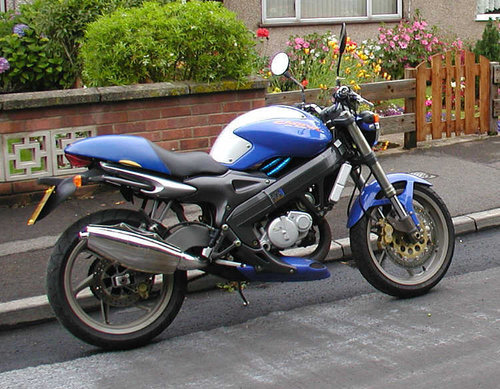
The Cagiva Planet 125 occupies a fascinating place in the history of lightweight Italian motorcycles. Introduced during the late 1990s, it took the mechanical character of Cagiva’s sporty 125 platform and placed it into a much more minimalist naked-bike package. At a time when many small-displacement motorcycles were becoming increasingly conservative, the Planet offered something distinctly Italian: a compact liquid-cooled two-stroke engine, an aluminium chassis, serious suspension hardware, powerful disc brakes, and styling that deliberately avoided the full fairing of its better-known sibling, the Cagiva Mito. Produced through the early 2000s, the Planet 125 became one of those motorcycles that appealed to riders who wanted their first road bike to feel like a genuine motorcycle rather than simply a scaled-down commuter. Its combination of light weight, aggressive mechanical specification and simple roadster appearance has helped the model remain interesting to enthusiasts long after production ended.
The Birth of the Cagiva Planet
A Naked Alternative to the Mito
The Planet 125 arrived in 1997 as part of Cagiva’s effort to broaden its 125 cc range. Rather than creating an entirely separate mechanical package, Cagiva built the Planet around technology closely related to the company’s sporty Mito. The result was a motorcycle that shared much of the engineering philosophy of the Mito while presenting a completely different visual identity. Where the Mito was shaped around aerodynamic bodywork and a race-inspired riding position, the Planet stripped away the fairings and exposed the compact engine, frame and mechanical components. This gave it a much more upright roadster character without abandoning the performance-oriented engineering underneath. Contemporary specifications identify a liquid-cooled, single-cylinder, two-stroke engine with a 56.0 mm bore and 50.6 mm stroke, electric starting and six-speed transmission.
That distinction was important because the Planet was not simply an inexpensive naked version of an ordinary 125 commuter. Its specification was unusually sophisticated for its class. The aluminium twin-spar frame was derived from Cagiva’s sporting architecture, while the suspension consisted of an inverted front fork and a rear monoshock. The braking system was equally substantial, with a large front disc and a rear disc rather than the simpler drum arrangements found on many lightweight motorcycles of the period. In other words, Cagiva treated the Planet as a proper performance motorcycle that happened to have a naked body style. That approach gave the bike a distinctive personality and explains why it continues to attract attention from riders interested in classic or modern-classic two-stroke machines.
A Proper Italian Two-Stroke Engine
Compact Capacity, Serious Character
At the heart of the Planet was a 124.6 cc single-cylinder, liquid-cooled two-stroke engine. The engine used reed-valve induction and electronic control of Cagiva’s C.T.S. exhaust system, a combination designed to make a small-displacement engine more flexible while still allowing it to produce strong performance at higher engine speeds. The 2003 owner’s manual confirms the two-stroke single-cylinder configuration, liquid cooling, 56 mm bore, 50.6 mm stroke and electronically controlled C.T.S. exhaust valve. The engine was fed by a Dell’Orto PHBH 28 BD carburetor, giving the Planet the traditional mechanical simplicity and distinctive response associated with performance two-strokes of the era.
Output varied somewhat according to model year and specification, but later Planet 125 documentation lists approximately 15 horsepower, with 2003 data showing around 14.8 horsepower at 8,500 rpm and 12 Nm of torque at 7,000 rpm. Earlier examples are also commonly listed at around 15 horsepower, although the precise engine characteristics changed during the model’s production run as emissions requirements and specifications evolved. The important point is that the Planet’s performance came from a relatively light motorcycle combined with a high-revving two-stroke engine rather than from outright displacement. With a six-speed gearbox and chain final drive, the rider could keep the engine in its useful rev range and extract considerably more character from the small capacity than the numbers alone might suggest.
The Appeal of Two-Stroke Power
The Planet’s two-stroke engine is arguably its defining feature. Modern riders accustomed to fuel-injected four-stroke 125s may find the Planet’s delivery unusually direct and mechanical. A two-stroke single of this type rewards the rider for using the gearbox and maintaining momentum, while the lightweight chassis means that relatively modest power can still feel entertaining on a winding road. The engine’s exhaust-valve system also illustrates how advanced Cagiva’s small-capacity technology had become. Rather than relying purely on a narrow high-rpm powerband, the C.T.S. system was intended to broaden the engine’s usable characteristics while retaining the energetic personality expected from a sporting two-stroke.
This is one reason the Planet remains more interesting than its displacement might initially suggest. The motorcycle was never about overwhelming acceleration or huge top speed. Its attraction came from the interaction between the engine, gearbox, low mass and responsive chassis. The result was a motorcycle that could be ridden energetically without requiring enormous speeds, making its character particularly well suited to technical roads and urban environments where agility matters more than outright horsepower.
A Chassis Built for More Than Commuting
Aluminium Twin-Spar Construction
The Planet’s chassis was another area where Cagiva refused to compromise. The motorcycle used an aluminium twin-spar frame, a design much more strongly associated with performance motorcycles than with basic 125 cc commuters. The 1997 specifications identify the frame as an aluminium double-beam design, combined with a Marzocchi inverted front fork and a Sachs rear monoshock. Suspension travel was listed at approximately 120 mm at the front and 140 mm at the rear.
The frame’s architecture helped give the Planet a purposeful appearance even without the Mito’s bodywork. Instead of hiding the chassis behind extensive fairings, the naked design placed the frame and engine at the centre of the motorcycle’s visual identity. The compact proportions, exposed mechanical components and relatively wide rear tyre made the Planet look closer to a scaled-down sporting roadster than a conventional learner motorcycle.
The reported wheelbase of around 1,395 mm contributed to the motorcycle’s compact proportions, while its low overall mass made changes of direction relatively easy. Later specifications list a dry weight around 125 kg, with a ready-to-ride figure of roughly 135 kg depending on the source and definition used.
Brakes and Wheels That Matched the Chassis
The Planet’s braking equipment was another indication of its sporting ambitions. Later specifications list a 320 mm front disc and a 230 mm rear disc, while the motorcycle used 17-inch wheels at both ends. The tyre sizes were typically 110/70 at the front and 150/60 at the rear, dimensions that gave the little Cagiva a surprisingly substantial stance.
For a 125 cc motorcycle weighing around 125 kg dry, a 320 mm front disc is considerable equipment. It gave the Planet strong braking potential and helped distinguish it from lightweight motorcycles designed primarily around low-cost transportation. The combination of a stiff aluminium chassis, sporting suspension and large brakes meant that the Planet could be treated as a miniature performance roadster rather than simply a practical commuter.
The 17-inch wheel arrangement also helped the motorcycle feel familiar to riders moving toward larger machines. Instead of using small wheels associated with scooters or lightweight urban motorcycles, the Planet had conventional full-size motorcycle proportions. That made it visually and dynamically closer to the larger road bikes that many young riders aspired to own.
Styling: Minimalist but Aggressive
The Naked Mito Philosophy
The Planet’s styling is perhaps its most immediately recognizable characteristic. Its design removed the Mito’s extensive fairing but retained the aggressive proportions and compact dimensions associated with Cagiva’s sporting machines. The result was a motorcycle with a small visual footprint, exposed engine and frame, a compact fuel tank and a simple tail section.
The absence of a full fairing changed more than the appearance. It gave the rider a more upright relationship with the motorcycle and made the Planet particularly suitable for urban riding. At the same time, the exposed mechanical components gave it an authentic mechanical presence. There was little attempt to disguise the fact that the motorcycle was built around a small, high-performance two-stroke engine.
Cagiva offered different colour schemes during the Planet’s production life, and period specifications list combinations including black, yellow and grey-purple. The variety helped reinforce the youthful character of the model, but the fundamental design remained remarkably coherent: compact, angular and unmistakably Italian.
The Planet in Everyday Riding
The Planet’s 12.5-litre fuel tank gave it useful capacity for a lightweight performance motorcycle, while its approximately 125 kg dry weight made it manageable at low speeds and easy to move around when parked. Depending on model year, published seat-height figures range from the high 700 mm range to around 800 mm, reflecting changes in specifications during production.
In practical terms, the Planet could therefore perform the everyday duties expected from a 125 while offering considerably more mechanical character. The riding position was more relaxed than that of the fully faired Mito, and the naked configuration made it easier to use around town. Yet the sporting chassis meant that the motorcycle did not become dull when the road became more interesting.
That balance is central to understanding the Planet. It was not designed to be the most economical or simplest 125 available. Instead, it occupied the space between everyday usability and youthful performance. The rider received a manageable motorcycle, but one equipped with technology that made every ride feel more involved.
Why the Cagiva Planet 125 Remains Memorable
The Planet’s production run from 1997 into 2003 coincided with the final era in which small road-going two-strokes could still occupy a relatively mainstream position in European motorcycle culture. Later emissions requirements made this type of engine increasingly difficult to maintain in ordinary road-bike production, and Cagiva’s Planet eventually disappeared from the market. Sources list the model through 2003, with later examples receiving updated emissions equipment and revised engine characteristics.
Today, the Planet is remembered not simply because it was a 125, but because it represented a particular approach to small motorcycles. Cagiva took a compact two-stroke engine, surrounded it with serious chassis technology and gave it the proportions of a genuine sporting roadster. The result was lightweight, mechanically distinctive and considerably more sophisticated than its capacity might suggest.
Its connection to the Mito also gives the Planet an important place in Cagiva’s history. The Mito became the company’s famous fully faired 125, while the Planet demonstrated that the same basic engineering philosophy could work in a naked configuration. For riders who appreciate mechanical simplicity, Italian design and the unique character of a performance two-stroke, that combination remains difficult to ignore.
Cagiva Planet 125 Technical Specifications
The following table summarizes representative specifications for the later Cagiva Planet 125. Exact figures can vary by model year and market, so the table should be treated as a reference rather than a universal specification for every Planet produced.
| Specification | Cagiva Planet 125 |
|---|---|
| Production | 1997–2003 |
| Motorcycle type | Naked / roadster |
| Engine | Single-cylinder, 2-stroke |
| Cooling | Liquid |
| Displacement | 124.6 cc |
| Bore × stroke | 56.0 × 50.6 mm |
| Induction | Reed valve |
| Carburetor | Dell’Orto PHBH 28 BD |
| Exhaust system | Cagiva C.T.S. electronically controlled exhaust valve |
| Maximum power | Approximately 15 hp / 11 kW |
| Maximum torque | Approximately 12 Nm on later versions |
| Transmission | 6-speed manual |
| Final drive | Chain |
| Starting | Electric |
| Frame | Aluminium twin-spar |
| Front suspension | Inverted fork |
| Rear suspension | Monoshock |
| Front brake | Disc, approximately 320 mm |
| Rear brake | Disc, approximately 230 mm |
| Front tyre | 110/70-17 |
| Rear tyre | 150/60-17 |
| Wheelbase | Approximately 1,395 mm |
| Fuel capacity | 12.5 litres |
| Dry weight | Approximately 125 kg |
| Wet/ready weight | Approximately 135 kg |
| Top speed | Approximately 120–122 km/h, depending on version |
Final Thoughts
The Cagiva Planet 125 was a product of a particularly interesting period in motorcycle history. It combined the compact practicality of a 125 with engineering that would not have looked out of place on a much larger sporting motorcycle. Its liquid-cooled two-stroke single, six-speed transmission, aluminium twin-spar frame, inverted fork, monoshock and substantial disc brakes gave it a specification that was unusually ambitious for its class. More importantly, the Planet delivered those ingredients in a simple naked package that allowed the rider to see and feel the mechanical character of the motorcycle.
For modern enthusiasts, the Planet represents more than an old learner motorcycle. It is a snapshot of the final generation of European performance two-strokes, created when manufacturers could still build lightweight road machines around compact engines that rewarded active riding and mechanical involvement. Its connection to the Mito gives it sporting credibility, but its upright roadster layout gives it a personality of its own. That combination is what makes the Cagiva Planet 125 such an appealing motorcycle to remember: small in displacement, light in weight, but ambitious in engineering and unmistakably Italian in character.