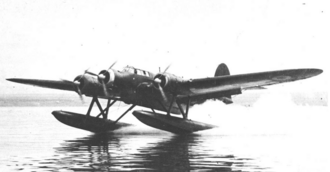
The CANT Z.506 Airone was one of Italy’s most distinctive aircraft of the 1930s and 1940s, combining the range of a long-distance transport with the versatility of a military reconnaissance aircraft and the unusual ability to operate directly from water. Designed by Filippo Zappata and built by Cantieri Riuniti dell’Adriatico (CANT), the aircraft first flew on 19 August 1935. Its name, Airone, means “Heron” in Italian, an appropriate name for a large aircraft designed to operate over coastal waters and maritime routes. Originally developed as a civil transport and mail aircraft, the Z.506 evolved into a military floatplane used for reconnaissance, bombing, maritime patrol, and air-sea rescue. Its long service life, impressive endurance, and ability to operate in demanding maritime conditions made it an important part of Italian aviation history.
The Airone was particularly notable because its three-engine configuration and twin-float arrangement allowed it to carry a substantial load while retaining the practical advantages of water-based operations. Its wooden airframe, large low-mounted wing, and three radial engines reflected the engineering practices of the interwar period, when aircraft designers were experimenting with ways to increase range, payload, and reliability without relying entirely on all-metal construction. During the Second World War, the military Z.506B performed reconnaissance and maritime attack missions, while specialised rescue versions helped search for and recover personnel in distress at sea. After the war, some aircraft continued serving in rescue roles into the late 1950s. The CANT Z.506 Airone therefore represents more than a historic seaplane: it illustrates the transition from civil long-distance aviation to specialised military maritime operations and, ultimately, the enduring value of aircraft designed around rescue and support missions.
The Origins and Development of the CANT Z.506 Airone
Italian Aviation During the 1930s
The development of the CANT Z.506 took place during a period of rapid technological progress in Italian aviation. Aircraft manufacturers were working to improve engine power, aerodynamic efficiency, structural strength, and long-distance performance, while civil airlines and military organisations increasingly recognised the value of aircraft capable of operating over the sea. Italy’s geography made seaplanes particularly attractive. Its extensive coastline, numerous islands, and position within the Mediterranean created practical requirements for maritime transport, observation, communication, and naval support. In the 1930s, a large floatplane could operate from a suitable harbour or coastal seaplane base without requiring the same conventional runway infrastructure as a land-based aircraft. Although water operations imposed their own challenges, this flexibility made seaplanes useful for routes and missions where access to land airports was limited or inconvenient.
Italian manufacturers developed several aircraft intended to exploit these opportunities, and CANT became an important participant in the process. Its experience in designing aircraft with substantial payloads and specialised maritime capabilities provided the foundation for the Z.506 programme. The Airone emerged at a time when civil aviation was also being used to demonstrate national industrial capability. Long-distance flights, record attempts, and the operation of advanced transport aircraft attracted considerable public attention and helped manufacturers establish their reputations. For CANT, developing a successful three-engine floatplane meant creating an aircraft that could serve commercial operators while also offering a design that could be adapted for military purposes. This dual-purpose potential became particularly important as European political tensions increased and governments placed greater emphasis on military preparedness.
Filippo Zappata and the CANT Design Philosophy
Filippo Zappata was responsible for the design of the CANT Z.506 and became one of the most prominent Italian aircraft designers of his generation. His work demonstrated an interest in combining practical structural arrangements with aerodynamic efficiency and substantial payload capacity. The Airone was developed from the earlier CANT Z.505, but the resulting Z.506 was a distinct aircraft designed around the requirements of a multi-engine floatplane. Its low-mounted cantilever wing, streamlined fuselage, and two long floats created a configuration that could carry passengers or military equipment while maintaining useful flight performance. The three-engine layout distributed propulsion across the wing, while the wooden airframe helped control structural weight. These choices reflected the engineering priorities of the period rather than an attempt to imitate the design philosophy of later all-metal aircraft.
Zappata’s design approach also reflected the practical realities of manufacturing. An aircraft intended for commercial service needed to be economical enough to operate, sufficiently reliable for scheduled routes, and capable of accommodating passengers or cargo in a usable cabin. A military version needed additional structural provisions, equipment, crew positions, and the ability to carry weapons. The Airone’s basic configuration proved adaptable to these different requirements. This adaptability was one of the design’s most significant strengths because it allowed the same general aircraft family to serve transport, reconnaissance, bombing, and rescue roles. The changes required for each role were not insignificant, but the underlying platform provided a useful foundation for several specialised versions.
The First Flight and Entry Into Service
The prototype CANT Z.506 made its maiden flight on 19 August 1935 at Monfalcone, near Trieste, with test pilot Mario Stoppani associated with the aircraft’s testing programme. Initial development demonstrated that the three-engine floatplane concept could provide the range and payload required for long-distance maritime transport. The early aircraft used different engine arrangements from those ultimately associated with the principal production models, reflecting the normal process of development in which powerplants and equipment were refined as flight testing progressed. The civil Z.506A entered production in 1936, and the aircraft was subsequently used for passenger transport and postal services. Its success in these roles helped establish the basic design before military requirements transformed the Airone into a more heavily equipped aircraft.
The transition from prototype to production involved more than simply manufacturing additional examples of the original aircraft. Production aircraft required repeatable construction methods, consistent component quality, established maintenance procedures, and suitable facilities for assembling and testing the completed machines. The demand for the Z.506 was sufficient to involve additional industrial capacity, including licensed production and the participation of other Italian manufacturers. The resulting aircraft family included civilian, military, and air-sea rescue configurations, each adapted to a different operational purpose. This development history is important because specifications quoted for one Z.506 variant should not automatically be applied to every other version. Engines, equipment, payload, weight, and performance could differ according to the aircraft’s production series and intended role.
Design and Construction of the Airone
The Low-Wing Monoplane Configuration
One of the most recognisable features of the CANT Z.506 Airone is its low-mounted cantilever wing, which distinguishes it from high-wing flying boats such as the CANT Z.501 Gabbiano. The wing was designed to support three engines, provide sufficient lift for a relatively heavy aircraft, and maintain the aerodynamic efficiency needed for long-distance operations. Its cantilever arrangement meant that the wing was supported structurally without the extensive external bracing associated with some earlier aircraft designs. This helped produce a relatively clean aerodynamic outline, although the three engine nacelles and their associated cooling and exhaust arrangements added complexity. The wing also had to accommodate the loads transmitted by the engines, propellers, and floats while maintaining the strength needed for repeated operations from water.
The low-wing arrangement influenced the aircraft’s relationship with its floats and the water surface. The floats were mounted beneath the wing, far enough apart to provide lateral stability when the aircraft was stationary or moving slowly on the water. The design had to balance several competing requirements: the floats needed sufficient buoyancy, the wing needed adequate ground and water clearance, and the complete structure had to remain within acceptable weight limits. The aircraft’s overall dimensions reflected the substantial space needed to accommodate these components. With a wingspan of approximately 26.5 metres and a length of around 19.45 metres in the representative military configuration, the Airone was a large aircraft by the standards of its time, especially when considered alongside its twin-float landing arrangement.
The Wooden Airframe
Despite its size and military capabilities, the CANT Z.506 was predominantly constructed from wood. Its fuselage used a wooden structural framework with shaped wooden outer covering, while the wings incorporated multiple structural spars, wooden ribs, and plywood covering. This construction method was well established in the 1930s and offered several advantages, including the ability to create complex shapes without depending entirely on the metal-forming and assembly techniques required for an all-metal airframe. Wood could also provide a favourable strength-to-weight balance when properly selected, treated, and assembled. For an aircraft expected to carry passengers or military equipment over long distances, structural weight was a major consideration because every additional kilogram affected payload, fuel requirements, and performance.
Wooden construction nevertheless demanded careful quality control and protection from environmental damage. Moisture, deterioration of adhesives, structural fatigue, and damage to protective coatings could compromise components if they were not properly inspected and maintained. The Airone’s maritime operating environment made these concerns particularly important because the aircraft repeatedly encountered water, spray, humid air, and changing weather conditions. The floats were constructed from duralumin, providing a metal structure for the components that were in direct contact with the water, while the wooden fuselage and wing retained the advantages of the aircraft’s original construction philosophy. The combination of wooden primary structures and metal floats illustrates the practical compromises available to aircraft designers during the interwar period, when manufacturers were seeking the best balance of weight, durability, production capability, and cost.
The Twin-Float System
The Airone was a floatplane rather than a conventional flying boat with a large central hull. Its fuselage remained above the water, supported by two long floats mounted beneath the wings. These floats provided the buoyancy needed to keep the aircraft afloat and were shaped to allow it to move through the water during taxiing, take-off, and landing. Their length and form were important because the aircraft had to transition from a floating state to a planing motion as speed increased. During take-off, the floats experienced hydrodynamic drag and pressure as they moved across the water, while during landing they had to absorb the forces associated with the aircraft’s contact with the surface. The structural attachments connecting the floats to the airframe consequently played an important role in the aircraft’s overall safety and handling.
The use of two floats also helped establish the Airone’s lateral stability on the water. Their separation created a wide support base, reducing the tendency for the aircraft to roll excessively while floating under suitable conditions. However, the arrangement did not eliminate the risks associated with rough seas. Waves could affect the aircraft’s attitude, spray could reach vulnerable areas, and strong crosswinds could complicate taxiing and take-off. Even a well-designed floatplane remained dependent on the quality of the water surface and the weather at its operating base. The Airone’s reputation for operating in challenging maritime conditions was therefore a meaningful achievement, but it should not be interpreted as evidence that the aircraft could operate safely in every sea state. Its performance on the water depended on pilot judgement, maintenance, loading, and the conditions encountered during each mission.
Engines and Propulsion System
Three Radial Engines
The CANT Z.506B military version was commonly powered by three Alfa Romeo 126 RC.34 nine-cylinder, air-cooled radial engines, each rated at approximately 750 horsepower in the representative production configuration. The engines were mounted individually along the wing, with one in the central position and one on each side. Together, they provided a combined nominal output of approximately 2,250 horsepower, or around 1,678 kilowatts. The radial engine arrangement was familiar in the aviation industry of the period and offered a practical combination of power and mechanical accessibility. Air cooling eliminated the need for a liquid-cooling circuit, although the engine installation still required suitable airflow, exhaust arrangements, lubrication, and maintenance. The three engines gave the Airone the power needed to lift its substantial weight from water and sustain extended flights with passengers, fuel, or military equipment.
The aircraft’s original civil development included other engine installations, and early versions were not necessarily powered by the same engines as later military aircraft. The prototype used a different engine arrangement, while the production programme introduced more powerful engines as the design evolved. This is why the Z.506 should be discussed as a family of aircraft rather than as one unchanging configuration. The engine ratings quoted in historical specifications generally refer to particular engine models and operating conditions, and actual performance depended on altitude, loading, maintenance condition, and the aircraft’s individual configuration. For a representative production Z.506B, however, the three Alfa Romeo engines form the clearest basis for understanding its power and flight performance.
Why Three Engines Were Important
The three-engine layout gave the Airone a useful combination of total power and distributed propulsion. Compared with a single-engine aircraft of similar weight, the arrangement provided more power for take-off and climbing, while the separate engine installations created some degree of propulsion redundancy. The aircraft was still vulnerable to the loss of an engine, and an engine failure could impose additional demands on the remaining engines and affect handling, particularly at low speed or during a water take-off. Nevertheless, having three engines could provide more flexibility than a comparable single-engine design, especially during long maritime journeys when an emergency landing might be difficult. The arrangement also allowed the aircraft to use engines of a power class that was available and established in Italian aviation manufacturing during the 1930s.
The trade-off was additional mechanical complexity. Three engines required more routine servicing, more components, additional fuel and oil management, and inspection of multiple propeller and engine-mounting systems. Each engine contributed weight and drag, while the nacelles affected the airflow around the wing. Maintenance personnel had to ensure that all three engines were functioning correctly and that their associated systems remained within the required operating condition. The benefits of distributed propulsion therefore came with a greater maintenance burden, something that mattered during wartime when aircraft were often operated intensively and spare parts could be difficult to obtain. The Airone’s continued service across several roles demonstrates the usefulness of its powerplant arrangement, but it also highlights the need for a reliable maintenance organisation to support a multi-engine aircraft.
Propellers and Take-Off Performance
Each engine drove a three-bladed propeller, with variable-pitch propeller arrangements identified in descriptions of the military version. Propeller pitch affects how effectively engine power is converted into thrust at different speeds. During take-off, the aircraft needs substantial thrust to overcome water drag and accelerate onto the step of its floats, while during cruise the propellers must operate efficiently at a higher forward speed. Variable-pitch technology helped balance these different requirements. The engines, propellers, wing, and floats therefore functioned as a coordinated system: the aircraft’s take-off performance could not be understood simply by adding together the three engine ratings, because water resistance, aircraft weight, wind, and aerodynamic lift all influenced the result.
Water take-offs were particularly demanding because the aircraft had to accelerate while overcoming the drag created by its floats. The transition from floating to planing and then to flight required the pilot to manage speed, attitude, and power appropriately. Excessive loading, unfavourable water conditions, or poor engine performance could reduce the aircraft’s margin for a successful departure. The Airone’s relatively high power output and aerodynamic design helped it perform this task effectively for a large floatplane, but operational limitations remained. As with other seaplanes, the ability to take off from water depended not only on engine power but also on the available water surface, wind direction, aircraft condition, and the experience of the crew.
Civilian Service: From Transport to Long-Distance Aviation
The CANT Z.506A Passenger and Mail Aircraft
The civilian CANT Z.506A established the Airone’s identity as a practical transport aircraft before the military version became widely known. It was developed to carry passengers and mail over routes where water-based operations were useful, particularly across Mediterranean destinations. The aircraft’s enclosed cabin and multi-engine configuration made it suitable for scheduled transport duties, while its long-range capability supported journeys between coastal cities and islands. Civil aviation during the 1930s was expanding but still operated within infrastructure and technology constraints that differed significantly from those of the modern airline industry. Seaplanes offered an alternative for routes that could be served from harbours and coastal bases, and the Airone’s capacity made it a notable example of this approach.
The aircraft’s civilian configuration differed from the military Z.506B in important respects. Passenger accommodation, luggage and mail capacity, internal layout, and the absence of combat equipment all influenced how the civil aircraft was arranged. The military version required room for additional crew members, observation and communications equipment, defensive armament, and weapons where fitted. These changes affected weight and balance and helped determine the aircraft’s operational role. The civilian aircraft was not simply a military aircraft without guns; it was configured to fulfil a different set of requirements, with comfort and transport utility taking priority over reconnaissance and combat functions.
Ala Littoria and Mediterranean Routes
Ala Littoria, Italy’s national airline during the period, operated the Z.506 on passenger and mail services. The aircraft’s ability to use water-based facilities allowed it to connect locations where seaplane operations were practical and where conventional airport infrastructure might be less convenient. Its three engines supported commercial operations with useful range and payload, while its floatplane configuration offered a direct connection between aviation and maritime transport. The Airone was part of an era when the distinction between air travel and seaplane travel was less sharply defined than it later became, because a number of civil routes were planned around bodies of water rather than conventional runways.
The aircraft also participated in the broader culture of aviation achievement that characterised the 1930s. Long-distance flights and record attempts attracted attention to the capabilities of Italian aircraft and helped demonstrate the potential of new designs. The Z.506 family was associated with multiple international records during this period, contributing to its reputation as a capable aircraft. Such achievements should be distinguished from routine airline operations, because record flights could involve specially selected conditions, specific loading arrangements, and carefully planned routes. Nevertheless, the records helped demonstrate the strength of the underlying design and its suitability for sustained flight.
The Significance of Civil Aircraft Development
The Airone’s civil origins were important to its later military success because transport operations provided experience with the aircraft’s basic structure, propulsion system, handling, and maintenance requirements. An aircraft that could carry passengers and mail over long distances already possessed several characteristics relevant to reconnaissance, including endurance, payload capacity, and the ability to operate from water. Military conversion introduced additional requirements, but the civil version demonstrated that the general platform could perform sustained operations before it was adapted for wartime use. This relationship between civil and military aviation was common during the interwar period, when manufacturers often developed aircraft that could be modified to meet changing government requirements.
The development of the Z.506 also shows how a specialised aircraft could serve several markets over its lifetime. The same basic design was used for commercial transport, military patrols, and later rescue work, illustrating the value of a versatile platform. The roles were not interchangeable without modification, but the underlying engineering gave operators a useful starting point for different missions. In this respect, the Airone provides a clear example of how civil aviation development could contribute to military capability while also creating aircraft that remained useful after the original operational circumstances had changed.
The Military CANT Z.506B
Conversion for Reconnaissance and Bombing
The CANT Z.506B was the principal military version of the Airone. It retained the basic three-engine floatplane configuration but incorporated changes intended to support reconnaissance, maritime patrol, and bombing missions. The military aircraft carried a larger crew than the civil transport and included defensive gun positions, observation equipment, and provisions for carrying bombs. A bomb bay and associated aiming position were incorporated into the military configuration, allowing the aircraft to attack suitable targets when assigned to offensive missions. The added equipment and weapons changed the aircraft’s weight distribution and internal layout, reflecting the different priorities of a military operator.
Military conversion also changed the way the aircraft was employed. Instead of following a passenger or mail schedule, the Z.506B could be sent to search maritime areas, monitor vessel movements, support naval operations, or attack selected targets. The aircraft’s range and ability to operate from water made it useful in a maritime environment where bases could be distributed along coastlines and islands. However, the military version still inherited many of the basic characteristics of the civil design, including its speed range, wooden structure, and dependence on water-based facilities. These characteristics influenced both its strengths and its vulnerabilities when operating in wartime conditions.
Defensive Armament
Published descriptions of the Z.506B commonly list one 12.7 mm machine gun and three 7.7 mm machine guns in flexible defensive positions, although exact installations could vary by production series and role. The larger-calibre weapon provided greater potential against attacking aircraft than the smaller guns, while the additional positions helped cover different approaches around the aircraft. Defensive weapons were important because maritime patrol aircraft could encounter hostile fighters while operating far from friendly airfields or without escort. The crew needed some ability to discourage an attack, protect the aircraft during a vulnerable phase of the mission, and potentially defend itself while returning to base.
The defensive armament nevertheless had significant limits. The Airone was a large aircraft designed for range and payload rather than fighter-like manoeuvrability. Its weapons could complicate an attack, but they could not guarantee survival against faster aircraft with more powerful armament. The weight of guns, ammunition, and their supporting structures also had to be accommodated within the aircraft’s overall payload. As enemy fighter performance improved during the war, the Airone’s defensive equipment became less capable of compensating for its modest speed and relatively large profile. Its crews therefore depended on mission planning, operational conditions, intelligence, and support from other forces as much as on the guns carried aboard.
Bomb Load and Offensive Capability
The military Z.506B could carry bombs for maritime attack and other limited offensive missions. Published references give differing figures for the maximum weapons load, with some describing a bomb load of around 640 kilograms and others listing a larger maximum load of approximately 1,200 kilograms for certain configurations. These figures should not be combined as if they necessarily applied to the same aircraft configuration or operational conditions. The practical load depended on the aircraft’s version, permitted weight, equipment, and mission requirements. In addition to conventional bombs, specialist accounts describe the aircraft’s ability to carry a torpedo in particular configurations, although this capability should be treated as variant- and source-dependent.
The presence of offensive weapons expanded the range of tasks the Airone could perform, but it did not make the aircraft equivalent to a purpose-built high-performance bomber. Its main design characteristics continued to reflect a long-range transport and maritime reconnaissance platform. Bombing accuracy, target detection, defensive survival, and operational effectiveness depended on the mission, crew training, weather, and the capabilities of the target’s defences. The aircraft could be useful when assigned to appropriate maritime duties, but its limitations became increasingly clear when it faced well-equipped enemy forces. Understanding this distinction helps explain why the Z.506B could be valued for reconnaissance and rescue while still facing considerable risks during offensive operations.
Operational Service During the Second World War
Maritime Reconnaissance and Coastal Patrol
When Italy entered the Second World War in June 1940, the CANT Z.506B was used extensively for maritime reconnaissance and patrol. Its long range made it useful for searching stretches of coastline, observing shipping movements, and reporting the presence of enemy naval forces. Maritime reconnaissance was particularly important in the Mediterranean, where control of sea routes influenced military supply, naval operations, and the movement of merchant vessels. The Airone could remain airborne for extended periods, allowing crews to observe broad areas and relay information to the appropriate command. These missions were often demanding even when no direct combat occurred, because crews had to navigate over water, maintain situational awareness, and manage changing weather conditions.
The aircraft’s usefulness depended on the quality of the information it could collect and communicate. In the absence of modern radar and electronic surveillance systems, visual observation played a central role in maritime patrol. Crews needed to identify vessels, estimate their movements, distinguish friendly shipping from possible threats, and report observations accurately. A sighting could influence the decisions of naval forces, but incomplete visibility, cloud cover, sea conditions, and the size of the patrol area could all affect the results. The Airone’s range and payload gave it a practical advantage, yet it remained part of a broader surveillance system that depended on coordination between aircraft, naval units, communications networks, and command centres.
Bombing and Support for Naval Operations
The Z.506B was also employed in bombing and support missions against maritime and coastal targets. Its weapons capability allowed it to contribute to operations in which reconnaissance and attack functions were closely linked. An aircraft sent to observe an area might also be assigned to attack a suitable target if circumstances permitted, although this depended on the mission plan and available armament. The Airone’s use in the Mediterranean and Aegean theatres reflected the importance of maritime aviation in supporting naval movements and operations around islands. Italian Navy historical accounts describe its participation in operations connected with the occupation of islands including Corfu, Cephalonia, and Zakynthos during the war’s early phases.
These missions were not without considerable risk. The aircraft’s size, relatively modest speed, and limited defensive capabilities made it vulnerable to interception, particularly when operating near enemy bases or naval formations protected by fighter aircraft. A patrol or bombing mission could require the crew to remain in an exposed area long enough to complete the task, increasing the possibility of encountering hostile forces. The Airone’s ability to operate from water provided useful flexibility in basing, but it did not eliminate the risks of combat. Its wartime record therefore reflects the broader difficulty faced by specialised aircraft whose design strengths did not necessarily match the requirements of every mission assigned to them.
The Challenge of Enemy Air Power
As the war progressed, the performance of fighter aircraft and the sophistication of air-defence systems improved. The Airone’s basic design dated from the mid-1930s, and its speed was not competitive with many later fighters. Its three engines gave it useful power for its size, but they could not compensate fully for the aerodynamic and structural compromises inherent in a large floatplane. The aircraft’s defensive guns provided some protection, yet its ability to evade an attack was limited when confronted by a faster opponent. Maritime patrol aircraft were often required to operate far from friendly fighter cover, making them especially vulnerable if enemy aircraft controlled the surrounding airspace.
This vulnerability did not mean that the Airone immediately became useless. Military forces frequently continue operating older aircraft when replacements are unavailable or when the existing platform remains adequate for less demanding missions. Reconnaissance, communication, transport, and rescue work could remain valuable even when offensive operations became increasingly dangerous. The Airone’s wartime employment thus illustrates the difference between a platform’s original design purpose and the range of tasks that military necessity may impose on it. Its service continued in roles where its range, payload, and water-operating capabilities remained useful, even as its limitations became more obvious in combat.
The CANT Z.506S: Air-Sea Rescue and Humanitarian Service
From Military Aircraft to Rescue Platform
One of the most important chapters in the Airone’s history was its adaptation for air-sea rescue. The specialised CANT Z.506S version was intended to locate and assist people in distress over the water, including aircrew forced to abandon their aircraft and personnel stranded at sea. Rescue operations demanded a different approach from bombing or reconnaissance missions. Rather than seeking targets or gathering military intelligence, crews had to locate survivors, assess the conditions, and determine whether the aircraft could safely land on the water and recover them. The Airone’s twin-float arrangement, relatively spacious fuselage, and ability to remain airborne for extended periods made it a useful platform for this work, although its actual rescue capacity depended on the aircraft’s configuration and the sea conditions at the time.
The transition to rescue duties also demonstrated the value of an adaptable aircraft design. Some Airones originally built for civilian purposes were adapted for rescue operations, while a specialised version was produced by Piaggio. Changes to the interior and equipment allowed the aircraft to accommodate rescue personnel and survivors rather than prioritising weapons and combat equipment. The aircraft could also support the transport of injured people, medical supplies, and other essential equipment. These tasks required coordination between pilots, rescue crews, medical personnel, and the organisations responsible for locating people in distress. The Airone’s rescue role therefore represented more than a secondary use for an ageing military aircraft; it became an important contribution to maritime safety during and after the war.
Search-and-Rescue Operations During Wartime
Wartime search-and-rescue missions were particularly difficult because aircraft and ships could be lost far from shore, often in poor weather or dangerous sea conditions. Survivors might be injured, exposed to cold water, or drifting away from the location where they first entered the sea. The rescue aircraft had to locate them before conditions deteriorated further, and the crew needed to judge whether a landing was possible without putting the aircraft and its occupants at unacceptable risk. The Airone’s ability to land on water could be decisive, but it was not an unlimited capability: rough waves, strong winds, and poor visibility could make recovery hazardous or impossible. The mission therefore required both technical skill and careful judgement, particularly when the urgency of rescuing survivors created pressure to operate in difficult conditions.
The Italian Air Force’s historical account records that, following the Italian armistice in September 1943, 29 CANT Z.506 aircraft of various versions formed part of the seaplane group of the Italian Co-Belligerent Air Force, alongside other seaplane types. During this period, the aircraft supported the search for survivors, the transport of wounded personnel, liaison duties, and the delivery of supplies. The Airone fleet accumulated approximately 3,000 flying hours during this operational cycle, according to the official historical record. These activities demonstrate the aircraft’s continued usefulness after Italy’s wartime alignment changed and illustrate how an aircraft originally developed for transport and reconnaissance could contribute to essential humanitarian tasks.
The Human Significance of the Rescue Mission
The rescue role is particularly important when assessing the Airone’s historical legacy because it shifts the focus from aircraft performance to the people whose lives depended on aviation support. A successful rescue required the aircraft to reach the search area, identify survivors, and operate safely in conditions that might already have caused the loss of another aircraft or vessel. The crew’s decisions could determine whether the mission ended with the recovery of survivors or with further casualties. Even when a rescue aircraft could not land, locating survivors and reporting their position could help other aircraft or ships reach them. In this way, the Airone contributed to the broader development of organised search-and-rescue operations, in which the aircraft was one element of a larger system of observation, communication, medical care, and recovery.
The value of rescue aviation continued beyond the immediate circumstances of the Second World War. Maritime regions remained difficult environments in which to conduct emergency operations, particularly around islands and remote coastal communities. An aircraft capable of reaching an isolated location quickly could help transport medical personnel, recover injured people, or deliver essential supplies. The Airone’s continued service in these roles after the war illustrates the lasting usefulness of a well-adapted seaplane, even when its original military mission had become less important. Its story therefore includes not only the history of military aviation but also the practical development of aerial emergency services.
Manufacturing and Production Numbers
Production of the Airone involved CANT and other Italian industrial organisations, including Piaggio, which manufactured aircraft under licence. The scale of production reflects the aircraft’s usefulness across several roles, although published totals differ depending on whether a source counts prototypes, civil versions, military aircraft, or specialised conversions. The Italian Navy’s historical record lists 302 production examples of the relevant aircraft grouping, comprising 258 wartime aircraft and 44 medical aircraft, plus two prototypes. Other historical summaries give higher totals for the military Z.506B or for the complete Z.506 family. These differences should be acknowledged rather than combined into a single figure without explanation.
The Airone’s production story also reflects the challenges of maintaining a specialised aircraft programme during a period of rapid technological change. Aircraft manufacturers had to supply engines, propellers, structural components, floats, instruments, and replacement parts while keeping the production process consistent across different facilities. Military orders could increase demand rapidly, while wartime shortages and changing priorities could disrupt manufacturing. The ability to transfer production or adapt the aircraft for different missions helped extend its usefulness, but it did not remove the difficulties of supporting a complex wooden airframe with three engines. The Airone’s long service life was therefore the result of both its original engineering and the continued work of the industrial and operational organisations that supported it.
International and Post-Armistice Operators
The Airone was associated primarily with Italian civil and military aviation, but its history also includes aircraft operated or used by other countries during the changing circumstances of the war. Some aircraft were captured or employed by German forces, while other examples were involved in international orders or transfers. These episodes illustrate how aircraft could move between operators as front lines shifted, military forces occupied bases, and national alliances changed. The individual history of an aircraft could therefore differ considerably from the intended service described in the original design documentation.
After the Italian armistice of September 1943, some Airones continued operating with Italian forces aligned with the Allies, while aircraft in northern Italy were used by other formations or by German forces. This division reflected the political and military fragmentation that followed the armistice. The aircraft’s subsequent history was shaped by the availability of fuel, spare parts, airfields and seaplane bases, trained crews, and the changing requirements of military operations. The Airone’s ability to survive these changes and remain useful in rescue and support work illustrates the value of an aircraft that could be adapted to tasks beyond its original combat role.
Postwar Service and Preservation
Continued Rescue Operations After 1945
The end of the Second World War did not immediately end the Airone’s operational career. Some CANT Z.506 aircraft continued in Italian service for air-sea rescue and related duties, helping transport injured people and supporting emergency operations around coastal and island communities. The aircraft’s ability to operate from water remained useful in locations where access to a conventional runway was limited or where a rapid response over the sea was needed. Its continued service also reflected the practical reality that rebuilding an aviation force takes time and that existing aircraft can remain useful when their condition and role justify continued operation.
The postwar rescue mission was different from the aircraft’s earlier wartime duties. Rather than being sent primarily to observe enemy vessels or attack targets, crews could be tasked with locating people in distress, transporting patients, and supporting maritime emergency services. These missions required dependable engines, a sound airframe, and a maintenance organisation capable of supporting ageing aircraft. The Airone’s wooden construction and three-engine arrangement made maintenance particularly important, as structural deterioration and engine wear had to be managed over many years of service. The aircraft’s survival into the postwar period demonstrates that a design introduced in the mid-1930s could retain practical value when assigned to suitable tasks and maintained properly.
The Surviving CANT Z.506
One CANT Z.506S Airone survives in the collection of Italy’s Air Force museum at Vigna di Valle, near Lake Bracciano. The aircraft is particularly important because surviving examples of historic wooden seaplanes are rare, given the challenges of preserving large structures made from materials vulnerable to environmental deterioration. A surviving aircraft provides an opportunity to examine the relationship between the fuselage, wings, engines, floats, and rescue-specific equipment in a way that photographs and written descriptions cannot fully reproduce. It also preserves evidence of a period when seaplanes played a more prominent role in civil transport and military aviation than they do today.
Preservation requires more than retaining the aircraft’s exterior appearance. Wooden structures must be protected against moisture and deterioration, while metal components require appropriate corrosion control and structural inspection. Historical aircraft may also require specialist conservation methods to prevent damage to original materials. A museum aircraft can therefore serve as both a historical artefact and an engineering reference, helping future generations understand the practical construction methods of the period. The surviving Airone is a reminder that aircraft history is best preserved when physical examples are supported by reliable records, careful conservation, and accurate interpretation.
Strengths and Limitations of the CANT Z.506 Airone
The Aircraft’s Principal Strengths
The Airone’s greatest strengths were its useful payload, long-range capability, and adaptability. Its three engines provided substantial combined power for a large floatplane, while its twin-float configuration allowed it to operate from suitable bodies of water. The aircraft could be used to carry passengers and mail, undertake maritime reconnaissance, carry bombs in military configurations, and support rescue operations. Its endurance made it valuable for missions over water, where the distance between a departure point and a suitable destination could be considerable. The wooden airframe and metal floats also demonstrated a practical combination of materials that reflected the manufacturing capabilities of the time.
Another important strength was the design’s adaptability over a long period. The Airone was not restricted to a single purpose, and the development of civilian, military, and rescue variants helped extend its operational life. A transport aircraft could be adapted to meet military requirements, while a military aircraft could later be modified for humanitarian work. This versatility was particularly valuable during periods when manufacturing resources were limited and existing aircraft needed to serve multiple purposes. The Airone’s career therefore demonstrates the benefits of a platform that can accommodate changes in equipment and mission without requiring a completely new aircraft for every operational need.
Limitations in a Changing Aviation Environment
Despite its strengths, the Airone had limitations that became increasingly significant during the Second World War. Its wooden construction required careful maintenance, particularly in a maritime environment, and its three engines increased the number of systems that had to be inspected and serviced. The aircraft’s large dimensions and floatplane configuration introduced aerodynamic and operational compromises when compared with newer land-based aircraft. Although its speed was useful for its original design period, it could not match the performance of later fighters, leaving it vulnerable when missions brought it into hostile airspace. Its defensive weapons could provide some protection, but they were not sufficient to eliminate the disadvantages associated with its size and role.
Water operations introduced further restrictions. The aircraft needed suitable conditions for take-off, landing, and safe movement on the surface, and its ability to operate in rough seas was not unlimited. Wind, wave height, visibility, and the condition of the floats could affect whether a mission could be completed safely. These limitations were especially important for rescue work, where the urgency of reaching survivors might create pressure to operate in dangerous conditions. The Airone’s continued service demonstrates that a specialised aircraft can remain useful despite limitations, but it also shows why operating conditions and mission selection matter as much as headline performance figures.
The CANT Z.506 Airone’s Place in Aviation History
A Bridge Between Civil Transport and Military Aviation
The CANT Z.506 Airone illustrates how the technologies developed for civil aviation could be adapted to military purposes during the interwar period. Its original role as a passenger and mail aircraft required endurance, payload capacity, and dependable operation. Those same characteristics were valuable for military reconnaissance and maritime patrol, although military service introduced new demands for defensive equipment, weapons, and additional crew positions. The Airone’s evolution from civilian transport to military floatplane and then to rescue aircraft demonstrates how a single basic design could support a variety of missions over time.
This adaptability also reflects the broader history of aviation during the 1930s and 1940s. Aircraft were evolving rapidly, and the distinction between civil and military technologies was often less rigid than it later became. Manufacturers could use existing airframes as a foundation for new variants, reducing development time and making better use of established production facilities. The Airone was not unique in this respect, but its long operational career and unusual floatplane configuration make it a particularly clear example. Its history helps explain why aircraft design should be understood as a continuing process of adaptation rather than a single moment when a finished machine leaves the factory.
Why the Airone Remains Worth Studying
The Airone remains an interesting subject for aviation historians, engineering enthusiasts, and readers interested in the development of maritime aviation. Its combination of a wooden structure, three radial engines, low-mounted wing, and twin floats makes it distinct from many better-known land-based aircraft of the Second World War. Its civilian origins reveal how transport aircraft were designed around long-distance travel and payload, while its military service illustrates the pressures placed on older aircraft during wartime. Its rescue operations add a humanitarian dimension to the story, showing how aviation technology could be used to save lives as well as support military objectives.
The aircraft is also a useful example of the relationship between engineering performance and operational context. Its range and payload were strengths, but its survivability depended on the threat environment. Its ability to land on water was an advantage, but its usefulness depended on sea conditions. Its wooden construction helped meet the demands of the period, but it also required maintenance and protection from moisture. These contrasts make the Airone more than a collection of specifications: it is an example of how design decisions shape the capabilities, limitations, and eventual legacy of an aircraft.
Conclusion: The Enduring Legacy of the CANT Z.506 Airone
The CANT Z.506 Airone was a remarkable Italian three-engine floatplane that evolved from a civilian transport into a versatile military and rescue aircraft. Designed by Filippo Zappata and first flown in August 1935, it combined a wooden airframe, a low-mounted cantilever wing, twin duralumin floats, and three radial engines to produce an aircraft capable of carrying substantial loads over long distances. Its civil service with Ala Littoria demonstrated the practicality of the design for passenger and mail transport, while the military Z.506B expanded its role to maritime reconnaissance, patrol, and bombing. The specialised Z.506S rescue version subsequently helped preserve the Airone’s usefulness in operations where reaching people in distress mattered more than combat performance.
The Airone’s career also reveals the challenges faced by aircraft designed before the rapid technological advances of the Second World War. Its relatively modest speed, maintenance requirements, and dependence on suitable water conditions imposed limitations, especially when it encountered modern enemy fighters. Yet the aircraft remained valuable in appropriate roles, and its postwar rescue service demonstrated that an older design could continue contributing to aviation long after its original military mission had changed. The surviving Airone at Vigna di Valle preserves a tangible link to this history. Ultimately, the CANT Z.506 deserves recognition not only for its engineering and operational versatility but also for the important rescue work that formed part of its legacy.
CANT Z.506 Airone: Summary of Technical Specifications
The table below focuses on the military CANT Z.506B, the principal wartime variant. Figures are representative published values; sources differ on certain dimensions, weights, and performance figures.
| Technical specification | Representative value |
|---|---|
| Full designation | CANT Z.506B Airone |
| Name meaning | Airone — “Heron” |
| Country of origin | Italy |
| Manufacturer | Cantieri Riuniti dell’Adriatico (CANT/CRDA) |
| Designer | Filippo Zappata |
| First flight | 19 August 1935 |
| Entry into service | 1936 for the civilian Z.506A; military Z.506B followed |
| Primary role | Maritime reconnaissance and patrol |
| Secondary roles | Bombing, transport, search and rescue |
| Crew | Typically 5 for the military version |
| Passenger capacity | Up to approximately 12 in civil configurations |
| Powerplant | 3 × Alfa Romeo 126 RC.34 nine-cylinder radial piston engines |
| Power per engine | Approximately 750 hp (560 kW) |
| Combined nominal power | Approximately 2,250 hp (1,678 kW) |
| Propellers | Three-bladed, variable-pitch |
| Wingspan | 26.5 m (86 ft 11 in) |
| Length | 19.45 m (63 ft 10 in) |
| Height | 7.465 m (24 ft 6 in) |
| Wing area | 92.8 m² (approximately 999 sq ft) |
| Empty weight | Approximately 8,300 kg (18,300 lb), official reference |
| Maximum loaded weight | Approximately 12,300 kg (27,117 lb), official reference |
| Maximum speed | Approximately 350–373 km/h (217–232 mph), depending on source and configuration |
| Cruise speed | Approximately 299 km/h (186 mph) |
| Range | Approximately 2,000 km (1,243 miles) in one military reference configuration |
| Service ceiling | Approximately 7,000–7,870 m (22,966–25,820 ft), depending on source |
| Armament | Typically 1 × 12.7 mm and 3 × 7.7 mm machine guns in military configurations |
| Bomb load | Published figures vary; approximately 640–1,200 kg in different references/configurations |
| Airframe construction | Predominantly wooden structure |
| Float construction | Duralumin |
| Landing and take-off | Water operations using two floats |
| Main variants | Z.506A, Z.506B, Z.506C, Z.506S |
| Related aircraft | CANT Z.509 |
| Postwar service | Air-sea rescue and support duties into the late 1950s |
| Surviving example | CANT Z.506S preserved at the Italian Air Force Museum, Vigna di Valle |
Specification note: The official Italian Air Force reference lists a wingspan of 26.5 metres, a length of 19.45 metres, an empty weight of 8,300 kg, a maximum speed of 373 km/h, and an engine installation of three 750 hp Alfa Romeo 126 RC.34 engines. Other references give different values for maximum weight, speed, range, and armament. These differences can reflect variant, production series, loading, or source methodology, so the table should be treated as a historical overview rather than an aircraft operating manual.
