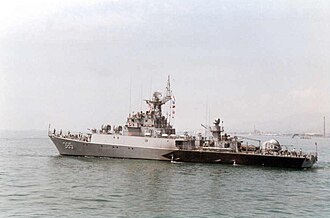
KRI Teuku Umar (385) is a corvette operated by the Indonesian Navy, known in Indonesia as Tentara Nasional Indonesia Angkatan Laut (TNI AL). The vessel belongs to the Kapitan Patimura class, a group of warships derived from the East German Parchim-class corvettes developed during the Cold War. Although relatively compact compared with modern frigates and destroyers, KRI Teuku Umar represents an important category of naval vessel designed to combine speed, maneuverability, and specialized combat capabilities within a comparatively small hull. Its original design emphasized coastal operations and anti-submarine warfare, reflecting the military priorities of the period in which the class was developed. Following the end of the Cold War and the reunification of Germany, several former East German naval vessels entered the international secondhand market, eventually providing Indonesia with an opportunity to expand its fleet through the acquisition and modernization of previously built warships.
What makes KRI Teuku Umar particularly interesting is the combination of its European construction heritage and its subsequent service within the Indonesian maritime environment. Indonesia is an archipelagic nation comprising thousands of islands spread across strategically important sea routes, where maritime surveillance, naval patrols, protection of territorial waters, and the security of national maritime interests are enduring defense priorities. A corvette such as KRI Teuku Umar offers a different set of advantages from those of a large frigate or amphibious assault ship. Its smaller size can make it suitable for a variety of regional naval assignments, while its onboard weapons and propulsion system reflect the requirements of a combat vessel designed to operate at sea rather than merely perform routine transportation duties. The ship’s history also illustrates how naval fleets evolve through international procurement, modernization, changes in strategic circumstances, and the continued use of platforms whose original designs may be several decades old.
Understanding KRI Teuku Umar requires looking beyond its name and numerical designation. Its history begins with the East German Navy, continues through the political transformation of Germany in the early 1990s, and eventually becomes part of Indonesia’s efforts to maintain and develop its naval capabilities. Its dimensions, diesel propulsion arrangement, reported speed, operational range, and weapons configuration help explain the vessel’s intended role, while its namesake connects a modern military platform with Indonesia’s historical struggle against colonial rule. Together, these elements make KRI Teuku Umar a compelling subject for readers interested in naval engineering, military history, Southeast Asian defense, and the evolution of the Indonesian Navy.
The Meaning Behind the Name KRI Teuku Umar
Who Was Teuku Umar?
The ship takes its name from Teuku Umar, an Indonesian national hero associated with the resistance against Dutch colonial rule in Aceh during the nineteenth century. Born in Aceh in 1854, Teuku Umar became one of the best-known figures in the region’s struggle against colonial expansion. His military and political activities formed part of the broader Aceh War, a prolonged conflict that began in 1873 and continued in various forms for decades. Teuku Umar is remembered for his determination, tactical adaptability, and willingness to use changing political circumstances to advance the resistance movement. His methods included negotiating with opponents, exploiting opportunities to obtain resources, and organizing forces to challenge Dutch authority. His life demonstrates the complexity of resistance movements, in which military action, diplomacy, intelligence, and local political relationships often interacted.
Teuku Umar’s historical significance extends beyond individual battles because his actions became part of a wider narrative of Indonesian resistance and national identity. Although the Indonesian state emerged much later, historical figures from the archipelago’s anti-colonial struggles have become important symbols of courage, sacrifice, and the pursuit of independence. Teuku Umar was killed in 1899 during the continuing conflict in Aceh, but his reputation endured through historical accounts, public commemorations, and the recognition granted to him as a national hero. Naming a naval vessel after him creates a connection between the Indonesian Navy’s modern responsibilities and the country’s historical experiences of defending its political independence. In this sense, the ship’s name is not simply an administrative label; it represents a deliberate association with a figure whose life remains meaningful within Indonesia’s national history.
Why Indonesian Warships Carry Historical Names
The Indonesian Navy uses ship names that frequently commemorate national heroes, historical leaders, geographic locations, and culturally significant figures. This tradition gives individual vessels an identity that extends beyond their hull numbers and technical characteristics. A warship’s pennant number helps identify it operationally, but its name communicates a different kind of meaning, linking the vessel to national memory and institutional heritage. The designation KRI stands for Kapal Perang Republik Indonesia, commonly translated as Warship of the Republic of Indonesia. The name Teuku Umar therefore identifies both the vessel itself and the historical figure whose legacy it commemorates.
For naval personnel, historical naming traditions can contribute to institutional identity and a sense of continuity between generations. For the public, the names provide a way to connect the armed forces with national history, including events that took place long before the modern military organization existed. KRI Teuku Umar is particularly representative of this practice because its namesake was associated with the defense of Aceh, a region whose geography has long placed it close to important maritime routes. The ship’s identity consequently combines historical symbolism with the practical responsibilities of a contemporary naval platform.
The Origins of KRI Teuku Umar
Development of the Parchim-Class Corvette
KRI Teuku Umar originated from a warship design developed in East Germany during the Cold War. The original vessel, named Grevesmühlen and identified by the pennant number 212, was constructed at Peene-Werft in Wolgast, East Germany. Its keel was laid on 7 December 1981, and the ship was launched on 3 September 1982 before entering service with the East German Volksmarine on 21 September 1984. The vessel belonged to the Parchim class, also associated with the Project 1331M designation. These ships were developed for coastal anti-submarine warfare, an important mission for East Germany’s navy because the Baltic Sea was a strategically sensitive area during the confrontation between NATO and the Warsaw Pact.
The Parchim-class design reflected a particular military environment rather than a universal approach to naval warfare. Instead of building a large ocean-going warship equipped for every possible mission, the designers concentrated on producing a relatively compact combat vessel with weapons and sensors suited to operations in coastal waters. During the Cold War, submarines represented a significant threat to naval forces, commercial shipping, and maritime supply lines. Smaller anti-submarine vessels could patrol likely submarine operating areas, cooperate with other naval units, and use specialized weapons intended to engage underwater targets. The resulting design incorporated a combination of propulsion power, surface and underwater detection equipment, guns, and anti-submarine weapons within a hull substantially smaller than that of a major surface combatant.
The class was also associated with the broader defense-industrial relationships of the Eastern Bloc. East German shipbuilders produced vessels for domestic service and for export to the Soviet Union, with different procurement requirements influencing the final configurations of ships within the wider family. This production history helps explain why the Parchim design became relevant to countries seeking relatively affordable naval combatants after the Cold War. When geopolitical circumstances changed, vessels built for one strategic environment could be transferred to another country and adapted to different operational requirements.
From Grevesmühlen to Indonesian Service
The political changes that followed German reunification created a new chapter in the vessel’s history. After the dissolution of East Germany as an independent state in 1990, Grevesmühlen was incorporated into the unified German Navy. It subsequently received the designation P 6164 and was decommissioned in 1991. The vessel was later sold to Indonesia as part of the transfer of former East German naval equipment to the Indonesian Navy. Such transfers were characteristic of the post-Cold War period, when military inventories changed rapidly and surplus equipment became available to countries interested in expanding their armed forces without purchasing every vessel new from a shipyard.
KRI Teuku Umar entered Indonesian service on 27 October 1996 under pennant number 385. Its transfer represented more than a simple change of flag: it placed a warship designed around the military priorities of Cold War Europe into the much larger and geographically different maritime setting of Southeast Asia. Indonesian naval planners needed to consider the vessel’s condition, maintenance requirements, weapons compatibility, crew training, and integration with the country’s existing fleet. Acquiring an older ship can provide useful capability, but it also requires careful management of the technical and logistical challenges associated with equipment that may no longer be in production or may depend on specialized spare parts.
The transition from Grevesmühlen to KRI Teuku Umar illustrates how naval vessels can experience several distinct operational lives. The ship was first built for East Germany, then passed into the inventory of the unified German Navy, and finally became an Indonesian warship. Each transfer reflected a different political and strategic context, while the physical platform retained much of its original architecture. Its subsequent service demonstrates the continuing relevance of secondhand military procurement in fleet planning, particularly when the acquiring country must balance operational requirements with budgetary constraints and the need to sustain a broad maritime presence.
KRI Teuku Umar and the Kapitan Patimura Class
Understanding the Ship’s Classification
KRI Teuku Umar is commonly identified as a Kapitan Patimura-class corvette in Indonesian service, while its original design belongs to the Parchim-class family. These descriptions are complementary rather than contradictory: one identifies the ship within Indonesia’s naval classification, while the other describes its design lineage. The distinction matters because international transfers, modernization programs, and national naming conventions can produce different classifications for vessels that share a common technical origin. For readers researching the ship, using both terms can help distinguish its Indonesian operational identity from the original German design.
A corvette generally occupies a position between smaller patrol craft and larger frigates, although the precise boundaries of these categories vary among navies and historical periods. Corvettes are typically smaller than frigates and are often intended for regional operations, coastal security, escort duties, surveillance, and specialized combat missions. Their size allows navies to distribute more hulls across different operating areas than would be possible if every assignment required a large, expensive surface combatant. However, a smaller displacement also limits the amount of fuel, ammunition, equipment, accommodation, and mission-specific systems that can be carried.
In KRI Teuku Umar’s case, the original anti-submarine emphasis of the Parchim design is central to understanding its role. The vessel was developed around the idea that a compact ship could provide a useful combination of underwater detection capability, anti-submarine weapons, gun armament, and relatively high speed. Indonesia’s operational requirements differ from those of East Germany, but the basic combination of mobility and specialized naval equipment remains relevant to understanding the platform. At the same time, the vessel should not be confused with a modern multirole frigate equipped with a fully contemporary integrated combat system, advanced long-range missiles, and the latest generation of networked sensors.
The Importance of a Compact Combatant
A corvette’s usefulness depends on more than the size of its guns or the maximum speed printed in a specification sheet. Naval operations require ships to balance mobility, endurance, situational awareness, communications, weapons, maintenance demands, and the availability of trained personnel. A smaller vessel may be able to operate effectively in regional patrol and escort assignments while requiring fewer resources than a much larger combatant. This does not mean that smaller warships can replace frigates or destroyers in every situation; instead, it means that different ship classes can provide complementary capabilities within a fleet.
KRI Teuku Umar’s displacement of less than one thousand tonnes at full load places it firmly within the category of relatively small surface combatants. That size has implications for both its strengths and its limitations. The vessel can carry substantial weapons for its dimensions, yet its ability to accommodate future upgrades is constrained by available space, electrical power, structural capacity, cooling, stability, and the demands of maintaining equipment throughout its service life. Modernizing a ship therefore involves more than installing new hardware: engineers must also consider how the equipment integrates with existing systems and how it affects the vessel’s overall performance.
Technical Specifications of KRI Teuku Umar
Dimensions and Displacement
Published technical summaries commonly list KRI Teuku Umar as measuring approximately 75.2 metres in length, 9.78 metres in beam, and 2.65 metres in draft. These dimensions describe a relatively narrow and compact warship, with a length that allows sufficient space for propulsion machinery, crew accommodation, weapons, sensors, and operational equipment. The beam, or maximum width of the hull, influences internal volume and stability, while draft indicates how far the hull extends below the waterline under the relevant loading conditions. Together, these measurements help explain why the ship can perform naval missions in regional waters without having the physical dimensions of a large frigate.
The vessel’s displacement is commonly reported as approximately 865 tonnes in standard condition and 935 tonnes at full load. Displacement represents the weight of water displaced by the ship and is conventionally used to express a vessel’s weight under specified loading conditions. The difference between standard and full-load displacement reflects the additional weight associated with fuel, ammunition, stores, personnel, and other operational supplies. Figures can vary among published sources because they may refer to different loading definitions, configurations, or stages of a vessel’s career, so these values should be treated as commonly reported figures rather than a substitute for an official technical record.
Displacement is important because it affects several interconnected aspects of a warship’s design. A greater displacement can provide more internal volume and payload capacity, but it also increases the amount of power required to achieve a particular speed and can influence the ship’s handling characteristics. A compact displacement can support economical regional operations and make a vessel easier to accommodate in certain naval facilities, but it restricts the weight of additional equipment that can be installed without affecting stability and performance. For a ship such as KRI Teuku Umar, the relationship between hull dimensions, displacement, and propulsion is fundamental to understanding the compromises involved in designing a coastal combatant.
Propulsion System and Performance
KRI Teuku Umar is commonly reported to use three M-504A diesel engines, each rated at approximately 4,750 horsepower, for a combined installed output of about 14,250 horsepower. The engines drive three fixed-pitch propellers, providing the thrust needed to propel the vessel through the water. This arrangement reflects the propulsion priorities of the original design, which required enough power for rapid movement during coastal patrols and anti-submarine operations. Diesel propulsion is a familiar solution for many smaller naval combatants because it can offer a practical balance of power, fuel consumption, and mechanical complexity, although actual performance depends on the engine condition, hull condition, loading, sea state, and maintenance standards.
The ship’s reported maximum speed is approximately 24.5 knots, equivalent to about 45.4 kilometres per hour. A knot represents one nautical mile per hour, making it the standard unit of speed in maritime navigation. A maximum speed figure describes a performance capability under particular conditions rather than a speed that a vessel can necessarily maintain for prolonged periods in all weather and loading situations. Operational planners must consider fuel consumption, machinery limitations, the sea state, the distance to be travelled, and the need to preserve sufficient endurance for the remainder of a mission.
The three-engine arrangement is also a useful example of how propulsion design reflects mission requirements. Multiple engines and propellers provide a means of generating substantial thrust within a relatively small hull, while the overall machinery layout influences maintenance access, vibration, noise, and internal compartment arrangements. For an anti-submarine vessel, acoustic considerations are particularly important because machinery noise can complicate underwater detection and potentially make the vessel easier for an opposing submarine to detect. The actual acoustic performance of an individual ship depends on many technical factors, and engine count alone is insufficient to establish how quietly it operates.
Operational Range and Endurance
The reported range of KRI Teuku Umar is approximately 2,100 nautical miles at a speed of 14 knots, equivalent to roughly 3,889 kilometres at about 25.9 kilometres per hour. This figure is useful for understanding the relationship between speed and endurance. A vessel travelling more slowly can generally cover a greater distance using the same fuel supply than it would at a substantially higher speed, although the exact relationship depends on the propulsion system and operating conditions. The stated range should therefore be interpreted as a reference figure at a specified speed, not as a guarantee of how far the ship can travel under every combination of weather, load, machinery condition, and operational activity.
Range is particularly relevant to Indonesia because the country’s maritime territory spans a large geographical area. A ship must be able to travel to its assigned operating area, carry out its duties, and return to a suitable port or rendezvous point while preserving appropriate reserves. Fuel consumption, provisioning, maintenance needs, and crew endurance all influence the practical duration of a deployment. Even a vessel with a respectable published range may require careful planning when operating far from its home base, especially if the mission involves sustained high-speed movement, frequent maneuvering, or extended periods of activity.
Endurance also depends on factors that cannot be represented by a single range figure. Crew accommodation, food and freshwater supplies, the reliability of onboard systems, the availability of maintenance support, and the ship’s operational tempo can determine how long a vessel remains useful at sea. For this reason, the reported range of KRI Teuku Umar is best viewed as one element of a larger operational picture rather than a complete measurement of its independent deployment capability.
Armament and Combat Capabilities
The AK-725 57 mm Naval Gun
One of the weapons commonly associated with KRI Teuku Umar’s configuration is the AK-725 twin 57 mm naval gun. The system was developed during the Soviet era and was designed to provide naval gunfire against suitable surface and airborne targets within its engagement envelope. A twin-barrel arrangement allows two barrels to be incorporated into a single mount, with the system’s practical effectiveness depending on its fire-control equipment, ammunition, target information, and the conditions under which it is operated. The gun is part of the ship’s original weapons heritage and reflects the Soviet-influenced armament philosophy associated with the Parchim-class design.
Naval guns remain useful because they can provide a flexible means of engaging certain targets without requiring the ship to expend a missile for every engagement. Depending on the weapon and the circumstances, gunfire can support warning or disabling actions, engagement of surface targets, and defensive action against suitable threats. A gun’s actual effectiveness is determined not only by calibre but also by its rate of fire, accuracy, ammunition characteristics, fire-control system, and the target’s range and behavior. Consequently, the presence of a 57 mm gun should not be treated as proof that a vessel can defeat every type of modern aerial or surface threat.
For KRI Teuku Umar, the AK-725 forms part of a weapons suite originally intended for a different strategic environment. The system’s continued relevance depends on the ship’s present equipment condition, ammunition availability, maintenance support, and integration with whatever sensors and fire-control arrangements are fitted. Published descriptions identify the weapon as a key component of the vessel’s armament, but detailed claims about current readiness or performance require more specific and up-to-date official information.
The AK-230 30 mm Gun
The ship is also commonly listed with a twin 30 mm AK-230 gun mount, another system originating from Soviet naval weapons development. The AK-230 was designed as an automatic naval gun system intended primarily for close-range defense against suitable aerial and surface targets. Its smaller calibre and automatic firing capability distinguish it from the larger 57 mm mount, giving the two weapon types different intended functions within the overall defensive arrangement. In broad terms, a warship carrying both systems has access to different gun calibres rather than relying on one weapon for every situation.
Close-range weapons are an important part of a naval vessel’s defensive equipment, but their capabilities should be understood within the limits imposed by detection range, tracking quality, reaction time, ammunition, and the characteristics of an approaching target. Modern anti-ship missiles and other threats can present difficult challenges even to ships carrying more advanced defensive systems. The existence of a gun mount therefore does not, by itself, establish the level of protection a ship can provide against a specific threat. A realistic assessment requires information about the complete sensor, command, fire-control, and weapon arrangement.
Denel GI-2 20 mm Guns
Published descriptions of the Indonesian configuration also list two Denel GI-2 20 mm guns. These weapons are associated with a later or adapted configuration rather than simply reproducing every aspect of the ship’s original East German fit. The GI-2 is a lightweight automatic cannon derived from the broader South African GI-2 weapon family and is intended for applications where a compact, rapid-firing gun can provide useful close-range firepower. On a naval vessel, guns of this category can contribute to local defense and engagement of suitable small surface targets, subject to the ship’s operational rules and equipment configuration.
The inclusion of 20 mm guns illustrates an important point about transferred military equipment: a ship’s armament can change after it enters service with a new navy. Weapons may be replaced, removed, or adapted because of supply constraints, differences in available ammunition, changes in doctrine, or the desire to use systems supported by the acquiring country’s defense infrastructure. For researchers, this means that the original weapons list of Grevesmühlen should not automatically be treated as identical to the later Indonesian configuration. The most reliable description distinguishes between systems associated with the original design and those reported for KRI Teuku Umar after its transfer.
RBU-6000 Anti-Submarine Rocket Launchers
KRI Teuku Umar is also reported to carry two RBU-6000 anti-submarine rocket launchers. This system was developed to engage underwater threats using rocket-propelled anti-submarine munitions, including weapons intended to reach a designated area around a suspected submarine contact. Unlike a conventional torpedo, which typically travels through the water toward a target, an anti-submarine rocket launcher delivers its payload into the water over a projected trajectory. Its effectiveness depends on the availability and quality of underwater contact information, the characteristics of the munition, and the tactical circumstances of the engagement.
The RBU-6000 system is particularly relevant to the vessel’s historical role because anti-submarine warfare was one of the principal missions for which the Parchim-class corvettes were designed. Submarines can be difficult to locate because they operate beneath the surface and can use environmental conditions to reduce the likelihood of detection. An anti-submarine ship must therefore combine sensors, trained operators, suitable weapons, and effective coordination with other naval units. A launcher by itself cannot find a submarine; it is one component of a larger process that begins with detecting, classifying, and tracking an underwater contact.
Descriptions of KRI Teuku Umar’s armament sometimes reproduce weapons lists that include equipment carried by the original Grevesmühlen, while other lists describe the Indonesian ship’s modified configuration. In particular, references to original torpedo tubes or short-range surface-to-air missile positions should be distinguished from weapons confirmed as part of the ship’s later fit. Publicly available summaries do not always provide a consistent, dated inventory of every system currently installed and operational. For that reason, the RBU-6000 launchers can be discussed as a reported part of the vessel’s armament, while claims about its complete current anti-submarine capability should be made cautiously.
Sensors, Detection, and Maritime Awareness
Radar and Surface Surveillance
Radar is a fundamental tool for a surface combatant because it enables the ship to detect and track certain objects beyond the distances at which visual observation alone would be sufficient. Depending on the type of radar, operating conditions, target size, and surrounding environment, the system may support surface surveillance, air surveillance, navigation, or other functions. For a corvette such as KRI Teuku Umar, radar contributes to the broader task of maintaining awareness of nearby maritime activity and supporting the crew’s understanding of the surrounding operational environment.
Some technical descriptions associated with the wider Parchim-class family identify Soviet-origin radar equipment, including the MR-302 surface and air search radar and the MR-123 fire-control radar. These designations provide useful historical context, but a reader should not assume that every ship within the class retains identical equipment after decades of service and national modernization. Individual vessels can receive modifications, equipment replacements, or changes to their onboard systems. Accordingly, equipment lists should be checked against dated documentation before being presented as a definitive description of KRI Teuku Umar’s present configuration.
Radar performance also depends on more than the radar model itself. Antenna condition, maintenance, the surrounding electromagnetic environment, crew training, and the integration of radar information with other onboard systems can all affect how useful the information is to the ship. A radar contact must be interpreted in context, and the presence of a detected object does not automatically reveal its identity, intentions, or exact characteristics. This is why radar is best understood as a component of maritime awareness rather than a complete solution to every surveillance requirement.
Sonar and the Anti-Submarine Mission
Sonar plays a central role in anti-submarine warfare because it allows a vessel to gather information about underwater objects and sound sources. Public descriptions of the Parchim-class design identify the MG-322T sonar among the systems associated with this family. Sonar can operate through the transmission and reception of sound or by listening for sound generated by other objects, depending on the system’s operating mode. The information collected must be assessed by trained personnel, since underwater acoustic conditions can be affected by temperature, salinity, depth, seabed characteristics, background noise, and the behavior of the target.
For a ship originally designed around coastal anti-submarine warfare, the combination of sonar and anti-submarine weapons represents an important connection between detection and action. The vessel must first gather information that suggests the presence of an underwater contact, then assess that information sufficiently to support an operational decision. In practical naval service, these activities can involve multiple platforms and supporting systems rather than a single ship operating independently. The effectiveness of an anti-submarine vessel consequently depends on the overall system of sensors, communications, training, weapons, and tactical coordination.
The age of the original design also matters when considering modern underwater threats. Sensor technology, submarine quieting, digital processing, and the wider use of networked maritime information have evolved significantly since the Cold War. Although an older corvette may retain useful functions, its effectiveness against contemporary threats depends on the condition and modernization of its equipment and on how it is employed alongside other forces. Without current official documentation, it would be inappropriate to infer the vessel’s exact detection range or its ability to locate a particular type of modern submarine.
The Role of KRI Teuku Umar in Indonesia’s Maritime Environment
An Archipelagic Nation and Its Naval Requirements
Indonesia’s geography creates a distinctive set of maritime responsibilities. The country extends across a vast area of Southeast Asia, connecting the Indian and Pacific Oceans through several important passages and encompassing extensive territorial waters and an exclusive economic zone. These waters support commercial shipping, fisheries, energy activities, coastal communities, and international trade. Protecting maritime interests therefore involves a combination of naval defense, law enforcement, maritime surveillance, cooperation with other government agencies, and the maintenance of a credible presence across geographically dispersed operating areas.
A corvette such as KRI Teuku Umar represents one component of the broader naval fleet used to support these responsibilities. Surface combatants can contribute to patrols, training activities, escort assignments, and other duties consistent with their equipment and operational condition. Their presence can also support the development of crew proficiency and provide a platform for practicing navigation, communications, coordination, and shiphandling. The exact duties assigned to an individual vessel vary with the Navy’s requirements, the ship’s readiness, its maintenance schedule, and the resources available to support operations.
The importance of a ship should not be judged solely by whether it carries the newest weapons or has the greatest displacement. A navy must sustain an appropriate mix of platforms, personnel, logistics, and supporting infrastructure. Large modern combatants provide capabilities that smaller corvettes cannot easily reproduce, while smaller ships can offer useful flexibility for selected regional tasks. The operational value of KRI Teuku Umar is therefore best understood within the context of the entire fleet rather than as an isolated comparison with the most technologically advanced warships in the region.
Patrol, Training, and Naval Presence
Regional patrols and routine deployments help naval organizations maintain familiarity with operating areas, sustain crew proficiency, and demonstrate an ongoing maritime presence. Depending on their tasking, warships may also participate in exercises, ceremonial activities, cooperation with other agencies, or training intended to prepare personnel for more demanding operations. These activities are not all combat missions, but they contribute to the broader readiness and institutional competence of a navy.
A vessel’s ability to perform such duties depends on its availability and maintenance condition. A ship may possess impressive specifications on paper but provide limited operational value if its engines, sensors, weapons, or supporting systems are unavailable. Conversely, a properly maintained older vessel can continue to offer useful service when assigned tasks appropriate to its capabilities. This distinction is especially important when discussing ships acquired secondhand, because age alone does not fully describe their condition, but age can increase the importance of spare-parts planning, engineering support, and systematic maintenance.
For KRI Teuku Umar, the publicly reported technical characteristics explain the basic design and intended mission, but they do not establish the vessel’s readiness on any particular date. Operational availability can change, and information about current deployments or specific assignments should be based on recent official announcements rather than assumptions derived from historical specifications. A balanced article should therefore distinguish between the ship’s established history, its published design characteristics, and the details of its present operational status.
Modernization and the Challenges of Maintaining Older Warships
The Benefits and Limitations of Secondhand Naval Procurement
Acquiring previously built warships can help a navy expand its inventory more quickly than ordering an entirely new class of vessels. The original construction cost has already been incurred, and the acquiring country may be able to obtain multiple hulls for a price that would otherwise purchase a smaller number of newly built ships. This approach can be attractive when a country needs to increase its maritime presence, replace aging equipment, or maintain a range of capabilities within a limited defense budget. The transfer of former East German Parchim-class corvettes to Indonesia fits within this broader pattern of post-Cold War naval procurement.
However, the purchase price represents only part of the total cost of operating a warship. An older platform may require extensive repairs, machinery overhauls, replacement of electronic equipment, structural work, and the establishment of a sustainable supply chain for spare parts. Weapons manufactured decades earlier can present particular challenges if production has ended or if the acquiring navy no longer maintains the original ammunition and support infrastructure. Training crews to operate and maintain unfamiliar systems also requires time and resources, while modifications intended to meet national requirements can introduce additional integration work.
Modernization can extend a ship’s useful life, but it cannot remove every limitation imposed by the original design. The amount of electrical power available, the strength and layout of the hull, internal space, stability margins, cooling capacity, and machinery arrangements may restrict the systems that can be installed. Upgrades must therefore be selected according to a realistic assessment of the vessel’s remaining service life, the cost of continued maintenance, and the missions it is expected to perform. For a corvette designed during the Cold War, these considerations are essential to understanding how it can remain useful in a substantially changed technological environment.
The Importance of Logistics and Crew Training
A warship is a complex technical system that requires coordination among engineering personnel, weapons operators, navigators, communications specialists, and command staff. Every major system introduces its own maintenance and training requirements, and the combined demands can become more complicated when a vessel uses equipment originating from several countries. Different spare parts, technical manuals, diagnostic procedures, ammunition types, and maintenance standards can increase the logistical burden on the navy responsible for keeping the ship operational.
Crew training is equally important because even a well-equipped vessel depends on people who understand its systems and can respond effectively to unexpected conditions. Familiarity with machinery, navigation equipment, communications procedures, damage control, and emergency response helps the crew maintain safe and reliable operations. Training must also account for the ship’s specific design and the limitations of its equipment. A vessel’s capabilities are therefore the product of hardware, maintenance, logistics, and human expertise working together rather than the result of weapons and engines alone.
The experience of maintaining older ships can also provide useful lessons for broader fleet management. Naval organizations must decide when an upgrade remains economically justified, when a system should be replaced, and when a vessel should eventually be retired. These decisions involve not only technical condition but also future operational requirements and the availability of newer platforms. KRI Teuku Umar’s long history illustrates why procurement decisions should be evaluated across the full life cycle of a warship rather than by acquisition cost alone.
KRI Teuku Umar Compared with Modern Warships
Differences Between Corvettes and Frigates
Comparisons between KRI Teuku Umar and modern frigates help illustrate how naval design priorities have changed. A modern frigate can be substantially larger, carry more fuel and stores, accommodate more sophisticated radar and sonar systems, and integrate weapons designed for several different mission areas. Some contemporary frigates also possess advanced air-defense missiles, anti-ship missiles, modern anti-submarine torpedoes, electronic warfare equipment, and combat management systems that coordinate information from multiple sensors. These features allow a modern frigate to undertake a wider range of demanding assignments, although its purchase and operating costs are generally much higher than those of a small corvette.
KRI Teuku Umar’s reported displacement and original Cold War design place it in a different category. Its equipment reflects the technology and operational assumptions of the era in which it was constructed, and its smaller hull limits the scale of potential upgrades. That does not mean a comparison is useful only for identifying shortcomings. Different vessel classes fulfill different requirements, and a smaller combatant may remain appropriate for tasks that do not require the full capabilities of a modern frigate. The relevant question is whether a platform can perform its assigned missions safely and effectively, not whether it matches a larger ship in every technical category.
Modern naval capability also increasingly depends on information sharing and coordination between platforms. A warship may receive information from shore-based surveillance, maritime patrol aircraft, helicopters, other ships, or broader command networks. The extent to which an individual vessel can participate in these arrangements depends on its communications equipment, onboard systems, and integration with the wider force. This networked approach makes it increasingly important to assess ships as part of a coordinated naval organization rather than relying exclusively on standalone measurements such as speed, displacement, or gun calibre.
Why Older Ships Still Matter in Naval History
Older warships provide an important record of how naval doctrine and engineering have evolved. Their propulsion arrangements, hull proportions, sensors, and armament reveal the priorities of the period in which they were designed. In the case of the Parchim-class corvettes, the emphasis on coastal anti-submarine warfare reflects the strategic importance of the Baltic Sea during the Cold War. The later transfer of these ships to Indonesia shows how a vessel designed for one geographic and political environment can enter a different navy and acquire a new institutional identity.
The continued study of such vessels also helps readers distinguish between historical design capability and present-day operational effectiveness. A ship may be historically significant even if its technology has been surpassed by newer systems. Its service record can illuminate procurement policy, industrial cooperation, maintenance practices, and the changing requirements of naval forces. KRI Teuku Umar is therefore relevant not only as an individual Indonesian warship but also as an example of the long life cycles that characterize many military platforms.
Frequently Asked Questions About KRI Teuku Umar
What type of warship is KRI Teuku Umar?
KRI Teuku Umar (385) is a corvette of the Indonesian Navy, commonly identified as part of the Kapitan Patimura class in Indonesian service. Its design lineage traces back to the Parchim-class corvettes developed in East Germany during the Cold War. The vessel was originally commissioned as Grevesmühlen before later entering Indonesian service.
When did KRI Teuku Umar enter Indonesian service?
The ship entered Indonesian Navy service on 27 October 1996. Before its transfer to Indonesia, it served in the East German Volksmarine as Grevesmühlen and subsequently became part of the unified German Navy following German reunification. Its history consequently spans several distinct political and naval contexts.
How long is KRI Teuku Umar?
Commonly published specifications list the vessel’s length as approximately 75.2 metres. Its reported beam is 9.78 metres, while its draft is approximately 2.65 metres. These measurements describe the hull’s principal dimensions and help explain its classification as a relatively compact surface combatant.
What is the maximum speed of KRI Teuku Umar?
The ship’s commonly reported maximum speed is approximately 24.5 knots, or about 45.4 kilometres per hour. Actual performance depends on the condition of its engines and hull, its loading, and environmental conditions. The maximum figure should not be interpreted as a speed that can necessarily be sustained throughout an entire deployment.
What weapons does KRI Teuku Umar carry?
Published descriptions of its Indonesian configuration commonly list a twin 57 mm AK-725 gun, a twin 30 mm AK-230 gun, two 20 mm Denel GI-2 guns, and two RBU-6000 anti-submarine rocket launchers. These details should be treated as reported configuration information because historical sources do not always distinguish clearly between the original East German fit and subsequent Indonesian modifications. A current official inventory would be needed to confirm the exact weapons installed and operational today.
What was the original purpose of the Parchim-class design?
The Parchim-class corvettes were developed primarily for coastal anti-submarine warfare. Their design combined relatively compact dimensions with propulsion, sensors, guns, and weapons intended to support operations against underwater threats in coastal waters. This mission reflected the strategic requirements of East Germany during the Cold War.
Who was Teuku Umar?
Teuku Umar was an Acehnese resistance leader who fought against Dutch colonial rule in the nineteenth century. Born in 1854, he became a prominent figure during the Aceh War and was killed in 1899. His status as an Indonesian national hero explains why his name remains significant in the country’s historical and military traditions.
Conclusion: The Historical and Maritime Significance of KRI Teuku Umar
KRI Teuku Umar is an informative example of how naval vessels can connect engineering history, international military procurement, national identity, and maritime defense. Built in East Germany as Grevesmühlen, the ship was originally designed for the coastal anti-submarine warfare requirements of the Cold War. Following German reunification and its subsequent transfer to Indonesia, it became part of the Indonesian Navy under the name of Teuku Umar, the Acehnese resistance leader whose legacy remains embedded in the country’s national history. Its transition between navies demonstrates how political changes can reshape military inventories and give existing platforms new roles within different strategic environments.
The vessel’s reported specifications provide a useful understanding of its physical characteristics and original design philosophy. With a length of approximately 75.2 metres, a full-load displacement commonly reported at around 935 tonnes, three diesel engines producing a combined 14,250 horsepower, and a reported maximum speed of 24.5 knots, KRI Teuku Umar represents a compact but purpose-built naval combatant. Its reported gun armament and anti-submarine rocket launchers reflect the priorities of its design lineage, while the history of its transfer highlights the importance of adapting older equipment to the requirements of a new operator. At the same time, its age means that assessments of present-day capability must take account of maintenance, modernization, equipment availability, and the changing technological demands of maritime warfare.
Ultimately, KRI Teuku Umar is best understood as one element of a much larger story about Indonesia’s maritime responsibilities and the evolution of its naval fleet. The vessel’s significance lies not simply in its dimensions or weapons but in the relationship between its original purpose, its subsequent service, and the strategic environment in which it has operated. For readers interested in warships, Southeast Asian naval history, or the long-term management of military equipment, KRI Teuku Umar offers a valuable case study of how a vessel built for one era can acquire a different identity and continue to form part of a nation’s maritime story.
Technical Specifications of KRI Teuku Umar
The following table summarizes commonly reported technical characteristics of KRI Teuku Umar. Values may differ between historical records, class-level descriptions, and ship-specific configuration reports. The table should therefore be used as a general reference rather than as a definitive statement of the ship’s current operational condition.
| Specification | Reported details |
|---|---|
| Ship name | KRI Teuku Umar |
| Pennant number | 385 |
| Country | Indonesia |
| Operator | Indonesian Navy (TNI AL) |
| Ship type | Corvette |
| Indonesian class designation | Kapitan Patimura class |
| Original design family | Parchim class / Project 1331M |
| Original name | Grevesmühlen |
| Original builder | Peene-Werft, Wolgast, East Germany |
| Keel laid | 7 December 1981 |
| Launched | 3 September 1982 |
| Original commissioning | 21 September 1984 |
| Commissioned into Indonesian service | 27 October 1996 |
| Length | Approximately 75.2 m |
| Beam | Approximately 9.78 m |
| Draft | Approximately 2.65 m |
| Standard displacement | Approximately 865 tonnes |
| Full-load displacement | Approximately 935 tonnes |
| Main propulsion | 3 × M-504A diesel engines |
| Reported engine output | 3 × 4,750 hp |
| Combined installed power | Approximately 14,250 hp |
| Propellers | 3 fixed-pitch propellers |
| Reported maximum speed | Approximately 24.5 knots |
| Reported range | Approximately 2,100 nautical miles at 14 knots |
| Reported crew complement | Approximately 62 personnel |
| Main gun | 1 × twin 57 mm AK-725 mount |
| Secondary gun | 1 × twin 30 mm AK-230 mount |
| Additional guns | 2 × 20 mm Denel GI-2 guns, as reported for the Indonesian configuration |
| Anti-submarine weapons | 2 × RBU-6000 launchers, as reported |
| Original design emphasis | Coastal anti-submarine warfare |
| Namesake | Teuku Umar, Acehnese resistance leader and Indonesian national hero |
