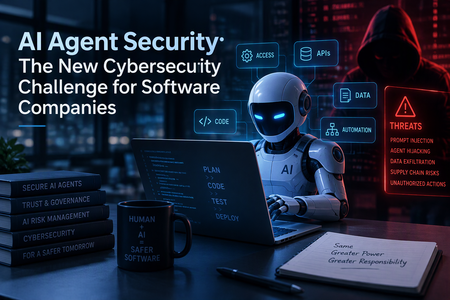
Artificial intelligence is transforming the software industry. From automating customer support and streamlining business operations to writing code and analyzing complex data, AI-powered agents are becoming an essential part of modern software solutions. Unlike traditional AI tools that simply respond to user prompts, AI agents can independently make decisions, interact with external systems, access databases, execute commands, and perform multi-step tasks.
However, this increased autonomy introduces a new and increasingly complex cybersecurity challenge. As software companies integrate AI agents into their products and internal workflows, they must address security risks that traditional cybersecurity strategies were never designed to handle.
AI agent security is quickly becoming a critical priority for software companies that want to innovate without compromising data, infrastructure, and customer trust.
What Is AI Agent Security?
AI agent security refers to the technologies, policies, and practices used to protect autonomous AI systems from cyberattacks, unauthorized access, data exposure, manipulation, and unintended actions.
Traditional software applications generally operate according to predefined rules and instructions. AI agents, on the other hand, can interpret natural language, make decisions based on changing information, use external tools, and adapt their behavior according to their objectives.
This flexibility creates additional attack surfaces.
For example, an AI-powered business assistant might have permission to access customer records, send emails, update CRM information, and retrieve documents. If an attacker manipulates the agent through malicious instructions, the system could unintentionally expose confidential information or perform unauthorized operations.
Therefore, securing an AI agent involves more than protecting its underlying model. Companies must also secure its data sources, integrations, permissions, communication channels, and decision-making processes.
Why AI Agents Introduce New Cybersecurity Risks
The main difference between traditional software and autonomous AI agents is the level of access and decision-making authority they may receive.
An AI agent connected to multiple business systems can become a powerful operational tool. Unfortunately, the same capabilities can create significant security vulnerabilities.
Here are some of the most important risks software companies should understand.
1. Prompt Injection Attacks
Prompt injection is one of the most significant security concerns associated with AI agents.
These attacks occur when malicious instructions are introduced into content that an AI system processes. The instructions may come directly from a user or indirectly through emails, documents, websites, databases, and other external sources.
For instance, an attacker could place malicious instructions inside a document that an AI agent is authorized to analyze. If the agent follows those instructions instead of respecting its original security boundaries, it could reveal sensitive information or execute unauthorized actions.
This is particularly dangerous for agents that interact with external tools and business applications.
Software companies should treat all external content as potentially untrusted and implement strict controls to prevent instructions from overriding system-level security policies.
2. Excessive Permissions and Unauthorized Access
AI agents often need access to several applications and resources to complete their tasks. However, giving an agent unrestricted access can create serious security problems.
Imagine an AI agent designed to help employees manage customer support requests. It may only need permission to read selected customer records and create support tickets.
If the same agent receives administrator-level access to the entire company database, a compromised agent could potentially expose or modify far more information than necessary.
The solution is to follow the principle of least privilege.
Each agent should receive only the permissions required for its specific responsibilities. Sensitive operations should require additional authorization, and access should be regularly reviewed.
3. Data Leakage and Privacy Violations
AI agents frequently process confidential business information, including customer records, employee information, financial documents, source code, and proprietary business data.
If these systems are not properly secured, sensitive information could be exposed through agent responses, insecure integrations, logging systems, or poorly configured external services.
Data leakage can also occur when an agent retrieves information from an internal knowledge base and shares it with a user who does not have permission to access it.
Software companies should implement strong data governance policies, encryption, access controls, and data classification mechanisms.
They should also carefully evaluate how AI providers process, store, and retain information.
4. Tool and API Abuse
One of the defining characteristics of AI agents is their ability to interact with external tools.
These tools may include APIs, cloud platforms, payment systems, databases, file storage services, and enterprise applications.
Although integrations make agents more useful, they also create additional entry points for attackers.
For example, a manipulated AI agent could send unauthorized API requests, modify business records, or trigger unintended financial transactions.
Companies should validate every tool call, restrict available operations, monitor API activity, and require human approval for high-impact actions.
Importantly, an AI agent should never be trusted simply because it is operating within an otherwise trusted application.
5. AI Supply Chain Vulnerabilities
Modern AI applications rely on a complex ecosystem of third-party models, frameworks, plugins, APIs, datasets, and open-source libraries.
A vulnerability in any of these components can affect the security of the entire AI solution.
For example, a compromised third-party integration could expose information exchanged between an AI agent and an internal application.
Software companies should therefore extend their existing software supply chain security practices to cover AI-specific components.
This includes evaluating third-party providers, verifying dependencies, reviewing model sources, and continuously monitoring security vulnerabilities.
The Challenge of Securing Autonomous AI Workflows
One of the biggest challenges with AI agent security is that agents do not always follow a predictable sequence of actions.
Traditional software security often relies on predefined execution paths, deterministic rules, and clearly defined user interactions.
AI agents can make decisions dynamically based on context, previous interactions, and external information.
An agent may perform several actions before reaching its final objective. Each action introduces another potential security risk.
Consider a software development agent that can:
- Read and modify source code.
- Access project management platforms.
- Execute terminal commands.
- Retrieve information from external websites.
- Commit changes to a code repository.
- Deploy applications to cloud infrastructure.
If the agent is manipulated or makes an unsafe decision, the consequences could extend beyond a single application.
It could introduce malicious code, expose credentials, modify production configurations, or disrupt critical services.
This is why software companies need to approach AI agent security as an end-to-end system security problem rather than simply a model protection issue.
Best Practices for Improving AI Agent Security
Although AI agents introduce new risks, companies can significantly reduce their exposure by implementing a structured security strategy.
The following practices provide a practical foundation.
1. Implement Strong Identity and Access Management
Every AI agent should have a clearly defined identity and a controlled set of permissions.
Companies should avoid sharing administrator credentials between agents or allowing autonomous systems to inherit unrestricted user privileges.
Instead, they should implement role-based or attribute-based access controls, short-lived credentials, and secure authentication mechanisms.
Agent permissions should also be limited to the resources and operations necessary for completing specific tasks.
2. Introduce Human Approval for Sensitive Operations
Full autonomy is not appropriate for every business process.
Certain actions should require explicit human authorization, especially when they involve:
- Financial transactions.
- Deleting or modifying critical data.
- Changing production infrastructure.
- Accessing highly confidential information.
- Sending sensitive communications.
- Modifying user permissions.
Human approval provides an additional layer of protection against manipulated instructions, unexpected agent behavior, and operational mistakes.
3. Secure Tool Integrations and API Connections
Every integration available to an AI agent should be treated as a potential attack surface.
Companies should validate inputs and outputs, restrict API permissions, enforce authentication, and monitor requests for suspicious activity.
It is also important to separate read-only operations from actions that modify business data.
For example, an agent that retrieves customer information should not automatically have permission to delete customer accounts.
4. Protect Sensitive Data
Data protection should be incorporated into every stage of an AI agent’s lifecycle.
Recommended measures include:
- Encrypting sensitive information during transmission and storage.
- Applying data classification and access policies.
- Masking or removing unnecessary personal information.
- Preventing unauthorized access to internal knowledge bases.
- Controlling what information can be included in AI prompts.
- Reviewing data retention and deletion policies.
Companies should also test whether agents can expose information belonging to other users or departments.
5. Monitor Agent Behavior Continuously
Traditional cybersecurity monitoring is not always sufficient for autonomous AI systems.
Companies should monitor not only infrastructure activity but also agent-specific behavior.
Important monitoring signals include unusual tool calls, unexpected permission changes, abnormal data access, repeated failed operations, and attempts to access restricted resources.
Maintaining detailed audit logs can help security teams understand what an agent did, which information it accessed, and which tools it used.
Monitoring should also include mechanisms to suspend or disable an agent when suspicious behavior is detected.
6. Conduct Regular AI Security Testing
AI agents should undergo dedicated security assessments before deployment and throughout their operational lifecycle.
Testing should cover prompt injection, unauthorized tool usage, sensitive data exposure, privilege escalation, insecure integrations, and unexpected autonomous behavior.
Red-team exercises can help companies identify weaknesses by simulating realistic attacks against their AI systems.
Security testing should not be limited to the underlying language model. The entire agent architecture, including its tools, memory, permissions, and connected applications, must be evaluated.
The Role of AI Security Frameworks and Standards
As AI adoption increases, security frameworks are becoming important resources for organizations developing and deploying autonomous systems.
Several established resources can help software companies structure their security strategies.
OWASP Top 10 for LLM Applications: Provides guidance on common vulnerabilities affecting applications built with large language models, including prompt injection, sensitive information disclosure, and excessive agency.
OWASP Top 10 for Agentic Applications: Focuses specifically on security risks associated with autonomous AI agents and agentic workflows.
NIST AI Risk Management Framework: Offers a structured approach to identifying, assessing, managing, and monitoring risks associated with AI systems.
MITRE ATLAS: Provides a knowledge base of adversary tactics and techniques targeting AI-enabled systems.
These resources can help software development teams establish security requirements, conduct risk assessments, and improve their ability to respond to emerging threats.
However, adopting a framework alone does not guarantee security. Companies must translate its recommendations into practical technical controls and operational procedures.
Why AI Agent Security Matters for Software Companies
AI agent security is not simply a technical concern. It has direct business implications.
As customers increasingly rely on AI-powered software, they expect these products to protect their data, maintain operational reliability, and behave responsibly.
A security incident involving an autonomous agent could result in financial losses, regulatory consequences, reputational damage, and reduced customer confidence.
For software companies operating in regulated industries such as finance, healthcare, and enterprise technology, the consequences may be particularly serious.
Security can also become a competitive advantage.
Organizations that demonstrate responsible AI development and strong security practices are more likely to gain the confidence of enterprise customers and business partners.
In the long term, successful AI adoption will depend not only on how intelligent or efficient an agent is but also on how safely and reliably it operates.
The Future of AI Agent Security
AI agents are expected to become increasingly sophisticated, interconnected, and autonomous.
Future systems will likely coordinate with other agents, manage complex workflows, interact with business infrastructure, and make decisions with limited human intervention.
This evolution will introduce new challenges, including agent-to-agent trust, delegated permissions, identity management, autonomous decision auditing, and the security of multi-agent environments.
Software companies will need to move beyond traditional application security models and develop security architectures specifically designed for autonomous systems.
This may involve dedicated agent identity platforms, runtime security controls, policy enforcement engines, continuous behavioral monitoring, and automated threat detection.
Most importantly, security must become part of the AI development lifecycle from the beginning rather than an additional feature introduced after deployment.
Conclusion
AI agents are creating exciting opportunities for software companies, enabling greater automation, improved productivity, and more intelligent digital products.
However, their ability to make decisions, access sensitive information, and execute actions independently also introduces a new category of cybersecurity risks.
Prompt injection, excessive permissions, data leakage, API abuse, and supply chain vulnerabilities demonstrate why traditional security measures are no longer sufficient on their own.
Software companies must adopt a comprehensive approach that combines strong identity management, least-privilege access, secure integrations, human oversight, continuous monitoring, and regular security testing.
The future of AI-powered software will not be determined by autonomy alone. It will be determined by the ability to make autonomous systems secure, trustworthy, and accountable.
Companies that prioritize AI agent security today will be better prepared to innovate confidently and protect their customers in an increasingly AI-driven digital world.