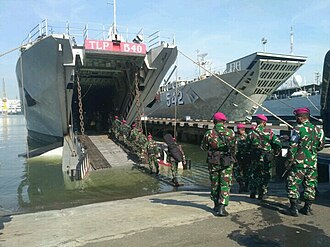
KRI Teluk Sangkulirang (542): History, Specifications, Capabilities, and Role in the Indonesian Navy
The Indonesian Navy (Tentara Nasional Indonesia Angkatan Laut, or TNI AL) operates a diverse fleet of warships designed to protect the country’s extensive maritime territory, secure important sea lanes, and support military operations across thousands of islands. Among the vessels that have contributed to these responsibilities is KRI Teluk Sangkulirang (542), a medium landing ship associated with Indonesia’s amphibious warfare capabilities. Although it is not among the newest or most technologically advanced vessels in the Indonesian naval inventory, its ability to transport military personnel, vehicles, equipment, and logistical supplies makes it an important example of the practical capabilities required by an archipelagic nation.
KRI Teluk Sangkulirang has an interesting international history. Originally constructed in East Germany, the vessel entered service with the East German Volksmarine under the name Grimmen before eventually becoming part of the Indonesian Navy. Its acquisition reflected Indonesia’s efforts during the 1990s to strengthen its naval capabilities through the procurement of additional warships from abroad. Since entering Indonesian service, the ship has represented an important component of the Navy’s amphibious transport capacity, particularly in operations requiring the movement of personnel and heavy equipment between islands and coastal areas.
The vessel’s significance is not determined exclusively by its dimensions, speed, or weapons. Its principal value lies in its ability to perform transportation and amphibious support missions in an operational environment where conventional port infrastructure may be limited. Indonesia’s geography creates unique military and logistical challenges, making ships capable of carrying vehicles and personnel especially valuable. In this context, KRI Teluk Sangkulirang (542) demonstrates how a relatively conventional landing ship can contribute to a much broader maritime defense strategy.
The History of KRI Teluk Sangkulirang (542)
Originally Built in East Germany
The origins of KRI Teluk Sangkulirang can be traced to East Germany during the late 1970s. The vessel was constructed by VEB Peenewerft, a shipbuilding company located in Wolgast, East Germany, which produced several naval vessels for the country’s maritime forces. The ship was originally named Grimmen and carried the pennant number 616 while serving with the East German Volksmarine.
Construction began in November 1977, and the vessel was launched on May 30, 1978. It officially entered service on July 15, 1979, becoming part of the East German naval fleet. Its original design belonged to the Project 108 family, internationally identified as the Frosch I class. This family of vessels was developed to provide amphibious transportation capabilities, allowing naval forces to move military vehicles, supplies, and personnel across coastal waters and between operational areas.
The Frosch-class design reflected the military requirements of the Cold War period, when amphibious mobility was considered an important component of naval strategy. Landing ships offered a practical solution for transporting heavy equipment without depending entirely on conventional port facilities. Their ability to support operations near beaches and coastal landing areas made them useful for both military transportation and logistical missions.
Grimmen was therefore designed around a relatively straightforward but valuable concept: transporting substantial quantities of equipment and personnel while retaining the ability to operate in maritime environments that might be unsuitable for larger conventional cargo vessels.
Transfer to Indonesia
Following the political changes that transformed East Germany and eventually led to German reunification, the East German Volksmarine underwent major organizational changes. Several vessels were removed from active service, and Grimmen was decommissioned in October 1990.
Indonesia subsequently acquired the ship as part of its efforts to strengthen its naval fleet. The acquisition took place on August 25, 1993, while the vessel was transferred into Indonesian service under a new identity. Following the necessary preparations and refitting, the ship arrived in Indonesia and officially entered service as KRI Teluk Sangkulirang (542) on December 9, 1994.
The transition from Grimmen to Teluk Sangkulirang represented more than a simple change of name and naval identification. It marked the vessel’s entry into a different maritime environment, one characterized by a vast archipelago, numerous strategic waterways, and the requirement to maintain military mobility across widely separated islands.
The name Teluk Sangkulirang refers to Sangkulirang Bay in East Kalimantan, Indonesia. The naming tradition reflects the Indonesian Navy’s practice of assigning geographical names to many of its warships, connecting naval vessels with the country’s coastal regions, islands, bays, and maritime heritage.
Design and Physical Characteristics
A Medium Landing Ship for Amphibious Operations
KRI Teluk Sangkulirang is a medium landing ship designed primarily for transporting personnel, military vehicles, and logistical cargo. Its historical classification as a Frosch I-class vessel places it within a family of ships developed specifically for amphibious transportation.
The vessel has a relatively long hull, with a published overall length of approximately 98 meters and a beam of around 11.1 meters. These dimensions provide sufficient internal and deck space for transporting a combination of vehicles, supplies, and personnel. Its design emphasizes carrying capacity and practical operational utility rather than the sophisticated combat systems normally associated with modern frigates or destroyers.
One of the most important characteristics of a landing ship is its ability to move heavy cargo close to shore. Unlike conventional cargo vessels that generally depend on specialized port facilities for loading and unloading, amphibious landing ships are designed to support military transportation and landing operations in coastal environments.
This capability is particularly relevant to Indonesia, where islands vary considerably in size, infrastructure, and accessibility. Some military destinations have well-developed ports, while others may have limited facilities or require supplies to be delivered through coastal landing areas. A vessel such as KRI Teluk Sangkulirang can therefore provide transportation flexibility that would be difficult to achieve with ordinary commercial cargo ships.
Hull Construction and Operational Layout
The ship’s construction reflects the engineering priorities of its original generation. Its steel hull and conventional diesel-powered propulsion arrangement were designed to provide durability, transportation capacity, and relatively straightforward mechanical operation.
The internal layout of an amphibious transport vessel is organized around the movement and storage of cargo. Vehicle accommodation areas, equipment spaces, and personnel facilities must work together to support loading, transportation, and unloading activities. This arrangement is fundamentally different from that of a warship whose primary purpose is conducting long-range surface combat or anti-submarine warfare.
The landing ship concept also requires careful attention to weight distribution. Heavy military vehicles and supplies must be arranged in a manner that maintains the ship’s stability and safe operating characteristics. This becomes especially important when transporting tanks, armored vehicles, trucks, and other equipment that can produce significant concentrated loads.
Propulsion System and Performance
Diesel Propulsion Configuration
KRI Teluk Sangkulirang was originally equipped with a conventional diesel propulsion system. Published historical specifications describe a twin-engine arrangement driving two propeller shafts, with an installed power figure of approximately 5,000 horsepower.
This configuration provides the ship with the mechanical power necessary to move a relatively large hull while carrying substantial loads. Diesel propulsion is commonly used in naval transportation vessels because it offers a practical combination of fuel efficiency, mechanical reliability, and maintainability.
The original published maximum speed is approximately 18 knots, equivalent to around 33 kilometers per hour. While this is not particularly fast compared with modern combat vessels, it is a useful performance level for a ship whose primary mission involves transporting troops, vehicles, and logistical supplies.
Speed must also be considered in relation to the vessel’s operational role. A landing ship is not generally expected to pursue high-speed combat maneuvers. Instead, its propulsion system must support dependable transportation, controlled navigation, and the ability to reach designated coastal areas while carrying its assigned cargo.
The 2026 Repowering Program
One of the most significant recent developments in the vessel’s service history was its repowering program. According to the Indonesian Navy’s official announcement, KRI Teluk Sangkulirang (542) completed a propulsion-system modernization program and was formally handed over following the work on June 11, 2026.
The program was conducted through the Indonesian Navy’s material service organization and was intended to improve the ship’s operational readiness and propulsion reliability. The completion ceremony took place at Fleet Command II in Surabaya, where senior naval officers inspected the vessel following the modernization.
Repowering is particularly important for older naval vessels because propulsion machinery is subject to considerable mechanical stress over many years of operation. Engines, associated equipment, cooling systems, fuel systems, and supporting machinery require regular inspection and maintenance. As components age, maintaining operational reliability becomes increasingly important.
A propulsion modernization program can help extend a vessel’s useful service life and improve its ability to perform assigned missions. It can also reduce the likelihood of machinery-related operational interruptions, although the actual benefits depend on the equipment installed, the quality of integration, and subsequent maintenance.
For KRI Teluk Sangkulirang, the completion of the 2026 program represents an important investment in an existing naval asset. Rather than relying exclusively on the acquisition of new ships, the Indonesian Navy has also pursued improvements to the readiness of vessels already serving in its fleet.
Military Transportation and Amphibious Capabilities
Transporting Marines and Military Personnel
One of the main responsibilities of KRI Teluk Sangkulirang is transporting military personnel. Historical specifications describe a troop capacity equivalent to approximately one company of marines, although actual loading arrangements depend on the mission, equipment carried, safety requirements, and available accommodation.
The transportation of marine personnel is a central requirement for amphibious warfare. Marines may be deployed to coastal locations, islands, forward positions, or other operational areas where naval transportation provides an important logistical advantage.
In Indonesia, this capability has considerable geographical importance. The country’s military forces must be capable of moving between islands separated by large stretches of water, sometimes without relying on established civilian transportation infrastructure. A landing ship can help bridge this logistical gap by providing a dedicated platform for moving personnel and equipment.
The ship’s transportation role is also relevant to military exercises. Amphibious training requires cooperation between naval crews and ground forces, particularly when personnel must be transferred from ships to coastal operating areas. Landing ships provide a practical platform for practicing these procedures and improving coordination between different military units.
Carrying Tanks and Armored Vehicles
Another important feature of KRI Teluk Sangkulirang is its ability to transport military vehicles. Published historical specifications describe a theoretical capacity of up to 11 amphibious tanks, although actual vehicle capacity depends on vehicle dimensions, weight, loading configuration, and operational restrictions.
The ability to transport armored vehicles is particularly valuable during amphibious operations. Tanks and armored personnel carriers provide ground forces with mobility, protection, and additional combat capabilities after reaching a landing area.
Without suitable naval transportation, moving these vehicles between islands would require alternative shipping arrangements or specialized transport infrastructure. A landing ship provides an integrated military transportation solution that can support the movement of heavy equipment alongside personnel and supplies.
The ship’s cargo capacity has also been described in historical reference material as approximately 400 to 600 tons, depending on the source and loading conditions. Such capacity allows the vessel to carry a combination of military vehicles, engineering equipment, supplies, and other logistical materials.
Supporting Logistics and Military Readiness
Amphibious transportation is not limited to the initial landing of military forces. Sustained operations require regular deliveries of food, fuel, ammunition, spare parts, medical supplies, and other essential materials.
A landing ship can therefore contribute to military operations long after the first deployment of troops. Its transportation capacity allows naval planners to organize repeated supply movements between ports, naval bases, islands, and forward operating locations.
This logistical function is particularly relevant to Indonesia because military units may be stationed far from major logistical centers. Maintaining their operational readiness requires dependable transportation links, and naval vessels remain an important part of that system.
KRI Teluk Sangkulirang is consequently valuable not only as an amphibious platform but also as a supporting asset within a larger maritime logistics network.
Weapons and Defensive Systems
The Main Gun Armament
Although KRI Teluk Sangkulirang is primarily a transportation and amphibious support vessel, it also has defensive weapons. Published specifications identify a combination of naval guns intended to provide limited protection against aerial and surface threats.
The commonly listed armament includes one single-barrel Bofors 40 mm L/60 gun, one twin-barrel V-11 37 mm L/63 gun mount, and two twin-barrel 2M-3 25 mm gun mounts.
These weapons represent a conventional defensive arrangement associated with the ship’s original generation and subsequent service history. Their presence provides the vessel with a measure of self-defense capability, but it should not be confused with the sophisticated integrated air-defense and anti-ship weapons found on modern frontline combatants.
The Role of Naval Artillery
Naval guns can serve several defensive and support functions. Depending on their configuration and the circumstances of an operation, they may provide limited protection against aircraft, small surface threats, or targets near coastal operating areas.
For an amphibious transport vessel, defensive weapons are particularly relevant because the ship may operate close to shore during loading, unloading, and troop deployment activities. These situations can expose a vessel to different types of threats and require appropriate defensive measures.
Nevertheless, the primary purpose of KRI Teluk Sangkulirang remains transportation rather than independent offensive combat. Its weapons should therefore be understood as supporting equipment rather than the central feature of its design.
Sensors, Navigation, and Electronic Protection
Radar and Navigation Equipment
Historical technical references identify the TSR-333 I-band navigation radar and MR-302 Strut Curve F-band air and surface surveillance radar among the ship’s sensor systems.
Radar is essential for safe naval navigation, especially when operating in congested waterways, coastal environments, and areas with substantial maritime traffic. Navigation radar helps the crew maintain situational awareness and identify surrounding vessels and potential navigational hazards.
Air and surface surveillance equipment serves a broader monitoring function by providing information about objects in the surrounding maritime environment. Such information can assist the crew in understanding the ship’s operating situation and supporting appropriate navigational and defensive decisions.
The exact current configuration of the ship’s radar and electronic equipment should be distinguished from its historically published specifications. Older naval vessels can undergo equipment changes throughout their service lives, and publicly available information does not necessarily provide a complete account of every modernization.
Electronic Countermeasures
Historical references also list two PK-16 chaff launchers as part of the vessel’s electronic warfare and decoy equipment.
Chaff systems are designed to release clouds of reflective material that can create misleading radar returns. Such systems are traditionally used as a defensive measure against certain radar-guided threats.
The inclusion of defensive decoy equipment illustrates that the vessel was designed with more than simple cargo transportation in mind. Even though its main mission is amphibious logistics, it requires defensive systems appropriate to a military operating environment.
However, the presence of historical defensive equipment should not be interpreted as evidence that the vessel possesses the same level of survivability as a modern guided-missile warship.
Operational Importance to the Indonesian Navy
Supporting Indonesia’s Archipelagic Defense
Indonesia is one of the world’s largest archipelagic countries, with a vast maritime territory connecting numerous islands and coastal communities. Protecting this geography requires more than warships designed for direct combat. It also requires vessels capable of transporting personnel, equipment, and supplies wherever they are needed.
This is where ships such as KRI Teluk Sangkulirang become important. Their contribution lies in providing the mobility required to support naval operations over long distances and in geographically challenging environments.
The vessel can help move troops and equipment between naval facilities, islands, and coastal destinations. This transportation capability supports the broader operational framework of the Indonesian Navy, where logistics and mobility are essential to maintaining an effective maritime presence.
Amphibious Exercises and Military Cooperation
Amphibious exercises are important for improving coordination between naval personnel and marine forces. These activities involve planning, transportation, landing procedures, communications, and logistical support.
A medium landing ship provides a useful training platform because it allows personnel to practice the practical requirements of moving military equipment and troops from sea to shore.
Such exercises also help naval crews maintain familiarity with amphibious operations. The ability to load, secure, transport, and unload military equipment requires specialized knowledge and cooperation among multiple personnel and units.
KRI Teluk Sangkulirang can therefore contribute to military readiness by supporting the training and operational activities associated with amphibious warfare.
Maritime Logistics and Non-Combat Missions
The transportation capabilities of a landing ship can also be relevant to missions beyond conventional warfare. Indonesia frequently faces geographical and logistical challenges when delivering assistance to remote islands and coastal communities.
Military vessels can support humanitarian assistance and disaster relief operations by transporting emergency supplies, personnel, equipment, and other essential materials. A ship with substantial cargo capacity can be useful when conventional transportation infrastructure is damaged or unavailable.
For example, following natural disasters, naval logistics may help deliver relief supplies to isolated areas and support the movement of personnel involved in emergency response operations.
Although the precise tasks assigned to KRI Teluk Sangkulirang will depend on operational requirements, its general design offers capabilities that can support a range of transportation and logistical missions.
Challenges of Operating an Older Landing Ship
Age and Maintenance Requirements
KRI Teluk Sangkulirang entered service with the East German Navy in 1979 and has therefore been in naval service for several decades. Maintaining an older ship requires consistent attention to hull condition, propulsion machinery, electrical equipment, navigation systems, and other critical components.
As vessels age, the maintenance requirements associated with their mechanical and structural systems generally become more demanding. Components may require replacement, specialized spare parts can become more difficult to obtain, and maintenance periods may need to become more extensive.
These issues are not unique to KRI Teluk Sangkulirang. They are common challenges for naval forces operating older vessels, especially when ships must continue to perform important missions despite their age.
Modernization Versus New Construction
Modernizing an existing ship can be an effective way to maintain naval transportation capacity without immediately replacing the vessel. Programs such as repowering can address important mechanical limitations and help restore operational reliability.
However, propulsion modernization does not automatically transform an older ship into a completely modern naval platform. Hull design, internal layout, original construction standards, and other systems remain products of the vessel’s original generation unless they are separately upgraded.
Consequently, modernization decisions must consider the ship’s overall condition, remaining service life, operating costs, and mission requirements.
The Indonesian Navy’s decision to complete a repowering program in 2026 demonstrates the continuing importance of maintaining existing amphibious assets. At the same time, the long-term development of the fleet will depend on balancing the modernization of older ships with the introduction of newer platforms.
KRI Teluk Sangkulirang (542) and Its Place in Naval History
The history of KRI Teluk Sangkulirang reflects several important developments in modern naval procurement and maritime defense. Its construction in East Germany, original service as Grimmen, transfer to Indonesia, and subsequent modernization illustrate how naval vessels can serve different countries and operational requirements throughout their lifetimes.
The ship also represents an important period in Indonesia’s efforts to strengthen its naval inventory through international procurement. Acquiring previously operated vessels provided an opportunity to increase transportation and operational capacity without depending exclusively on new construction.
Its continued presence in the Indonesian Navy demonstrates the practical value of maintaining amphibious transportation assets. While technological developments have significantly changed modern naval warfare, the fundamental requirement to move people, vehicles, and supplies by sea remains essential.
The 2026 repowering program is particularly noteworthy because it shows that the vessel continues to receive attention as part of the Navy’s operational readiness efforts. For a ship with such a long history, the modernization of its propulsion system represents an important step in supporting its continued usefulness.
Technical Specifications of KRI Teluk Sangkulirang (542)
The following table summarizes commonly published historical technical specifications for KRI Teluk Sangkulirang. Some figures differ between reference sources, particularly displacement, dimensions, and cargo capacity. These variations may reflect different measurement conventions, loading conditions, or the distinction between original design data and later technical records.
| Specification | Details |
|---|---|
| Ship name | KRI Teluk Sangkulirang |
| Pennant number | 542 |
| Original name | Grimmen |
| Original pennant number | 616 |
| Ship type | Medium landing ship / tank landing ship |
| Original class | Frosch I class |
| Design project | Project 108 |
| Original country | East Germany |
| Shipbuilder | VEB Peenewerft, Wolgast |
| Laid down | November 2, 1977 |
| Launched | May 30, 1978 |
| Original commissioning | July 15, 1979 |
| Acquired by Indonesia | August 25, 1993 |
| Indonesian commissioning | December 9, 1994 |
| Published length | Approximately 98 meters |
| Published beam | Approximately 11.1 meters |
| Published draught | Approximately 2.8 meters |
| Published displacement | Approximately 1,980 tonnes |
| Original installed power | Approximately 5,000 hp |
| Original propulsion | Two diesel engines |
| Propeller arrangement | Two shafts |
| Published maximum speed | Approximately 18 knots |
| Historical cargo capacity | Approximately 400–600 tonnes |
| Historical vehicle capacity | Up to 11 amphibious tanks |
| Troop capacity | Approximately one company of marines |
| Main gun | 1 × Bofors 40 mm L/60 |
| Additional guns | 1 × twin 37 mm V-11 mount |
| Light naval guns | 2 × twin 25 mm 2M-3 mounts |
| Navigation radar | TSR-333 I-band |
| Air/surface radar | MR-302 Strut Curve |
| Electronic countermeasures | 2 × PK-16 chaff launchers |
| Original crew complement | Approximately 46 personnel |
| Recent major upgrade | Propulsion-system repowering |
| Repowering completion | June 11, 2026 |
| Indonesian Navy formation | Fleet Command II (Koarmada II) |
Note: The figures above are historical published reference specifications, not a certified statement of the vessel’s complete present-day configuration. The 2026 repowering program updated its propulsion system, but detailed replacement-engine specifications and revised performance figures have not been established in the publicly cited announcement.
Conclusion
KRI Teluk Sangkulirang (542) is an important example of the Indonesian Navy’s amphibious transportation capabilities and its long-standing approach to maintaining a diverse fleet. Originally built in East Germany as Grimmen, the vessel entered Indonesian service in December 1994 and has since contributed to the movement of personnel, military vehicles, and logistical supplies across Indonesia’s maritime environment.
Its medium landing ship design provides a combination of cargo capacity, troop transportation, and coastal operating flexibility. These capabilities are especially relevant to a country whose geographical structure requires dependable maritime connections between islands and military operating areas.
Although the ship was designed during the Cold War and is considerably older than many contemporary naval platforms, its operational usefulness has been supported by maintenance and modernization efforts. The completion of its propulsion repowering program in June 2026 is an important development in this regard, reflecting the Indonesian Navy’s continued efforts to improve the readiness of existing vessels.
Ultimately, the importance of KRI Teluk Sangkulirang should be measured not simply by its age or armament, but by the practical military functions it can perform. Amphibious transportation, logistical support, troop mobility, and maritime assistance remain essential elements of national defense. As long as these requirements continue to shape Indonesia’s naval strategy, vessels with the capabilities of KRI Teluk Sangkulirang will remain relevant to understanding the country’s maritime defense structure.
