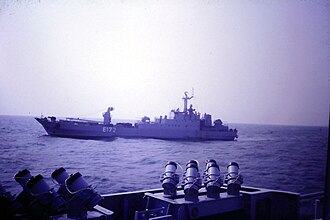
KRI Teluk Sabang (544): History, Design, Specifications, and Role in the Indonesian Navy
KRI Teluk Sabang (544) is an amphibious logistics ship whose history links the naval forces of Cold War East Germany with the modern maritime development of Indonesia. Originally commissioned as Südperd in the East German Volksmarine, the vessel was transferred to Indonesia during the 1990s and became part of the Indonesian Navy’s effort to strengthen its ability to transport troops, military vehicles, and supplies across the archipelago. Unlike a frigate or destroyer, whose primary purpose is surface combat, Teluk Sabang was designed around a different but equally important naval requirement: moving large quantities of equipment and personnel by sea and supporting operations near coastlines.
The ship belongs to the Frosch II class, also identified as Project 109, a development of East Germany’s amphibious landing-ship programme. Its design combined a broad cargo-carrying hull with a bow ramp, cargo-handling equipment, and the ability to transport military vehicles and embarked troops. These features made it useful for logistical deployments and amphibious training, particularly in a country where islands, naval bases, and coastal communities are separated by extensive stretches of water. Teluk Sabang’s story is also a useful illustration of how former Cold War naval equipment found a second life in Southeast Asia after the reunification of Germany.
Origins and Historical Background
Construction as Südperd in East Germany
Before becoming KRI Teluk Sabang, the vessel was known as Südperd and served in the Volksmarine, the navy of the former German Democratic Republic (East Germany). It was constructed at VEB Peenewerft in Wolgast, a shipbuilding centre that produced a range of vessels for East German naval requirements. Its keel was laid on 16 April 1978, it was launched on 30 October 1978, and it entered service on 26 February 1980. The ship was assigned to the Frosch II family, a class of amphibious logistics vessels developed under Project 109. Its original East German pennant numbers included E 36 and E 172, reflecting the identification systems used during different periods of its service.
The Frosch II programme emerged from the East German Navy’s requirement for vessels capable of transporting military supplies, vehicles, and personnel in coastal and regional operations. Amphibious logistics ships were valuable because they could deliver equipment to locations where conventional port facilities might be limited or unavailable. Their mission was not primarily to engage enemy warships, but to sustain other military forces by moving the materials and personnel needed for operations. The design therefore emphasised cargo capacity, practical loading arrangements, and the ability to approach suitable coastal areas. These characteristics distinguished the Frosch II ships from conventional surface combatants and gave them a specialised place in the East German fleet.
The Frosch II Project and Its Design Philosophy
The Frosch II design was an evolution of the earlier Frosch I landing ships. Both families belonged to the same broad tradition of East German amphibious shipbuilding, but the later design incorporated changes intended to improve cargo handling and logistical flexibility. Among its notable features were cargo hatches, a crane, and arrangements for loading and unloading equipment. The design also retained a bow ramp, allowing the ship to support beaching operations and the movement of suitable vehicles between the vessel and a shore location.
The addition of cargo-handling equipment was particularly significant. A landing ship operating in a remote area cannot always depend on a large port crane or specialised unloading infrastructure. An onboard crane provides greater independence when handling supplies, vehicles, or other heavy loads, while cargo hatches improve access to internal storage spaces. These features made Frosch II vessels useful not only for amphibious landings but also for ordinary naval logistics. Their operational value came from their ability to move material between locations where conventional shipping arrangements might be inconvenient.
The End of East German Naval Service
The political transformation of Germany in 1989 and 1990 brought a fundamental change to the future of the Volksmarine. Following German reunification, the East German Navy ceased to exist as an independent service, and many of its vessels were removed from the active fleet. Südperd was struck from the East German naval register on 1 October 1990 and formally decommissioned on 2 October 1990. The unified German Navy did not retain the ship as a regular operational unit, and it was subsequently made available for disposal.
This transition created an opportunity for other countries to acquire former East German naval equipment. For Indonesia, which needed to strengthen its maritime transport and amphibious capabilities, the availability of these vessels offered a potential way to expand the fleet without relying exclusively on the construction of entirely new ships. The transfer of Südperd would eventually give the Indonesian Navy a ship with a useful combination of cargo capacity, vehicle transport facilities, and coastal operating capability.
Acquisition by Indonesia
The 1990s Naval Procurement Programme
Indonesia acquired Südperd as part of a wider programme to purchase former East German naval vessels in the early 1990s. The procurement effort was associated with a government initiative to strengthen the capabilities of the Indonesian Armed Forces, particularly the Navy, through the acquisition of available warships and support vessels. The programme was coordinated under the leadership of B. J. Habibie, who served as Minister of State for Research and Technology and was involved in the procurement team. Presidential Instruction No. 3 of 1992 provided the policy framework for the acquisition of warships for the Indonesian Navy.
The decision to acquire former East German ships reflected Indonesia’s particular geographical and strategic requirements. The country consists of thousands of islands spread across a vast maritime area, making sea transport essential for the movement of military personnel, equipment, and supplies. Amphibious landing ships could help connect naval bases with remote islands and coastal locations, while also providing useful platforms for military exercises and emergency logistics. Purchasing vessels that had already been built and operated by another navy offered a relatively rapid way to increase available transport capacity, although refurbishment and long-term maintenance remained important considerations.
Transfer, Refitting, and Commissioning
The Indonesian Navy formally acquired the former Südperd on 25 August 1993. Before its journey to Indonesia, the ship underwent preparation and refitting in Germany, including work at Rostock. Historical accounts of the transfer describe the vessel as having been demilitarised before delivery, with its original weapons removed and arrangements made for its subsequent configuration under Indonesian ownership. This process was a normal part of transferring a military vessel between different national services, as equipment, weapons, communications systems, and operating requirements could differ between the original and receiving navy.
After the transfer process and preparation for Indonesian service, the vessel was commissioned as KRI Teluk Sabang (544) on 25 April 1995. The commissioning marked its formal entry into the Indonesian Navy and gave it a new identity under the Republic of Indonesia. Its pennant number, 544, distinguished it from other vessels in the fleet, including KRI Teluk Cirebon (543), another Frosch II ship acquired from East Germany. The two ships formed a small group of similar amphibious logistics vessels within the Indonesian naval inventory.
The Meaning Behind the Name Teluk Sabang
The name Teluk Sabang refers to Sabang Bay, associated with the island of Weh at the northwestern end of the Indonesian archipelago. Sabang is a strategically important maritime location near the entrance to the Strait of Malacca, one of the world’s most significant commercial shipping routes. The area has long been associated with maritime movement, navigation, and Indonesia’s position between the Indian Ocean and the waters of Southeast Asia.
Naming a naval vessel after a geographical feature is a longstanding Indonesian Navy tradition. The practice connects individual ships with the country’s islands, bays, coastal regions, and maritime identity. In the case of Teluk Sabang, the name evokes a location that holds particular importance in the geography of Indonesian waters. It also reflects the broader role of the Indonesian Navy in protecting and supporting maritime activities throughout the national territory.
The prefix KRI stands for Kapal Perang Republik Indonesia, meaning Republic of Indonesia warship. Although Teluk Sabang was primarily a logistical and amphibious transport vessel, it carried the KRI designation because it was an officially commissioned naval ship. Its identity therefore combined the name of an Indonesian geographical location with the naval designation and pennant number used to identify it in service.
Design and General Characteristics
Frosch II-Class Amphibious Logistics Ship
KRI Teluk Sabang is classified as a Frosch II-class amphibious logistics ship, built under the East German Project 109 programme. The vessel was designed to transport military cargo and personnel while retaining the ability to operate close to shore. Its broad hull and relatively shallow draught supported the movement of heavy loads, while its cargo-handling arrangements helped it function in locations where shore-based unloading equipment might not be available.
A vessel of this type occupies a different place in a navy from a frigate, corvette, or destroyer. A combat ship is generally designed to detect, track, and engage threats, whereas an amphibious logistics ship is intended to sustain military operations through transport. It can carry the vehicles, equipment, food, fuel, and personnel required by forces operating away from their main bases. This does not mean that the ship is entirely without defensive capability, but its central contribution is logistical rather than offensive.
Hull Dimensions and Displacement
Published specifications commonly give KRI Teluk Sabang a length of approximately 90.7 metres, a beam of 11.1 metres, and a draught of around 2.8 metres. Some technical references distinguish between mean and maximum draught, listing a maximum figure of approximately 3.4 metres. These dimensions reflect the ship’s role as a medium amphibious logistics platform: it needed enough internal volume to accommodate substantial cargo while retaining the ability to approach suitable coastal locations.
Its displacement figures vary according to the source and the loading condition being described. One commonly circulated specification gives a full-load displacement of approximately 1,700 long tons, while another technical reference lists around 1,900 tonnes at full load and 1,750 tonnes standard. Displacement is not a fixed measurement in every operating condition. The weight of fuel, provisions, embarked personnel, vehicles, and cargo can change the vessel’s total displacement, which is why technical summaries sometimes contain different values.
Cargo Decks, Hatches, and Bow Ramp
The cargo arrangement is one of the most important features of the Frosch II design. Unlike a conventional warship, whose internal volume is largely devoted to weapons, sensors, machinery, and accommodation, a landing ship must provide substantial space for transported equipment. Cargo areas and access points are therefore central to its architecture. The Frosch II family incorporated two cargo hatches and a crane, allowing the crew to handle loads in addition to using the vessel’s beaching and ramp arrangements.
The bow ramp was particularly useful for the movement of suitable vehicles. In an amphibious operation, the ability to move equipment directly from a ship to a beach can reduce dependence on conventional port facilities. This capability requires careful consideration of water depth, beach gradient, sea conditions, and the nature of the cargo being transported. Not every shoreline is suitable for a landing ship, and the use of a bow ramp does not mean that the vessel can safely beach under all circumstances. Nevertheless, it gives the ship a degree of operational flexibility that ordinary cargo ships do not necessarily possess.
Onboard Crane and Cargo Handling
One distinguishing feature of the Frosch II family was its onboard crane. Published references describe the ship’s crane with different lifting capacities, commonly around five to eight tonnes depending on the source and configuration being reported. Its presence allowed the vessel to load or unload selected cargo without requiring a shore-based crane for every operation. This was especially useful when delivering supplies to smaller ports, temporary facilities, or locations with limited cargo-handling infrastructure.
A crane is an important part of a logistics ship’s practical capability, but its lifting capacity must be understood in context. The maximum rated load depends on the crane’s configuration, reach, operating angle, and the stability conditions of the ship. Heavy loads must be handled according to established procedures to prevent excessive movement or an unsafe change in the vessel’s centre of gravity. Cargo operations therefore require trained personnel, careful communication, and coordination between the bridge, deck crew, and engineering department.
Propulsion and Performance
Twin Diesel Engines
KRI Teluk Sabang uses a conventional diesel propulsion arrangement with two engines driving two propeller shafts. Diesel machinery was a practical choice for a vessel designed primarily for transport and logistical operations. It offered a familiar propulsion system for naval engineering personnel and was appropriate for the operating speeds and endurance requirements of an amphibious support ship.
Published figures for the ship’s installed power are not entirely consistent. Some references list approximately 4,408 horsepower, while others give a combined output of around 12,000 brake horsepower for the two diesel engines. These figures should not be treated as interchangeable without checking the original technical documentation and the units or measurement basis used. The discrepancy may reflect different records, engine ratings, or the way the power output has been transcribed in secondary sources. For a blog article, it is more accurate to acknowledge the variation than to present one disputed figure as unquestionably definitive.
Maximum Speed and Range
The ship is generally credited with a maximum speed of approximately 18 knots, or about 33 kilometres per hour. This performance was suitable for a medium amphibious logistics vessel, although it was not intended to match the speed of a modern escort ship. Landing vessels are designed around the combined requirements of cargo capacity, stability, endurance, and practical operation near shore. Their performance must therefore be judged according to their mission rather than by comparison with high-speed combatants.
A technical reference for the Frosch II ships lists an endurance figure of approximately 2,450 nautical miles at 14 knots. Endurance is important because an amphibious logistics ship may need to travel between widely separated islands or operate away from its principal base for extended periods. Actual range depends on fuel load, sea conditions, speed, machinery condition, and the weight being carried. A ship’s published maximum range is consequently a planning reference rather than a guarantee of the distance it can achieve on every voyage.
Cargo Capacity and Troop Transport
Transporting Vehicles and Heavy Equipment
KRI Teluk Sabang was designed to carry substantial military cargo, including vehicles and equipment needed for amphibious and logistical operations. Commonly circulated specifications describe a capacity of approximately 400 to 600 tonnes of cargo, while some technical references list a military load of around 650 tonnes. The ship is also frequently associated with the ability to carry up to 11 amphibious tanks, although the actual number of vehicles carried on a particular voyage would depend on their dimensions, weight, arrangement, and the vessel’s approved loading limits.
The capacity to move vehicles by sea is particularly valuable for an archipelagic military. Heavy vehicles are not easily transported by small patrol boats or ordinary landing craft, and moving them over long distances by road may be impossible when the destination is an island. A landing ship can carry equipment from a major base to a suitable coastal destination, helping military units maintain their mobility across the country’s maritime territory. The same basic capability can also support engineering equipment, emergency supplies, and other bulky cargo.
Carrying Marine Corps Personnel
The Frosch II design is commonly described as having the capacity to transport approximately one company of Marines. The precise number of personnel that could be carried depends on the accommodation configuration, the length of the voyage, the quantity of equipment embarked, and the operational conditions. A troop-carrying ship must provide more than simple deck space: embarked personnel need food, drinking water, sanitation, safe accommodation, and arrangements for movement between the ship and shore.
For the Indonesian Navy, this capacity was relevant to the movement and training of Marine Corps units. Amphibious operations require coordination between naval crews and embarked troops, particularly when personnel and vehicles must be transferred to a coastal operating area. The ship’s role is to deliver the force and its equipment, while the Marines conduct the assigned activities ashore. Such operations can range from routine training and transport exercises to larger joint manoeuvres involving multiple ships and military units.
Armament and Defensive Systems
Naval Gun Configuration
Although KRI Teluk Sabang was primarily a transport and logistics vessel, it was fitted with naval guns for local defensive purposes. Commonly published Indonesian-service specifications list two twin V-11 37 mm gun mounts and two twin 2M-3 25 mm gun mounts. These weapons provided close-range defensive firepower and were consistent with the relatively modest combat requirements of a ship whose primary mission was to transport cargo and personnel.
The vessel’s weapons should not be confused with the armament of a modern frontline combatant. A frigate or destroyer may carry sophisticated missiles, advanced fire-control systems, and specialised sensors for air defence or anti-submarine warfare. An amphibious logistics ship, by contrast, generally relies on its own limited defensive equipment and the protection provided by other vessels when operating in a potentially hostile environment. Its weapons are intended to contribute to local security rather than establish control of an entire maritime battlespace.
It is also important to distinguish the ship’s Indonesian configuration from its original East German armament. Historical references describe Südperd as having been equipped with twin 57 mm AK-725 guns and twin 25 mm 2M-3 weapons during its East German service. The ship was demilitarised during the transfer process, and its later Indonesian weapons fit differed from that original arrangement. This change illustrates how a vessel’s configuration can evolve when it moves between navies.
Radar and Navigation Equipment
Published technical summaries associate the Frosch II design with the TSR-333 navigation radar and the MR-302 Rubka or Strut Curve air and surface search radar. These systems supported the ship’s ability to navigate safely and maintain awareness of surrounding maritime activity. Navigation radar is particularly important for a large vessel operating in coastal waters, where it may encounter fishing boats, merchant ships, small craft, land features, and navigational hazards.
The MR-302 search radar provided a broader picture of contacts around the vessel. On a logistics ship, radar contributes to safe navigation and general situational awareness, even though it does not provide the advanced multi-target combat capabilities expected of modern fleet air-defence systems. The performance and reliability of any radar depend on equipment condition, maintenance, calibration, and the skill of the operators.
Electronic Countermeasures
The Frosch II class is also commonly listed with two PK-16 chaff launchers. Chaff is a radar countermeasure consisting of small metallic elements released into the air to create radar reflections that may confuse or distract certain radar-guided threats. Its purpose is defensive, helping a ship complicate an attacker’s ability to maintain a reliable radar track.
The presence of chaff launchers reflects the military origins of the design, but it should not be taken as evidence that the ship possessed the full defensive capabilities of a modern combat vessel. Electronic countermeasures are only one element of a wider defensive system, and their effectiveness depends on the threat, the ship’s sensors, crew training, and coordination with other naval units. For Teluk Sabang, these systems complemented its transport role rather than defining it.
Operational Role in the Indonesian Navy
Amphibious Logistics and Military Transport
KRI Teluk Sabang’s most important contribution was its ability to transport cargo, vehicles, and personnel. The Indonesian Navy operates across a large and geographically complex maritime area, where military units may need to be supplied or moved between islands. A medium landing ship can provide a practical means of carrying equipment that would be difficult to transport using smaller vessels. It can also support the movement of supplies to naval facilities and locations where port infrastructure is limited.
Amphibious logistics is an essential part of military planning because forces operating ashore depend on a continuing flow of supplies. Vehicles require fuel and maintenance, personnel need food and water, and units depend on communications equipment, spare parts, and other materials. A landing ship can move these items in useful quantities and help sustain operations beyond the immediate area of a major naval base. Its contribution may not be as visible as that of a missile-armed combat ship, but logistics is fundamental to the ability of a military force to operate effectively.
Support for Marine Corps Exercises
The ship’s ability to carry troops and amphibious vehicles made it suitable for training activities involving the Indonesian Marine Corps. Amphibious exercises test the coordination required to transport personnel from a ship to a shore-based operating area. They may include embarkation, cargo preparation, navigation, communications, landing procedures, and the movement of vehicles after they reach land.
Such exercises help crews and embarked units become familiar with the practical challenges of amphibious operations. A ship must approach the operating area under suitable conditions, maintain communication with the force ashore, and ensure that personnel and cargo are moved safely. Even routine exercises can involve complex planning because the ship’s stability, loading arrangement, weather, sea state, and shoreline characteristics all affect the operation.
Humanitarian and Disaster-Relief Potential
The same characteristics that make an amphibious logistics ship useful for military operations can also make it valuable during natural disasters. Indonesia is exposed to earthquakes, volcanic activity, tsunamis, floods, and other emergencies that can disrupt transport infrastructure. When roads and airports are damaged or when isolated communities cannot be reached by land, naval vessels may provide an alternative route for delivering assistance.
A landing ship with substantial cargo capacity can transport food, drinking water, medical supplies, temporary shelter materials, and engineering equipment. Its ability to operate near suitable coastal locations can be particularly useful when conventional port facilities are unavailable. Although individual missions depend on the ship’s operational status and the requirements of the emergency, the Frosch II design offers the kind of transport flexibility that can support both military and humanitarian activities.
KRI Teluk Sabang and the Indonesian Frosch II Fleet
Relationship with KRI Teluk Cirebon
KRI Teluk Sabang (544) was not the only Frosch II vessel acquired by Indonesia. Its sister ship, KRI Teluk Cirebon (543), was also built by VEB Peenewerft and originally served the East German Volksmarine as Nordperd. Both vessels were transferred to Indonesia in the 1990s and commissioned on 25 April 1995. Their shared design gave the Indonesian Navy two ships with similar cargo-handling and amphibious logistics capabilities.
Operating two ships of a common design can offer practical advantages. Crew training, technical documentation, maintenance procedures, and spare-parts planning may be easier to organise when vessels share major systems and equipment. However, common design does not eliminate the challenges of ageing machinery or the need to maintain individual ships according to their actual condition. The availability of a sister ship can support operational planning, but each vessel still requires its own inspection and maintenance programme.
Differences Between Frosch I and Frosch II
The Frosch I and Frosch II ships were related designs, but they were not identical. The earlier Frosch I family was developed under Project 108, while the later Frosch II family was associated with Project 109. Both were intended to provide amphibious transport and logistical support, but the Frosch II design included changes to cargo handling and internal arrangements. Its crane and cargo hatches were important features that distinguished it from the earlier design.
For the Indonesian Navy, these differences meant that the two families could contribute similar but not completely identical capabilities. The Frosch I ships provided transport and landing capacity, while the Frosch II vessels added a different arrangement for handling cargo. Understanding the distinction is important when comparing technical specifications, because figures associated with one class should not automatically be applied to the other.
Service Life, Maintenance, and Current Status
The Challenges of Operating an Older Ship
KRI Teluk Sabang was originally commissioned in East Germany in 1980 and entered Indonesian service in 1995. Its long service history illustrates the potential value of extending the operational life of an existing vessel through transfer, refurbishment, and continued maintenance. At the same time, an older ship requires careful attention to structural condition, machinery reliability, corrosion protection, electrical systems, and the availability of replacement components.
The operating environment can influence the rate at which a ship ages. Vessels serving in tropical waters may experience high temperatures, humidity, salt exposure, and conditions that accelerate corrosion if protective coatings and maintenance are not properly managed. Machinery also experiences wear through regular operation, while equipment can become difficult to support when original manufacturers no longer produce spare parts. These challenges are not unique to Teluk Sabang; they are common to older naval vessels around the world.
Importance of Regular Inspection and Modernisation
Maintaining an amphibious logistics ship involves more than keeping its engines running. The hull must remain structurally sound, cargo spaces must be safe, loading equipment must function correctly, and navigation and communications systems must be reliable. The bow ramp, crane, and cargo-handling arrangements require particular attention because they are central to the vessel’s primary mission. Any failure in these systems could affect the ship’s ability to transport or unload its cargo safely.
Modernisation can help extend a vessel’s usefulness, but upgrades must be balanced against the age and condition of the underlying platform. Replacing radar equipment, improving communications, refurbishing machinery, or upgrading safety systems may improve performance, yet these measures cannot indefinitely compensate for structural deterioration. A navy must therefore evaluate whether continued maintenance remains worthwhile compared with the cost and capability of acquiring a replacement ship.
Is KRI Teluk Sabang Still in Service?
Some published fleet references and historical ship listings have described KRI Teluk Sabang as active, including sources that reported its status in 2019 and later reproduced that information. However, an old status entry does not by itself confirm a ship’s operational condition in 2026. Publicly available information does not always provide a current, independently verified account of a vessel’s readiness, deployment schedule, or formal decommissioning status. For that reason, its present operational condition should be checked against the latest official Indonesian Navy announcements before being described as definitively active or retired.
This distinction matters when writing about naval vessels. A ship may remain on a fleet list while undergoing maintenance, be temporarily unavailable for operational duties, or have a status that has changed without extensive public reporting. It is therefore more responsible to distinguish between a documented commissioning date and a current service claim that may require fresh confirmation.
Strategic Importance for Indonesia
Supporting an Archipelagic Navy
Indonesia’s geography creates a persistent requirement for maritime transport. The country stretches across a wide area of Southeast Asia and the surrounding oceans, with communities and military facilities distributed among thousands of islands. In this environment, naval logistics is a central part of national defence. Ships must be able to transport personnel, equipment, and supplies between locations that may not have direct road or rail connections.
KRI Teluk Sabang represented one part of the Indonesian Navy’s effort to meet that requirement. Its cargo capacity and amphibious features gave it the ability to support transport operations beyond the capabilities of smaller patrol craft. Although it was not a large strategic sealift vessel, it could provide useful capacity for moving vehicles, supplies, and troops. The ship’s design was therefore relevant to the practical needs of an archipelagic navy.
The Importance of Logistics in Naval Operations
Naval power is often associated with combat ships, missiles, submarines, and advanced sensors. However, a fleet cannot operate effectively without a reliable logistical foundation. Warships need fuel, food, spare parts, ammunition, and technical support, while troops and vehicles require transport to reach their assigned locations. Amphibious logistics ships help connect these requirements by moving material from established bases to forward areas.
This role becomes particularly important during prolonged deployments. A force may have capable combat ships and well-trained personnel, but its effectiveness can decline if it cannot receive supplies or move equipment where it is needed. Landing ships such as Teluk Sabang help address this challenge by providing a dedicated platform for military transport. Their contribution is often measured not by weapons carried but by the cargo and personnel they can deliver.
Legacy of KRI Teluk Sabang (544)
KRI Teluk Sabang’s history reflects the changing international naval environment after the Cold War. Built for East Germany as Südperd, it became available for transfer following the dissolution of the Volksmarine and was subsequently acquired by Indonesia as part of a wider naval procurement programme. Its commissioning in April 1995 introduced a former East German Frosch II vessel into the Indonesian fleet, where its transport and amphibious logistics capabilities served a practical purpose.
The ship also demonstrates why support vessels deserve attention in naval history. Their missions may receive less public attention than missile launches or major combat exercises, yet their ability to carry vehicles, supplies, and personnel is essential to the operation of a modern military. In a country with Indonesia’s maritime geography, a landing ship can provide a valuable connection between naval bases, islands, and coastal operating areas.
As an example of East German shipbuilding and Indonesian naval procurement, Teluk Sabang occupies an interesting position in the history of Southeast Asian naval forces. Its Frosch II design combined a vehicle-carrying platform, cargo-handling equipment, and a bow ramp, creating a vessel intended for practical amphibious support. Whether considered as a Cold War-era design or as part of Indonesia’s post-Cold War fleet development, KRI Teluk Sabang remains a noteworthy example of the importance of naval logistics.
Technical Specifications of KRI Teluk Sabang (544)
The following table summarises commonly published specifications for KRI Teluk Sabang and the Frosch II / Project 109 design. Some figures differ between reference works, particularly displacement, propulsion power, cargo capacity, crane rating, and crew complement. These variations may reflect different loading conditions, equipment configurations, measurement conventions, or secondary-source transcription. The figures should therefore be treated as approximate reference values rather than a verified record of the ship’s exact configuration at every stage of its service.
| Specification | Details |
|---|---|
| Ship name | KRI Teluk Sabang |
| Pennant number | 544 |
| Former name | Südperd |
| Former navy | East German Volksmarine |
| Country of service | Indonesia |
| Ship type | Amphibious logistics / landing ship |
| Class | Frosch II |
| Design project | Project 109 |
| Builder | VEB Peenewerft, Wolgast, East Germany |
| Yard number | 343 |
| Keel laid | 16 April 1978 |
| Launched | 30 October 1978 |
| Commissioned in East Germany | 26 February 1980 |
| Decommissioned in East Germany | 2 October 1990 |
| Acquired by Indonesia | 25 August 1993 |
| Commissioned in Indonesia | 25 April 1995 |
| Standard displacement | Approximately 1,750 tonnes |
| Full-load displacement | Approximately 1,700–1,900 tonnes, depending on source |
| Length | 90.7 metres |
| Beam | 11.1 metres |
| Draught | Approximately 2.8 metres mean; up to 3.4 metres in some references |
| Propulsion | Two diesel engines |
| Propeller arrangement | Two shafts |
| Published power figures | Approximately 4,408 hp in some summaries; 12,000 bhp in others |
| Maximum speed | Approximately 18 knots |
| Published endurance | Approximately 2,450 nautical miles at 14 knots |
| Cargo capacity | Approximately 400–650 tonnes, depending on source |
| Vehicle capacity | Commonly listed as up to 11 amphibious tanks |
| Troop capacity | Approximately one Marine company |
| Crew complement | Commonly listed as approximately 46 |
| Cargo-handling equipment | Onboard crane; published lifting ratings vary around 5–8 tonnes |
| Bow arrangement | Bow ramp for suitable landing and vehicle-transfer operations |
| Cargo access | Two cargo hatches, according to class descriptions |
| Indonesian-service armament | Two twin V-11 37 mm mounts and two twin 2M-3 25 mm mounts, in commonly published summaries |
| Original East German armament | Reported as twin AK-725 57 mm and twin 2M-3 25 mm mounts |
| Navigation radar | TSR-333 |
| Air/surface search radar | MR-302 Rubka / Strut Curve |
| Electronic countermeasures | Two PK-16 chaff launchers |
| Primary roles | Amphibious logistics, vehicle transport, cargo delivery, troop transport, naval support |
Conclusion
KRI Teluk Sabang (544) is a significant example of the Indonesian Navy’s use of former East German amphibious ships to expand its logistical and transport capabilities. Originally built as Südperd for the Volksmarine, the vessel was acquired by Indonesia in 1993 and commissioned into the Indonesian Navy on 25 April 1995. Its Frosch II design provided a combination of cargo capacity, vehicle transport facilities, a bow ramp, and onboard cargo-handling equipment, making it suitable for the movement of military supplies and personnel across Indonesia’s extensive maritime territory.
Although its weapons and radar systems provided a degree of local defensive capability, Teluk Sabang’s main importance lay in its logistical role. It was designed to help move the materials and personnel that sustain military operations, rather than to serve as a frontline missile-armed combatant. Its history also illustrates the opportunities and challenges involved in acquiring older foreign-built vessels: a second-hand ship can add valuable capability to a fleet, but long-term usefulness depends on maintenance, spare-parts support, and the condition of the hull and machinery.
From its origins in East Germany to its service under the Indonesian flag, KRI Teluk Sabang represents an important chapter in the development of Indonesia’s amphibious transport fleet. It highlights the essential relationship between naval logistics and maritime security, demonstrating that a navy’s effectiveness depends not only on its combat ships but also on the vessels capable of carrying the people, equipment, and supplies that keep its operations moving.
