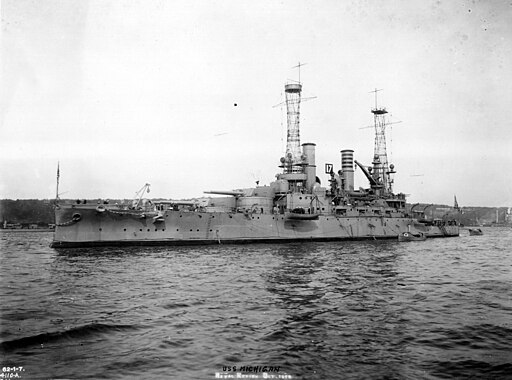
USS Michigan (BB-27)
Commissioned in 1910, the USS Michigan (BB-27) was a South Carolina-class battleship that contributed to the naval strength of the United States during the early 20th century. With an overall length of 452 feet and a displacement exceeding 16,000 tons, the USS Michigan featured a robust design that showcased the evolution of battleship technology. Armed with eight 12-inch guns in four twin turrets and a secondary battery of twenty-two 3-inch guns, the USS Michigan exemplified the firepower and versatility essential for naval operations.
While it primarily served in the Atlantic during World War I as part of the Allied blockade, the USS Michigan later became a training ship, contributing to the development of naval personnel. The battleship’s service history represents a pivotal era in naval warfare, leaving an enduring mark on the legacy of the United States Navy.
armament of USS Michigan (BB-27)
The USS Michigan (BB-27), a South Carolina-class battleship commissioned in 1910, was armed with a formidable array of weaponry. Here is a list of the main and secondary armament of the USS Michigan:
Main Battery:
- Eight 12-inch/45 caliber guns
- Mounted in four twin turrets (two forward and two aft)
Secondary Battery: 2. Twenty-two 3-inch/50 caliber guns
- Placed in casemates along the sides of the ship
Anti-Aircraft Battery (as upgraded during World War II): 3. Four 3-inch/50 caliber guns
- Initially part of the ship’s anti-aircraft defense.
- Eight 1.1-inch/75 caliber anti-aircraft guns
- Added during World War II to enhance the ship’s anti-aircraft capabilities.
- Eight .50 caliber machine guns
- Deployed for anti-aircraft defense.
The USS Michigan underwent various modifications and upgrades to its armament during its service, adapting to the changing requirements of naval warfare. The battleship’s armament showcased its versatility in engaging both surface and aerial threats.
Parameters of USS Michigan (BB-27)
Commissioned in 1910, the USS Michigan (BB-27), a South Carolina-class battleship, possessed parameters that reflected its design for naval strength during the early 20th century. With an overall length of 452 feet, a beam (width) of 80 feet, and a draft (maximum depth submerged) of 24 feet, the USS Michigan had a displacement exceeding 16,000 tons. These dimensions provided the battleship with stability and seafaring capabilities essential for its diverse roles. Armed with eight 12-inch guns in four twin turrets and a secondary battery of twenty-two 3-inch guns, the USS Michigan showcased a balanced design that allowed it to engage both surface and aerial threats effectively.
The parameters of the USS Michigan were not merely indicative of its physical size but were integral to its operational capabilities. The battleship’s length and breadth allowed for the deployment of its powerful armament, and its draft facilitated navigation in various maritime environments. The USS Michigan participated in World War I as part of the Allied blockade and later served as a training ship. Its parameters reflected the naval technology and strategic considerations of its time, contributing to the evolving maritime strength of the United States.
