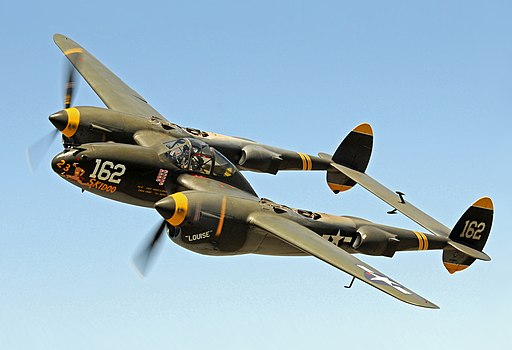
Lockheed P-38 Lightning
The Lockheed P-38 Lightning is a legendary twin-engine fighter aircraft that played a pivotal role during World War II. Designed by Clarence “Kelly” Johnson and his team at Lockheed’s Skunk Works, the P-38 was distinctive for its twin-boom design, central nacelle, and a unique twin-tail configuration. The aircraft’s standout feature was its ability to house a heavy armament package, including a nose-mounted 20mm Hispano M2 cannon and four .50 caliber Browning M2 machine guns. This armament, combined with the P-38’s excellent speed and range, made it a formidable adversary in both air-to-air combat and ground-attack missions.
One of the P-38’s most notable attributes was its versatility. Serving in various roles, the P-38 operated as a long-range escort fighter, a reconnaissance aircraft, and a ground-attack platform. Its long-range capabilities were crucial for escorting bombers deep into enemy territory, and its twin-engine design provided redundancy, enhancing its survivability. The P-38 also gained fame with America’s top-scoring ace of World War II, Richard Bong, who credited the aircraft’s performance for many of his victories. The Lockheed P-38 Lightning remains an iconic symbol of American aviation history, celebrated for its innovative design and significant contributions during the war.
parameters – Lockheed P-38 Lightning
The Lockheed P-38 Lightning was a versatile and distinctive twin-engine fighter aircraft with a range of specifications. Here are some key parameters of the P-38:
- Crew: One or two pilots
- Length: 37 feet 10 inches (11.53 meters)
- Wingspan: 52 feet (15.85 meters)
- Height: 9 feet 9 inches (2.97 meters)
- Empty Weight: Approximately 12,780 pounds (5,796 kilograms)
- Loaded Weight: Approximately 17,500 pounds (7,938 kilograms)
- Maximum Takeoff Weight: 21,600 pounds (9,798 kilograms)
- Engines: Twin Allison V-1710 liquid-cooled V-12 engines
- Maximum Speed: Approximately 414 miles per hour (666 kilometers per hour)
- Range: Approximately 1,300 miles (2,092 kilometers)
- Service Ceiling: 44,000 feet (13,411 meters)
- Rate of Climb: 3,750 feet per minute (19.05 meters per second)
- Armament: One 20mm Hispano M2 cannon, four .50 caliber Browning M2 machine guns
- Hardpoints: Could carry bombs or rockets underwing for ground attack missions
- First Flight: January 27, 1939
- Entered Service: 1941
These parameters underscore the P-38’s design and capabilities, showcasing its role as a long-range escort, reconnaissance aircraft, and effective fighter during World War II. The distinctive twin-boom layout and twin-engine configuration contributed to the P-38’s success and made it one of the iconic aircraft of its era.
Armament of the Lockheed P-38 Lightning
The Lockheed P-38 Lightning boasted a formidable armament package that contributed to its effectiveness in various roles during World War II. The primary armament of the P-38 included one 20mm Hispano M2 cannon mounted in the nose, complemented by four .50 caliber Browning M2 machine guns arranged in pairs in the central nacelle. The combination of a powerful cannon and multiple machine guns provided the P-38 with a potent punch in air-to-air combat scenarios. The nose-mounted cannon allowed for accurate targeting, while the machine guns provided sustained firepower.
This armament setup made the P-38 a formidable adversary against enemy aircraft and earned it a reputation for its lethality in dogfights. Additionally, the P-38 could be equipped with external stores, such as bombs or rockets, under its wings, enhancing its versatility and enabling it to undertake ground-attack missions. The Lockheed P-38 Lightning’s robust armament, combined with its speed, range, and twin-engine design, solidified its place as a versatile and effective aircraft in the theater of World War II.
