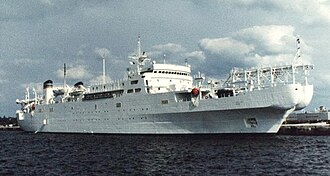
The modern world is built on invisible infrastructure. Beneath the oceans, far from sight and often from public awareness, lies a vast network of cables that carries military communications, scientific data, and global information flows. Maintaining this hidden backbone requires a highly specialized vessel—one that blends precision engineering, oceanography, and naval logistics. Among such ships, few are as unique or as technologically refined as the USNS Zeus (T-ARC-7).
Unlike aircraft carriers or destroyers that dominate headlines, USNS Zeus operates in relative obscurity. Yet its role is critical: it installs, repairs, surveys, and supports undersea cable systems that form the backbone of strategic naval operations. As the only active cable-laying and repair ship in the U.S. Navy, Zeus represents a rare convergence of maritime engineering, deep-sea technology, and mission-specific design.
This article explores the ship in depth—its history, engineering, mission systems, operational philosophy, and long-term strategic importance—before concluding with a detailed technical specification table.
Origins and Strategic Context
The Need for a Dedicated Cable Ship
During the Cold War, the United States Navy increasingly relied on undersea surveillance systems such as the Sound Surveillance System (SOSUS), later renamed the Integrated Undersea Surveillance System (IUSS). These networks depended on thousands of miles of submarine cables linking hydrophone arrays across the ocean floor. Maintaining such infrastructure required more than adapted commercial vessels—it demanded a purpose-built platform.
That need led to the creation of USNS Zeus, the first cable ship designed from the keel up specifically for the U.S. Navy. Unlike earlier converted ships, Zeus was engineered to integrate cable handling, propulsion control, and oceanographic instrumentation into a single cohesive system.
Originally, the Navy planned a class of two ships, but only one was ultimately constructed, making Zeus a unique, one-of-a-kind vessel.
Construction and Entry into Service
USNS Zeus was built by the National Steel and Shipbuilding Company in San Diego, California. The keel was laid in 1981, the ship launched in 1982, and it entered service in March 1984.
From the outset, Zeus was assigned to the Military Sealift Command (MSC), a branch of the U.S. Navy responsible for operating auxiliary and support vessels. Unlike commissioned warships, MSC ships are crewed primarily by civilian mariners, with a smaller contingent of Navy personnel and technical specialists.
This hybrid crew structure reflects the ship’s technical and logistical mission rather than combat operations.
Design Philosophy: Precision Over Power
A Ship Built for Stability and Control
At first glance, Zeus resembles a conventional auxiliary vessel. However, its design is optimized not for speed or combat survivability but for precision maneuvering and stability—essential qualities for cable-laying operations.
The ship employs a diesel-electric propulsion system with twin shafts and integrated bow and stern thrusters. This configuration allows extremely fine control over position and movement, enabling the vessel to maintain a steady course even in challenging sea conditions.
Unlike traditional propulsion setups, where engines directly drive propellers, Zeus uses diesel generators to produce electricity that powers propulsion motors. This arrangement provides smoother control and allows for dynamic positioning, which is critical when laying cable on the seabed.
Integrated Control Systems
One of the defining features of Zeus is its integrated control architecture. The propulsion system, thrusters, and cable-handling equipment are all coordinated through centralized systems that allow operators to maintain precise track-keeping.
This level of integration ensures that the ship can follow exact paths during cable deployment—often within meters of the planned route—despite currents, wind, and wave action.
Such precision is essential because even minor deviations can affect cable tension, alignment, and long-term reliability.
Cable Handling Systems: The Heart of Zeus
Cable Storage and Deployment
At the core of Zeus’s mission capability are its extensive cable-handling systems. The ship is equipped with five large cable tanks capable of storing vast lengths of submarine cable.
These cables are fed through a series of transporters, tension machines, and overboarding sheaves that carefully control how the cable is deployed into the ocean.
The system must maintain precise tension at all times. Too much tension could snap the cable; too little could result in tangling or improper placement on the seabed.
Deployment Capabilities
Zeus can lay up to 1,000 miles (approximately 1,600 kilometers) of cable in a single deployment and operate at depths of up to 9,000 feet (2,700 meters) without resupply.
This capability allows the ship to undertake extended missions in remote ocean regions, supporting both military and scientific operations.
Specialized Equipment
The cable-handling suite includes:
- Cable tension machines for controlled deployment
- Self-fleeting drums for even cable distribution
- Dynamometer fairleaders for tension monitoring
- Overboarding sheaves for safe cable entry into the water
These systems work together to ensure smooth, continuous cable operations under varying environmental conditions.
Oceanographic and Survey Capabilities
Sonar Systems
Beyond cable operations, Zeus is equipped with advanced sonar systems, including the SIMRAD EM 121 multibeam sonar.
These systems enable detailed mapping of the ocean floor, which is essential for selecting optimal cable routes and avoiding hazards such as underwater ridges, trenches, or debris fields.
Environmental Monitoring
Zeus also deploys a range of instruments to measure ocean conditions:
- Temperature and salinity sensors
- Acoustic measurement buoys
- Environmental monitoring systems
These data help engineers understand how environmental factors may affect cable performance and longevity.
Remotely Operated Vehicles (ROVs)
The ship can deploy remotely operated vehicles (ROVs) and other subsea systems for inspection, repair, and installation tasks.
These vehicles allow operators to perform precise work on the seabed without requiring human divers, especially at depths beyond safe diving limits.
Mission Profile and Operational Role
Supporting Undersea Surveillance
The primary mission of USNS Zeus has historically been to support undersea surveillance networks. These systems provide early warning of submarine activity and are a critical component of naval defense strategy.
Zeus installs, maintains, and repairs the cables that connect these sensor arrays, ensuring their continuous operation.
Secondary Missions
In addition to its primary role, Zeus performs:
- Oceanographic surveys
- Acoustic research
- Hydrographic mapping
- Testing of underwater systems
These secondary missions highlight the ship’s versatility and its importance beyond purely military applications.
Global Operations
With an endurance of approximately 10,000 nautical miles, Zeus can operate globally without frequent resupply.
The ship does not have a fixed homeport and is deployed as needed, reflecting its strategic importance and specialized capabilities.
Crew and Life Onboard
Civilian-Military Hybrid Crew
USNS Zeus is operated by a mixed crew:
- Civilian mariners (MSC personnel)
- U.S. Navy personnel
- Scientists and technical specialists
This structure allows the ship to combine maritime expertise with specialized technical knowledge.
Life at Sea
Life aboard Zeus differs significantly from that on combat vessels. Missions are often long and technically demanding, requiring constant monitoring of equipment and environmental conditions.
Crew members must coordinate closely across disciplines, from navigation and engineering to cable operations and scientific analysis.
Engineering and Propulsion
Diesel-Electric Power System
The ship’s propulsion system consists of multiple diesel generators that power electric motors driving twin propellers.
This setup offers several advantages:
- Smooth and precise speed control
- Reduced mechanical complexity
- Improved fuel efficiency
Thrusters and Maneuverability
Zeus is equipped with both bow and stern thrusters, allowing it to maintain position and orientation with exceptional accuracy.
This capability is crucial during cable-laying operations, where even slight deviations can compromise the mission.
Stability Systems
The ship incorporates passive stabilization features to reduce roll and provide a stable working platform. (globalsecurity.org)
This stability is essential for safe and effective cable handling, particularly in rough seas.
Strategic Importance in the Modern Era
The Invisible Infrastructure War
In today’s interconnected world, undersea cables are more important than ever. They carry not only military data but also global communications and internet traffic.
Protecting and maintaining this infrastructure is a matter of national security.
Role in Future Naval Strategy
As geopolitical competition extends into the undersea domain, ships like Zeus are becoming increasingly valuable. They provide the capability to:
- Repair damaged infrastructure
- Deploy new surveillance systems
- Support emerging technologies
Replacement Plans
Recognizing the importance of this capability, the U.S. Navy has explored plans for a replacement vessel, often referred to as T-ARC(X). (Wikipedia)
This future ship is expected to incorporate modern technologies such as advanced sonar systems and improved cable-handling equipment.
A Unique Vessel in Naval History
USNS Zeus stands alone—not just as the only ship of its class, but as a symbol of a specialized and often overlooked aspect of naval operations.
It is not designed for combat, yet it plays a critical role in enabling the systems that underpin modern naval warfare.
Its combination of precision engineering, advanced technology, and mission-specific design makes it one of the most unique vessels in the U.S. Navy fleet.
Technical Specifications of USNS Zeus (T-ARC-7)
| Parameter | Specification |
|---|---|
| Ship Name | USNS Zeus (T-ARC-7) |
| Type | Cable Repair / Cable Laying Ship |
| Operator | Military Sealift Command |
| Builder | National Steel and Shipbuilding Company |
| Year Completed | 1984 |
| Length | 513 ft (156.5 m) |
| Beam | 73 ft (22.3 m) |
| Draft | ~26 ft (7.9 m) |
| Displacement | ~14,300–15,700 tons (full load) |
| Propulsion | Diesel-electric, twin shaft |
| Power Output | ~10,200 shp |
| Speed | 15 knots |
| Range / Endurance | ~10,000 nautical miles |
| Crew | ~51 civilian + Navy personnel + scientists |
| Cable Capacity | Up to 1,000 miles |
| Max Cable Depth | Up to 9,000 ft |
| Sonar Systems | Single-beam & multibeam (SIMRAD EM 121) |
| Special Equipment | Cable tanks, tension machines, ROV deployment systems |
| Armament | None |
Final Thoughts
USNS Zeus is not a ship that captures public imagination in the way aircraft carriers or submarines do. Yet its importance cannot be overstated. It operates in the shadows—quietly maintaining the infrastructure that enables global communication and undersea surveillance.
