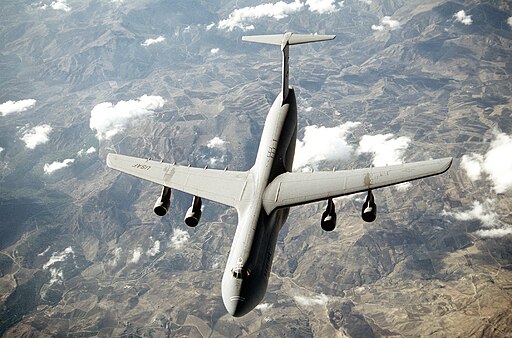
Lockheed C-5 Galaxy
The Lockheed C-5 Galaxy stands as a colossal symbol of strategic airlift capability within the United States Air Force’s fleet. Introduced in 1970, this massive military transport aircraft was designed to meet the demands of transporting oversized and heavy cargo, including tanks, helicopters, and other military equipment. With its distinctive high-wing design, the C-5 Galaxy features a massive payload capacity of up to 270,000 pounds, making it one of the largest military aircraft globally.
Powered by four General Electric turbofan engines, each providing around 43,000 pounds of thrust, the C-5 is capable of reaching speeds of approximately 518 miles per hour and covering impressive distances, making it an indispensable asset for global airlift missions. Beyond its sheer size and power, the C-5 Galaxy’s ability to carry diverse and oversized loads has contributed significantly to U.S. military operations, disaster relief efforts, and humanitarian missions, solidifying its role as a critical component of the nation’s strategic airlift capability.
Lockheed C-5 Galaxy parameters
The Lockheed C-5 Galaxy is a massive military transport aircraft known for its ability to carry oversized and heavy cargo. Here are some key parameters of the C-5 Galaxy:
- Crew: Minimum of 8 (pilot, co-pilot, two flight engineers, three loadmasters, and one navigator)
- Length: 247 feet 1 inch (75.31 meters)
- Wingspan: 222 feet 9 inches (67.89 meters)
- Height: 65 feet 1 inch (19.84 meters)
- Empty Weight: Approximately 380,000 pounds (172,365 kilograms)
- Max Takeoff Weight: Approximately 840,000 pounds (381,018 kilograms)
- Payload Capacity: Up to 270,000 pounds (122,470 kilograms)
- Maximum Speed: Approximately 518 miles per hour (834 kilometers per hour)
- Range: Approximately 5,524 miles (8,890 kilometers) with a payload
- Service Ceiling: 34,000 feet (10,363 meters)
- Cruise Speed: Approximately 518 miles per hour (834 kilometers per hour)
- Engines: Four General Electric TF39-GE-1C turbofan engines
- Thrust: Approximately 43,000 pounds of thrust per engine
- First Flight: June 30, 1968
- Entered Service: June 1970
These parameters highlight the immense size and capabilities of the Lockheed C-5 Galaxy, making it one of the largest and most powerful military transport aircraft in the world. The C-5’s ability to carry oversized cargo, including tanks and helicopters, makes it a crucial asset for the United States Air Force in strategic airlift missions.
History of the Lockheed C-5 Galaxy
The Lockheed C-5 Galaxy stands as one of the largest military transport aircraft in the world and has played a crucial role in strategic airlift operations for the United States. Developed by Lockheed’s Georgia-based Skunk Works division, the C-5 Galaxy was conceived in the 1960s to meet the U.S. military’s need for a high-capacity, long-range transport aircraft capable of carrying oversized and heavy cargo. The prototype made its maiden flight in June 1968, and the first operational C-5A Galaxy entered service with the United States Air Force (USAF) in 1970.
Throughout its history, the C-5 Galaxy has undergone various upgrades and modifications to enhance its performance and address operational challenges. The aircraft has been involved in a wide range of military missions, including transporting troops, vehicles, and oversized equipment to support global deployments and humanitarian efforts. The C-5 has been a critical asset in transporting large payloads for military operations, disaster relief, and peacekeeping missions. Despite facing some technical and reliability issues early in its service life, ongoing modernization efforts have extended the C-5’s operational lifespan, ensuring its continued service as a vital component of the U.S. military’s strategic airlift capability.
