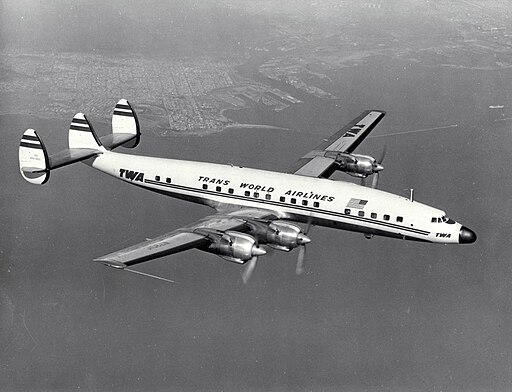
Lockheed L-1649 Starliner
The Lockheed L-1649 Starliner, introduced in the late 1950s, stands as the epitome of luxury and sophistication in the era of piston-engine airliners. A development of the successful L-1049 Super Constellation, the Starliner was designed to offer unparalleled comfort and speed for transatlantic flights. With its distinctive triple-tail design and elongated fuselage, the L-1649 exuded elegance and boasted advanced features, including more powerful engines and improved aerodynamics. The Starliner could accommodate up to 92 passengers in a spacious and lavishly appointed cabin, setting a new standard for luxury air travel.
Despite its aesthetic and technological achievements, the L-1649 Starliner faced challenges in the wake of the growing popularity of jet-powered aircraft. The arrival of faster and more fuel-efficient jetliners overshadowed the Starliner’s capabilities, leading to a limited production run. However, the aircraft’s legacy endures as a symbol of the golden age of piston-engine airliners, celebrated for its graceful design, sumptuous interiors, and contribution to the evolution of long-range commercial air travel. A few well-preserved L-1649s remain as cherished artifacts, providing a glimpse into the bygone era of glamorous air transportation.
Lockheed L-1649 Starliner parameters
The Lockheed L-1649 Starliner, an enhanced version of the L-1049 Super Constellation, was a long-range piston-engine airliner. Here are some key parameters for the L-1649:
- Crew: 5-6 (flight crew and cabin crew)
- Passenger Capacity: Typically configured for 92 passengers in a high-density arrangement
- Length: 116 feet 2 inches (35.42 meters)
- Wingspan: 123 feet (37.49 meters)
- Height: 24 feet 9 inches (7.54 meters)
- Empty Weight: Approximately 67,000 pounds (30,391 kilograms)
- Max Takeoff Weight: Approximately 134,000 pounds (60,781 kilograms)
- Engines: Four Wright R-3350-DA3 Turbo Compound radial engines
- Cruise Speed: Approximately 322 miles per hour (518 kilometers per hour)
- Range: Approximately 4,200 miles (6,759 kilometers)
- Service Ceiling: 24,000 feet (7,315 meters)
- First Flight: October 10, 1956
- Entered Service: February 1, 1957
- Number Built: 44 aircraft (including all variants)
These parameters highlight the Lockheed L-1649 Starliner‘s design as a long-range, piston-engine airliner, emphasizing its capacity, range, and elegance. The Starliner, with its sleek fuselage and distinctive triple-tail configuration, remains an iconic representation of the era when piston-engine aircraft ruled the skies.
History of the Lockheed L-1649 Starliner
The Lockheed L-1649 Starliner, introduced in the late 1950s, stands as a testament to the luxurious and elegant era of piston-engine airliners. A development of the successful L-1049 Super Constellation, the Starliner aimed to provide unparalleled comfort and speed for transatlantic flights, boasting advanced features and a distinctive triple-tail design. Its powerful four Wright R-3350 Turbo Compound radial engines and elongated fuselage contributed to its enhanced performance, allowing for a cruise speed of approximately 322 miles per hour and a range of around 4,200 miles. The Starliner was celebrated for its spacious and lavishly appointed cabin, accommodating up to 92 passengers.
Despite its technological advancements and aesthetic appeal, the L-1649 Starliner faced challenges with the rise of more fuel-efficient and faster jet-powered aircraft, leading to a limited production run of 44 aircraft. However, the Starliner’s legacy endures as an iconic representation of the golden age of piston-engine airliners, embodying the epitome of luxury air travel. A few well-preserved L-1649s remain as cherished relics, serving as a nostalgic reminder of an era when the skies were dominated by the graceful and opulent designs of piston-engine aircraft.
