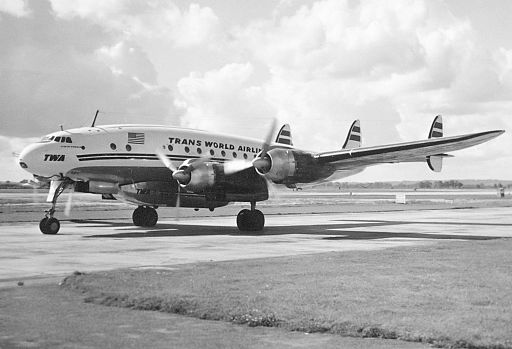
Lockheed L-749 Constellation
The Lockheed L-749 Constellation, an evolutionary development of the iconic Constellation series, played a crucial role in shaping post-World War II commercial aviation. Introduced in the early 1950s, the L-749 was an upgraded version, featuring a lengthened fuselage and improved performance over its predecessors. With its distinctive triple-tail design and streamlined fuselage, the L-749 maintained the elegant aesthetic that characterized the Constellation series. It was designed to accommodate around 60 passengers in a comfortable and spacious cabin, making it a preferred choice for long-haul flights.
The L-749 Constellation not only excelled in the civilian aviation sector but also found utility in military applications. The U.S. Air Force operated the L-749A as the C-121A, utilizing it as a transport aircraft. The L-749 contributed to the expansion of global air travel, providing a reliable and efficient means of transportation during the post-war era. Despite facing increased competition from jet-powered aircraft in the following decades, the Lockheed L-749 Constellation remains an emblematic representation of the era when piston-engine airliners dominated the skies, celebrated for its combination of elegance, range, and performance.
Parameters of the Lockheed L-749 Constellation
The Lockheed L-749 Constellation, an upgraded version of the iconic Constellation series, was a piston-engine airliner. Here are some key parameters for the L-749:
- Crew: 5-6 (flight crew and cabin crew)
- Passenger Capacity: Typically configured for around 60 passengers
- Length: 95 feet 2 inches (29.01 meters)
- Wingspan: 123 feet (37.49 meters)
- Height: 23 feet 8 inches (7.21 meters)
- Empty Weight: Approximately 49,662 pounds (22,529 kilograms)
- Max Takeoff Weight: Approximately 86,250 pounds (39,135 kilograms)
- Engines: Four Wright R-3350 Duplex-Cyclone radial engines
- Cruise Speed: Approximately 300 miles per hour (483 kilometers per hour)
- Range: Approximately 4,095 miles (6,589 kilometers)
- Service Ceiling: 23,200 feet (7,071 meters)
- First Flight: October 17, 1949
- Entered Service: 1950
- Number Built: 48 aircraft (L-749 Constellation and L-749A Constellation)
These parameters highlight the L-749 Constellation’s design as a long-range, high-capacity airliner, emphasizing its range, versatility, and classic Constellation series features. The L-749 played a significant role in post-World War II air travel, contributing to the expansion of global commercial aviation.
History of the Lockheed L-749 Constellation
The Lockheed L-749 Constellation emerged as a pivotal chapter in the post-World War II era, representing the evolution of the iconic Constellation series. Introduced in the early 1950s, the L-749 featured a lengthened fuselage and improved performance over its predecessors, enhancing its capacity and range. Designed to accommodate around 60 passengers, the L-749 retained the distinctive triple-tail design and streamlined fuselage that characterized the Constellation family, adding to its timeless aesthetic appeal. The aircraft played a significant role in the global expansion of commercial air travel, connecting distant destinations with reliability and efficiency.
Beyond its civilian success, the L-749 Constellation found utility in military applications, with the U.S. Air Force adopting it as the C-121A transport aircraft. The L-749’s versatility and dependability contributed to its enduring legacy, and a total of 48 aircraft, including both the L-749 Constellation and L-749A Constellation variants, were built. Despite the eventual transition to jet-powered aircraft, the Lockheed L-749 Constellation remains a symbol of the golden age of piston-engine airliners, celebrated for its iconic design and its crucial role in shaping the trajectory of post-war aviation.
