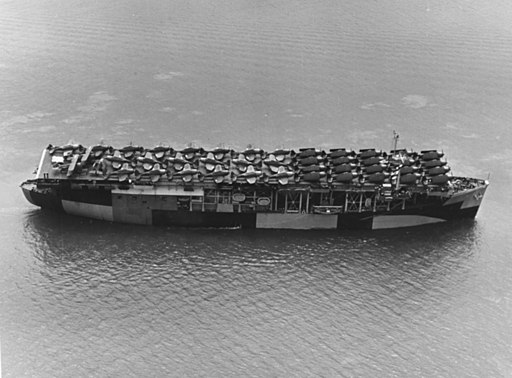
USS Long Island CVE-1
The USS Long Island (CVE-1) was a pioneering vessel in the history of the United States Navy, serving as the first escort carrier to be commissioned into the fleet. Originally built as a merchant ship, the USS Long Island was converted into an escort carrier to meet the growing demand for aircraft carriers during World War II. Commissioned on June 2, 1941, the USS Long Island played a crucial role in expanding the Navy’s capabilities for providing air support and protection to convoys traversing the Atlantic Ocean.
As a Casablanca-class escort carrier, the USS Long Island possessed a unique combination of versatility and adaptability. While not as large or heavily armed as fleet carriers, the Long Island was capable of carrying a complement of aircraft, including fighters, torpedo bombers, and reconnaissance planes. These aircraft provided essential air cover for convoys, conducted anti-submarine patrols, and supported amphibious landings, contributing significantly to the Allied war effort in the Atlantic and Mediterranean theaters.
Throughout World War II, the USS Long Island participated in numerous operations, including the North African Campaign, the invasion of Sicily, and the Allied landings in Italy. Despite facing the constant threat of enemy submarines and aircraft, the Long Island performed admirably, earning a reputation for its reliability and effectiveness in combat. After the war, the USS Long Island was decommissioned in 1946 but left a lasting legacy as one of the pioneering vessels that helped shape the future of naval aviation and escort carrier operations.
Armament of USS Long Island (CVE-1)
As an escort carrier, the USS Long Island (CVE-1) was equipped with a modest armament for self-defense and protection of the convoys it escorted. The armament of the USS Long Island typically included:
- Anti-Aircraft Guns: The primary armament of the USS Long Island consisted of anti-aircraft guns to defend against enemy aircraft attacks. This usually included a combination of 3-inch (76 mm) and 40 mm Bofors anti-aircraft guns, as well as 20 mm Oerlikon cannons. These guns were distributed across the carrier’s deck and island structure to provide coverage against aerial threats.
- Machine Guns: In addition to the larger caliber anti-aircraft guns, the USS Long Island was also equipped with numerous .50 caliber Browning machine guns for close-range defense. These machine guns were positioned at various locations around the carrier to engage enemy aircraft and provide additional protection against strafing attacks.
- Depth Charges: To defend against enemy submarines, the USS Long Island carried depth charges and depth charge projectors for anti-submarine warfare (ASW) operations. Depth charges were dropped into the water to explode at predetermined depths, potentially damaging or destroying submerged submarines threatening the carrier and its convoy.
Overall, while the USS Long Island was not heavily armed compared to fleet carriers, its armament was sufficient to provide a degree of self-defense and protection for the convoys it escorted. The carrier relied primarily on its aircraft for offensive operations, while its anti-aircraft guns, machine guns, and depth charges served to deter and defend against enemy threats encountered during escort duties in the Atlantic and Mediterranean theaters of World War II.
Dimensions of USS Long Island (CVE-1)
The USS Long Island (CVE-1), as a Casablanca-class escort carrier, had the following approximate dimensions:
- Length: The overall length of the USS Long Island was approximately 512 feet (156 meters). This measurement encompassed the entire length of the flight deck from the bow to the stern.
- Beam: The width, or beam, of the USS Long Island was approximately 65 feet (20 meters). This measurement represented the widest point of the carrier’s flight deck.
- Draft: The draft of the USS Long Island, which refers to the vertical distance between the waterline and the bottom of the hull, varied depending on the ship’s load and displacement. However, the average draft during normal operating conditions was around 22 feet (6.7 meters).
- Displacement: The displacement of the USS Long Island varied depending on factors such as fuel, ammunition, and aircraft onboard. However, the standard displacement was approximately 7,800 tons, while the full load displacement could exceed 10,000 tons.
These dimensions provided the USS Long Island with the necessary size and stability to accommodate a complement of aircraft and support operations in the role of an escort carrier during World War II. As one of the numerous escort carriers constructed during the war, the USS Long Island played a crucial role in providing air support and protection to Allied convoys in the Atlantic and Mediterranean theaters.
_in_San_Francisco_Bay,_California_(USA),_on_10_June_1944_(80-G-236393).jpg)