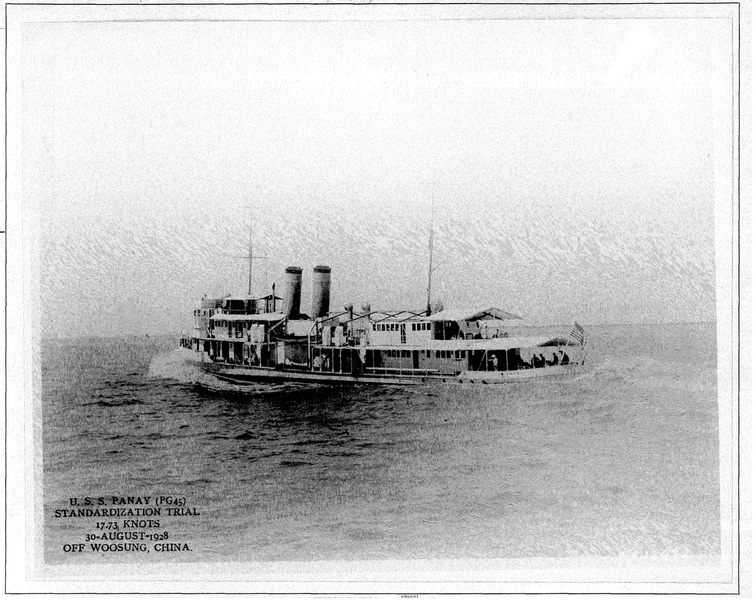
USS Panay PR-5
The USS Panay (PR-5) was a river gunboat of the United States Navy that served on the Yangtze River in China during the interwar period. Commissioned in 1928, the USS Panay was tasked with protecting American interests and citizens in the turbulent regions of China. As tensions escalated between China and Japan in the late 1930s, the Panay found itself operating in increasingly dangerous waters, navigating the complexities of international relations and regional conflicts.
On December 12, 1937, during the early stages of the Second Sino-Japanese War, the USS Panay came under attack by Japanese aircraft while patrolling the Yangtze River near Nanjing. Despite flying the American flag and clearly identifying itself as a neutral vessel, the Panay was repeatedly bombed and strafed by Japanese warplanes. The attack resulted in the deaths of three crew members and numerous injuries, as well as significant damage to the ship.
The sinking of the USS Panay became an international incident, sparking outrage in the United States and further escalating tensions between the U.S. and Japan. Although Japan officially apologized and paid reparations for the attack, the sinking of the Panay served as a stark reminder of the dangers of international conflict and the vulnerability of neutral vessels operating in hostile waters. Today, the USS Panay is remembered as a symbol of American resilience and perseverance in the face of aggression, and its legacy serves as a poignant reminder of the sacrifices made by sailors in the pursuit of peace and security.
Armament of USS Panay (PR-5)
As a river gunboat of the United States Navy, the USS Panay (PR-5) was equipped with a modest armament suitable for its patrol and escort duties on the Yangtze River in China during the interwar period. The armament of the USS Panay typically included:
- Guns: The primary armament of the USS Panay consisted of several deck-mounted guns for engaging enemy vessels, ground targets, or providing fire support. These typically included 3-inch (76 mm) guns, which were effective against smaller vessels and shore targets.
- Machine Guns: In addition to the larger caliber guns, the USS Panay was also armed with multiple machine guns for close-range defense and anti-personnel purposes. These machine guns were typically .30 caliber or .50 caliber Browning machine guns and were mounted at various locations around the ship.
- Depth Charges: Given the potential threat of enemy submarines in the riverine environment, the USS Panay may have been equipped with depth charges and depth charge projectors for anti-submarine warfare (ASW) operations. These depth charges would be deployed in the water to explode at predetermined depths, potentially damaging or destroying submerged enemy submarines.
Overall, while the armament of the USS Panay (PR-5) was not extensive compared to larger naval vessels, it was sufficient for its intended patrol and escort duties on the Yangtze River. The combination of guns, machine guns, and potentially depth charges provided the USS Panay with the firepower and capability needed to fulfill its role in protecting American interests and citizens in the turbulent regions of China during the interwar period.
Dimensions of USS Panay (PR-5)
The USS Panay (PR-5), as a river gunboat of the United States Navy, had the following approximate dimensions:
- Length: The overall length of the USS Panay was approximately 200 feet (61 meters). This measurement encompassed the entire length of the vessel from the bow to the stern.
- Beam: The width, or beam, of the USS Panay was approximately 35 feet (10.7 meters). This measurement represented the widest point of the gunboat’s hull.
- Draft: The draft of the USS Panay, which refers to the vertical distance between the waterline and the bottom of the hull, varied depending on the ship’s load and displacement. However, the average draft during normal operating conditions was around 7 feet (2.1 meters).
- Displacement: The displacement of the USS Panay varied depending on factors such as fuel, ammunition, and crew complement. However, the standard displacement was approximately 1,000 tons, while the full load displacement could exceed 1,300 tons.
These dimensions provided the USS Panay with the necessary size and stability to operate effectively as a river gunboat on the Yangtze River in China during the interwar period. As a smaller vessel compared to ocean-going warships, the USS Panay was well-suited for patrolling and escort duties in the confined and shallow waters of the riverine environment.