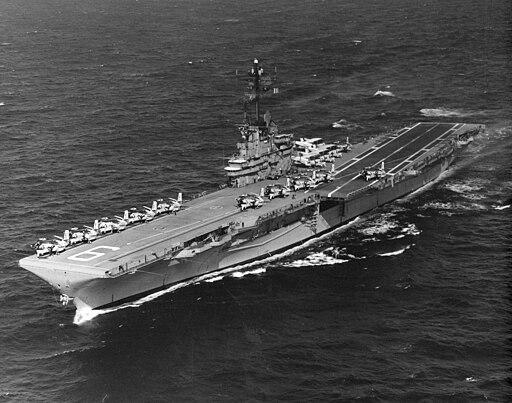
USS Essex CV-9
The USS Essex (CV-9) stands as a testament to American naval innovation, resilience, and bravery during World War II and beyond. Commissioned in 1942, the Essex swiftly became a cornerstone of the United States Navy’s Pacific Fleet, playing a pivotal role in turning the tide of the war in the Pacific Theater. As the lead ship of the Essex-class aircraft carriers, the Essex epitomized American naval engineering excellence, boasting formidable firepower, robust defenses, and the capability to launch and recover a diverse array of aircraft with precision and efficiency.
Throughout its illustrious career, the USS Essex showcased its versatility and adaptability in a variety of combat roles, from providing air support during amphibious landings to engaging enemy fleets in decisive naval battles. Its participation in key operations such as the Battle of Leyte Gulf, the Battle of Okinawa, and air raids on Japanese-held islands showcased its instrumental role in securing victory for the Allied forces in the Pacific. The Essex and her crew earned a reputation for courage, tenacity, and steadfastness, withstanding relentless attacks and emerging victorious from some of the most ferocious battles of the war.
Today, the legacy of the USS Essex lives on, preserved as a museum ship in San Diego, California. Open to the public, the USS Midway Museum offers visitors a unique opportunity to step aboard this historic vessel and experience firsthand the storied history and remarkable achievements of the USS Essex and her crew. Through immersive exhibits, interactive displays, and educational programs, the museum honors the bravery and sacrifice of those who served aboard the Essex and ensures that their legacy of valor and service endures for future generations to admire and learn from.
Armament of USS Essex (CV-9)
The armament of the USS Essex (CV-9) included various weapons systems for self-defense and aircraft support. Here is a list of its main armament:
- Aircraft: The USS Essex was capable of carrying a diverse complement of aircraft, including fighters, bombers, torpedo bombers, and reconnaissance planes. These aircraft formed the primary offensive and defensive capability of the ship.
- Anti-Aircraft Guns: For self-defense against air attacks, the Essex was equipped with a range of anti-aircraft guns, including 5-inch (127 mm) guns and 40-mm Bofors guns. These guns were used to engage enemy aircraft that threatened the ship.
- Machine Guns: In addition to the larger anti-aircraft guns, the Essex carried a number of 20-mm Oerlikon machine guns for defense against air attacks and for engaging low-flying targets.
- Torpedo Tubes: Some versions of the Essex were equipped with torpedo tubes as part of their armament for defense against enemy ships or submarines. These torpedo tubes were used to launch torpedoes to engage hostile vessels.
This armament provided the USS Essex with the means to defend itself and provide protection to its aircraft during missions. Throughout its service, the Essex played a crucial role in various operations and battles, contributing significantly to the Allied war effort in the Pacific Theater during World War II.
Dimensions of USS Essex (CV-9)
Here are the approximate dimensions of the USS Essex (CV-9):
- Length: Approximately 872 feet (265.8 meters)
- Beam (Width): Approximately 147 feet (44.8 meters)
- Draft (Depth): Approximately 28 feet (8.5 meters)
These dimensions may vary slightly depending on specific configurations and modifications made over the course of the ship’s service. The USS Essex was one of the early Essex-class aircraft carriers, known for their size, strength, and versatility during World War II and beyond.
