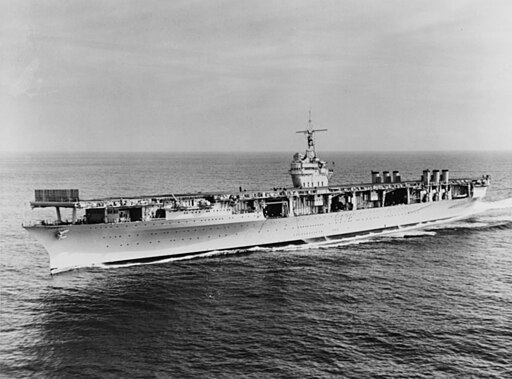
USS Ranger CV-4
The USS Ranger (CV-4) holds a significant place in the annals of American naval history as the first purpose-built aircraft carrier in the United States Navy. Commissioned in 1934, the Ranger represented a leap forward in naval aviation capabilities, serving as a pioneer in the development of carrier-based aircraft operations. As the lead ship of its class, the Ranger played a crucial role in advancing the tactics and technologies of naval aviation, laying the groundwork for future generations of aircraft carriers.
Throughout its service, the USS Ranger participated in numerous operations and campaigns, showcasing its versatility and adaptability in a variety of combat roles. During World War II, the Ranger played a key role in convoy escort duties in the Atlantic, protecting vital supply lines and engaging enemy submarines. It also conducted offensive operations against Axis forces, launching airstrikes against German shipping and installations along the coast of Europe. The Ranger’s presence in the Atlantic Theater served as a vital deterrent to enemy aggression and contributed to the overall success of Allied operations.
Tragically, the USS Ranger was ultimately decommissioned in 1946, marking the end of its illustrious career in the United States Navy. Despite its relatively short service life compared to later aircraft carriers, the Ranger’s legacy endured as a trailblazer in naval aviation and a symbol of American innovation and determination. The pioneering spirit of the Ranger paved the way for the development of modern aircraft carriers, leaving an indelible mark on the history of naval warfare and the evolution of maritime power projection.
Armament of USS Ranger (CV-4)
The armament of the USS Ranger (CV-4) included various weapons systems for self-defense and aircraft support. Here is a list of its main armament:
- Aircraft: The USS Ranger was capable of carrying a complement of aircraft, including fighters, bombers, torpedo bombers, and reconnaissance planes. These aircraft formed the primary offensive and defensive capability of the ship.
- Anti-Aircraft Guns: For self-defense against air attacks, the Ranger was equipped with a range of anti-aircraft guns, including 5-inch (127 mm) guns and 40-mm Bofors guns. These guns were used to engage enemy aircraft that threatened the ship.
- Machine Guns: In addition to the larger anti-aircraft guns, the Ranger carried a number of 50-caliber machine guns for defense against air attacks and for engaging low-flying targets.
This armament provided the USS Ranger with the means to defend itself and provide protection to its aircraft during missions. Throughout its service, the Ranger played a crucial role in various operations and battles, contributing significantly to the Allied war effort in the Atlantic Theater during World War II.
Dimensions of USS Ranger (CV-4)
The USS Ranger (CV-4) had the following approximate dimensions:
- Length: Approximately 769 feet (234.4 meters)
- Beam (Width): Approximately 109 feet (33.2 meters)
- Draft (Depth): Approximately 24 feet (7.3 meters)
These dimensions may vary slightly depending on specific configurations and modifications made over the course of the ship’s service. The USS Ranger was one of the earliest aircraft carriers of the United States Navy, serving primarily in the Atlantic Theater during World War II.
_underway_at_sea_during_the_later_1930s.jpg)