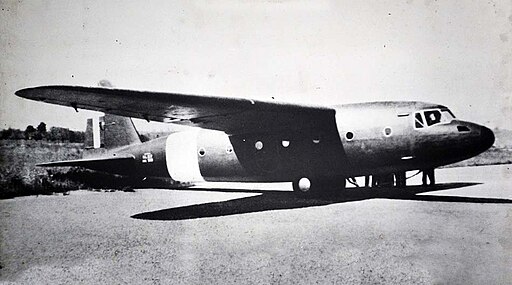
Aeronautica Lombarda AL-12P
The Aeronautica Lombarda AL-12P emerged during the Second World War as Italy’s answer to the growing need for a large-capacity transport glider. Designed by Angelo Ambrosini and built by Aeronautica Lombarda, the AL-12P could carry a full infantry section or equivalent cargo under combat conditions. Though only a small number reached the prototype and pre-series stage, its robust wooden construction, streamlined shape, and later motorized conversion left a lasting impression on post-war light transport designs.
Design and Development
Concept and Requirements
In early 1942, the Regia Aeronautica issued a request for a heavy transport glider capable of delivering up to a dozen fully equipped troops or nearly two tonnes of material to forward landing zones. Engineers needed a design that combined low cost, simple wood construction, and easy ground handling with adequate aerodynamic performance for safe release from towing aircraft.
Airframe and Structure
Aeronautica Lombarda responded with a high-wing cantilever monoplane built around a plywood-skinned wooden shell. Spruce ribs and plywood planking formed the wings and fuselage in a true monocoque style, keeping empty weight below 1 600 kg. The forward fuselage used a welded steel-tube frame covered in molded plywood to reinforce the cockpit area while retaining overall lightness.
Wing and Control Surfaces
The straight-tapered wing spans over 21 m and provides ample lift for heavy loads. A plywood spar carries the wing’s bending loads, while large slotted spoilers and two-position flaps allow the pilot to adjust descent rate during landing approaches. Full-span ailerons ensure responsive roll control despite the glider’s mass.
Variants and Evolution
AL-12P Transport Glider
The pure glider version seated two crew side-by-side up front and loaded soldiers or cargo through a hinged nose section. Up to twelve troops could be carried in the main fuselage space, accessed via a large side door. Production plans called for multiple pre-series batches, but wartime disruptions limited output to around sixteen prototypes and early examples.
Ambrosini P.512 Motorized Variant
After the war, Ambrosini converted at least one AL-12P into a self-powered transport designated P.512. Two inverted six-cylinder Alfa Romeo 115ter engines, each delivering 225 hp, were mounted in streamlined nacelles under the wings. A revised undercarriage added shock-absorbing struts and variable-pitch propellers, transforming the glider into a versatile turbo-charged freighter.
Technical Specifications
General Characteristics
| Characteristic | AL-12P (Glider) | P.512 (Motorized) |
|---|---|---|
| Crew | 2 | 2 |
| Capacity | 12 troops (fully equipped) | 12 troops or 1 600 kg cargo |
| Length | 14.02 m | 14.02 m |
| Wingspan | 21.34 m | 21.34 m |
| Height | 3.40 m | 3.40 m |
| Wing Area | 50.7 m² | 50.7 m² |
| Empty Weight | 1 588 kg | 2 000 kg |
| Maximum Takeoff Weight | 2 812 kg | 3 600 kg |
| Powerplant | — | 2 × Alfa Romeo 115ter, 168 kW each |
Performance
| Metric | AL-12P (Glider) | P.512 (Motorized) |
|---|---|---|
| Maximum Speed | — | 249 km/h |
| Cruise Speed | — | 230 km/h |
| Minimum Control Speed | — | 85 km/h (flaps down) |
| Range | Towed by tug | 500 km |
| Service Ceiling | Towed operational ceiling | 2 100 m |
| Rate of Climb | — | 4.9 m/s |
| Wing Loading | 55 kg/m² (empty) to 56 kg/m² | 71 kg/m² |
| Power-to-Mass Ratio | — | 0.09 kW/kg |
Operational History
Military Service
First flown in 1943, the AL-12P underwent comparative trials against German DFS 230 gliders. Pilots praised its handling and greater aerodynamic efficiency. Italian Army plans to build multiple pre-series batches were halted by the 1943 armistice, leaving only prototypes in service. One survived hidden in a northern Italian hangar until war’s end.
Post-War Adaptations
In 1946, Ambrosini’s workshop transformed a surviving AL-12P into the P.512 motorized freighter. Though the single P.512 prototype never entered production, its successful conversion demonstrated the adaptability of the original design. It proved capable of short takeoff runs, independent operation without tugs, and respectable cargo speeds, laying groundwork for future light transport projects.
Legacy and Impact
Though only a handful of AL-12P gliders and a lone P.512 reached the skies, their innovative blend of wooden monocoque construction and later twin-engine propulsion embodied Italian wartime engineering resourcefulness. The AL-12P’s aerodynamics, load-carrying capacity, and cockpit layout influenced post-war light transport designs in Italy and beyond. Remnants of the prototype continue to inspire restoration projects and historic exhibits, preserving a key chapter in glider-borne logistics.
