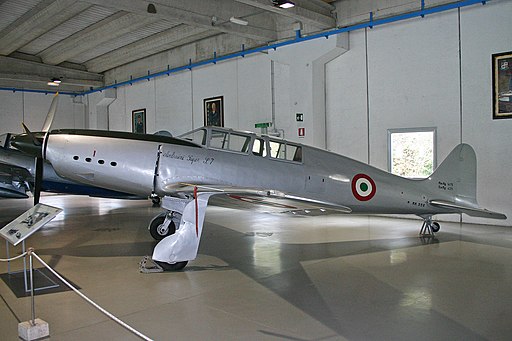
Ambrosini S.7
The Ambrosini S.7 emerged in the late 1930s as a testament to Italian aeronautical ingenuity. Developed by SAI Ambrosini, it blended sleek aerodynamics with advanced materials for its era. Initially conceived as a single-seat racing seaplane, the S.7 evolved into a versatile platform, finding roles in both civil touring and military training.
Despite modest production numbers, its refined low-wing monoplane layout and retractable undercarriage set new benchmarks for handling and performance. Pilots lauded its responsive controls and robust powerplant, which together enabled spirited cross-country trips and record-chasing sorties.
Design and Development
Structural Characteristics
At the heart of the S.7’s structure lay an all-metal monocoque fuselage, crafted from duralumin panels. This shell provided high torsional rigidity while minimizing weight, a crucial factor for both speed and maneuverability.
The wing employed a single-spar design with stressed-skin covering. Thoughtful stiffening ribs ensured that the airfoil shape remained true under load, delivering predictable stall behavior and crisp roll response.
Aerodynamic Refinements
Ambrosini’s engineers paid particular attention to laminar-flow sections, sculpting the wing root fairings and engine cowling to reduce drag. Flush-riveted skinning and retractable landing gear doors further trimmed parasite drag, boosting top speed by as much as 15 km/h over contemporaries.
Wingtip spoilers, a novel feature for 1938, improved roll damping at high speed, making high-G turns smoother and safer during racing circuits or dogfight drills.
Powerplant and Propulsion
Engine Variants
The prototype S.7 flew with a Fiat A.70 seven-cylinder radial engine delivering 200 hp. Production trainers often swapped in an Alfa Romeo 115 inline engine rated at 205 hp, offering a slimmer frontal area and better forward visibility.
Several custom racers experimented with supercharged versions, pushing output to 240 hp. These high-boost plants raised top speed into the 450 km/h bracket on timed courses.
Propeller System
A two-bladed, variable-pitch propeller was standard, allowing pilots to fine-tune blade angle for climb, cruise, and dash phases. Ground-adjustable three-bladed props saw limited use on postwar civilian S.7s, favoring smoother idle and slightly improved fuel efficiency.
Performance Specifications
Speed and Range
Thanks to its aerodynamic finesse and potent powerplant, the S.7 cruised at 370 km/h and achieved a maximum speed of 425 km/h at 3,000 m. With auxiliary fuel tanks fitted under the wings, ferry range extended to 1,100 km, making it competitive in long-distance events.
Climb and Ceiling
Standard trainers reached 5,000 m in under 10 minutes, with a service ceiling of 10,500 m. Supercharged racers shaved the time to altitude to below eight minutes, leveraging higher manifold pressures and optimized intercoolers.
Avionics and Systems
Cockpit Layout
The single-seat cockpit featured a panoramic windshield and a compact instrument panel clustered around the pilot’s primary sightline. Airspeed indicator, altimeter, turn-and-bank, and tachometer occupied the central panel, while backup gauges and fuel management controls lined the side console.
Electrical and Fuel Systems
A 12-volt DC electrical system powered navigation lights, a radio transceiver, and an electric starter. Fuel was stored in two wing tanks with a combined capacity of 260 L, feeding through a dual-pump system that ensured uninterrupted flow during steep maneuvers.
Operational Use and Legacy
Military Trainer Role
During World War II, the Regia Aeronautica adopted the S.7 for advanced fighter training. Its nimble handling taught cadets energy-management and high-speed aerobatics. By war’s end, more than 50 airframes had served in training schools across Italy.
Civil and Racing Appearances
Postwar, private owners restored several S.7s to racing trim. At Mediterranean air races in the early 1950s, these survivors often finished in the top five, a striking achievement given their age. Their elegant lines and competitive spirit cemented the S.7’s reputation among enthusiasts and collectors.
Technical Specifications Summary
| Specification | Value |
|---|---|
| Crew | 1 |
| Length | 6.80 m (22 ft 4 in) |
| Wingspan | 10.00 m (32 ft 9 in) |
| Wing Area | 15.0 m² (161.5 ft²) |
| Empty Weight | 920 kg (2,028 lb) |
| Maximum Takeoff Weight | 1,350 kg (2,976 lb) |
| Powerplant | 1 × Fiat A.70 radial, 200 hp (149 kW) |
| Maximum Speed | 425 km/h (264 mph) |
| Cruise Speed | 370 km/h (230 mph) |
| Service Ceiling | 10,500 m (34,450 ft) |
| Range (standard tanks) | 755 km (469 mi) |
| Rate of Climb | 7.8 m/s (1,535 ft/min) |
Further Exploration
Beyond its celebrated racing and training heritage, the S.7 influenced postwar Italian light aircraft design. Its blend of metal monocoque and laminar-flow aerodynamics paved the way for 1950s touring monoplanes. Today, a handful of restored examples still delight airshow crowds, embodying an era when speed and style soared hand in hand.
.jpg)