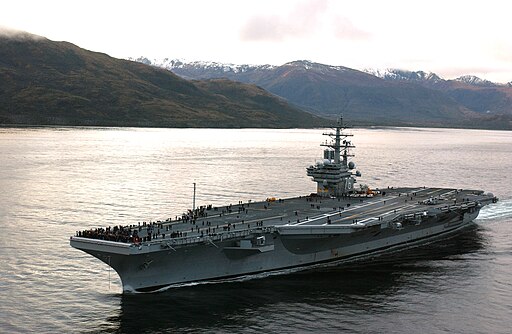
USS Ronald Reagan (CVN-76)
USS Ronald Reagan (CVN-76) is the ninth of ten nuclear-powered Nimitz-class aircraft carriers serving the United States Navy. Named in honor of the 40th President of the United States, she represents the zenith of carrier design with an unrivaled blend of power projection, endurance, and flexibility.
Design and Construction
Contract Award and Keel Laying
The contract for CVN-76 was awarded on 8 December 1994 to Northrop Grumman Newport News Shipbuilding in Virginia. Her keel was ceremonially laid on 12 February 1998, marking the start of module assembly and pressure-hull welding operations under stringent nuclear-certification standards.
Launch and Commissioning
Following nearly three years of outfitting, Ronald Reagan was launched on 4 March 2001. She completed builder’s sea trials and weapons system tests before being commissioned into active service on 12 July 2003 at Naval Station Norfolk, officially entering the fleet with Captain J. W. Goodwin in command.
Dimensions and Displacement
Principal Measurements
| Characteristic | Measurement |
|---|---|
| Overall Length | 1,092 ft (332.8 m) |
| Waterline Length | 1,040 ft (317.0 m) |
| Beam (Flight Deck) | 252 ft (76.8 m) |
| Beam (Waterline) | 134 ft (40.8 m) |
| Maximum Draft | 37 ft (11.3 m) |
| Limit Draft | 41 ft (12.5 m) |
All dimensions optimize aircraft operations, seakeeping in high seas, and stealthy hydrodynamics.
Displacement
| Condition | Displacement |
|---|---|
| Light | 97,000 long tons (approx.) |
| Full Load | 101,400 long tons |
Her full-load displacement supports a crew complement, aviation fuel, munitions, and provisions for extended deployments.
Propulsion and Performance
Nuclear Power Plant
Two Westinghouse A4W pressurized-water reactors supply steam to four shaft-driven turbines. Each reactor uses highly enriched uranium designed to operate core life spans of 20–25 years without refueling, ensuring continuous strike readiness.
Propulsion Machinery
The steam turbines collectively generate 260,000 shaft horsepower, driving four controllable-pitch propeller shafts. Auxiliary electric motors enable precise low-speed maneuvering during flight-deck operations and alongside piers.
Speed and Endurance
Cruising speeds exceed 30 knots, with a top speed in excess of 31 knots possible under surge power. Nuclear propulsion grants an effectively unlimited range, limited only by stores and crew endurance for deployments up to 90 days without replenishment.
Flight Deck and Aviation Facilities
Catapults and Arresting Gear
– Four steam-driven catapults arranged for near-simultaneous aircraft launches. – Four arresting wires on the angled landing area to recover high-performance jets.
This configuration supports a surge launch rate of up to four sorties per minute during high-tempo operations.
Hangar and Elevators
– Spacious hangar deck measuring 4.5 acres accommodates maintenance and ordnance-loading. – Four deck-edge and island-side elevators transfer aircraft and munitions between decks.
Fire-proof bulkheads and rapid-closure doors contain incidents below decks while preserving flight operations above.
Air Wing Complement
Ronald Reagan routinely embarks up to 90 fixed- and rotary-wing aircraft, typically organized into:
- F/A-18E/F Super Hornets for fleet air defense and strike
- EA-18G Growler electronic-attack jets
- E-2D Advanced Hawkeyes for airborne early warning
- MH-60R/S Seahawks for anti-submarine and search-and-rescue missions
- C-2A Greyhounds for carrier onboard delivery logistics
This mix grants the carrier unmatched versatility across mission sets.
Sensors and Electronic Warfare
Radar and Combat System
– AN/SPS-48E three-dimensional air search radar – AN/SPS-49(V)1 long-range two-dimensional air search radar – AN/SPQ-9B fire-control radar – AN/SPN-46 air-traffic-control landing radar system
All feed data to the Aegis-derived ship-wide combat information center, enabling simultaneous tracking of hundreds of contacts and rapid engagement decision cycles.
Sonar and Undersea Detection
A hull-mounted array pairs with a towed passive sonar system to detect and classify submarine threats, integrating with ASW helicopters and shipborne torpedoes for layered undersea defense.
Electronic Warfare Suite
– AN/SLQ-32A(V)4 electronic warfare countermeasures for threat warning – SLQ-25A “Nixie” towed decoy system for torpedo counter-decoy
This package protects the ship and embarked air wing against radar and acoustic threats.
Defensive Armament
Surface-to-Air Missiles
Two Mk 29 launchers for RIM-162 Evolved Sea Sparrow Missiles provide medium-range point defense, augmented by the Rolling Airframe Missile system for short-range missile interception.
Close-In Weapon Systems
up to four 20 mm Phalanx Block 1B CIWS mountings deliver a final automated layer of defense against incoming missiles and small surface threats.
Anti-Ship and ASW Weapons
– Mk 13 torpedo tubes for Mk 46/Mk 54 lightweight torpedoes – Integration with MH-60R ASW helicopters for standoff torpedo delivery
These systems enable offensive and defensive engagement of underwater targets beyond the ship’s hull-mounted array range.
Crew and Habitability
Complement
– Ship’s company: 3,532 officers and enlisted personnel – Carrier air wing: approx. 2,480 aviators, maintainers, and support staff
Living and Support Facilities
– Multi-deck berthing compartments with modern berths – Modular galley and mess decks for rapid meal service – Fitness center, medical and dental clinics – Upgraded HVAC and LED lighting for morale and energy efficiency
Habitability enhancements during periodic maintenance ensure high retention and operational readiness on long cruises.
Operational Role
Based at Naval Base Kitsap, Washington, USS Ronald Reagan serves as the flagship of a carrier strike group, projecting air power globally. She supports air superiority, maritime strike, sea control, and humanitarian relief missions, cementing her role as a centerpiece of U.S. naval strategy.
