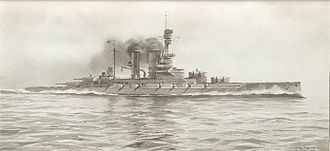
SMS Württemberg (1917): The Unfinished Bayern-Class Battleship
The SMS Württemberg was the final battleship ordered by the Imperial German Navy and the fourth member of the powerful Bayern class. Launched in 1917, she was designed to carry eight 38 cm guns, operate at approximately 22 knots, and combine the heavy armor characteristic of German dreadnoughts with a modern propulsion system and extensive underwater protection. Yet Württemberg never became an operational warship. The First World War consumed the industrial resources needed to complete her, while the German Navy increasingly shifted its attention toward submarines and other vessels that could be brought into action more quickly. Although her hull was launched on 20 June 1917, construction eventually stopped when she was still roughly a year away from completion. After Germany’s defeat, the Treaty of Versailles made completion impossible, and Württemberg was removed from the naval register in November 1919. She was sold for scrap and dismantled in Hamburg in 1921–1922.
Württemberg is therefore an unusual subject in naval history. Unlike famous German battleships such as SMS Bayern, SMS Baden, or the König-class ships that fought at Jutland, she never entered service and never fired her main battery in wartime. Nevertheless, her design reveals much about the direction in which German battleship construction was moving during the final years of the dreadnought era. She was intended to be faster and more refined than earlier members of the Bayern family, while retaining their heavy 38 cm artillery and substantial armor. Her unfinished hull also tells another story: the story of how total war could make even the most ambitious naval projects increasingly irrelevant when industrial resources were urgently needed elsewhere.
The Bayern-Class Battleships
Germany’s Final Dreadnought Generation
The Bayern class represented the highest point reached by Imperial Germany in the construction of conventional dreadnought battleships. The class consisted of Bayern, Baden, Sachsen, and Württemberg, although only the first two were completed and commissioned. Bayern and Baden entered service too late to participate in the Battle of Jutland in May and June 1916, while Sachsen and Württemberg remained incomplete throughout the war. The class introduced Germany’s first battleship armament of eight 38 cm guns, a substantial increase in caliber over the 30.5 cm weapons carried by the preceding König class.
The adoption of 38 cm artillery reflected an international trend toward increasingly powerful naval guns. British battleships had already moved toward larger-caliber weapons, and German naval designers responded with their own heavy artillery. Rather than increasing the number of guns, the Bayern design emphasized the destructive power of each individual weapon. Eight guns in four twin turrets gave the battleships a formidable broadside while simplifying the arrangement compared with the five twin turrets of the König class.
Württemberg was especially interesting because she incorporated refinements made after experience with the earlier ships. Her design was somewhat different from that of Bayern and Baden, and she is sometimes described alongside Sachsen as belonging to a modified or “Sachsen” subgroup of the Bayern class. She was slightly longer in some specifications and was designed for a speed of about 22 knots. Her propulsion reverted to an all-steam turbine arrangement rather than the experimental mixed turbine-and-diesel system planned for Sachsen.
Construction of SMS Württemberg
A Battleship Ordered During Wartime
Württemberg was ordered under the provisional name Ersatz Kaiser Wilhelm II. The contract was awarded to AG Vulcan in Hamburg, one of Germany’s major shipbuilding companies. Her keel was laid down on 4 January 1915, several months after the outbreak of the First World War. At the time, Germany was already experiencing the enormous industrial demands created by the conflict, and the construction of a large battleship competed directly with many other military requirements.
The ship was launched on 20 June 1917. The launch itself was relatively understated compared with the elaborate ceremonies associated with German battleships during peacetime. By this stage of the war, resources were increasingly scarce, and the navy’s strategic priorities had changed considerably. Launching the hull nevertheless served an important practical purpose: it freed the building slip for other construction work. Württemberg could then be moved aside while the shipyard concentrated on projects considered more urgent.
Launching, however, did not mean that the ship was close to operational service. A battleship still required its machinery, armor, electrical systems, weapons, fire-control equipment, communications apparatus, internal fittings, and countless other components to be installed and tested. Württemberg never completed this process. By the time construction was abandoned, she was still approximately twelve months away from completion.
The Cost of Wartime Priorities
The circumstances surrounding Württemberg’s construction demonstrate the enormous difficulty of building capital ships during total war. Germany’s shipyards were required to maintain and repair the existing fleet while also producing submarines, destroyers, minesweepers, torpedo boats, and other vessels. Skilled labor and raw materials were limited, while submarine construction increasingly dominated German naval planning.
The strategic importance of U-boats became especially pronounced after Germany adopted unrestricted submarine warfare. Submarines could be constructed in substantially less time than battleships and could immediately contribute to Germany’s campaign against Allied shipping. A battleship such as Württemberg required vast quantities of steel and precision machinery but could not be deployed until years after its original order. As the war continued, that imbalance became increasingly significant.
Design and Dimensions
A Large and Heavily Armed Hull
Württemberg was approximately 180 meters long overall, with a beam of 30 meters and a maximum draft of about 9.39 meters. German sources give a design displacement of approximately 28,530 tonnes and a maximum displacement of about 32,200 tonnes, while some English-language references give slightly different figures. These variations reflect differences in how displacement was calculated and whether particular loading conditions were included.
Her hull was designed around the demands of a modern battleship. The 30-meter beam provided considerable stability for her heavy artillery and armor while leaving enough internal volume for machinery, ammunition, fuel, crew spaces, and protective subdivision. The underwater hull was particularly important because mines and torpedoes had become major threats to capital ships during the First World War.
The design also reflected a desire for greater speed than some preceding German battleships. Württemberg was intended to reach approximately 22 knots, which would have allowed her to operate effectively alongside other major units of the High Seas Fleet. Her planned range was approximately 5,000 nautical miles at 12 knots, adequate for the North Sea and Baltic operations for which the German fleet was primarily designed.
The Main Battery
Eight 38 cm Guns
The centerpiece of Württemberg’s offensive capability was her planned battery of eight 38 cm SK L/45 guns. These were arranged in four twin turrets, with two superfiring turrets forward and two aft. This configuration provided a powerful broadside while allowing substantial firepower to be directed ahead or astern.
The 38 cm gun represented a major increase in destructive power compared with the 30.5 cm artillery of the König class. A larger projectile could carry a greater explosive charge and potentially penetrate thicker armor, provided that the gun could deliver the shell with sufficient velocity and accuracy. The adoption of these weapons placed Württemberg firmly within the contemporary international battleship arms race.
The four-turret arrangement also offered a practical advantage. Fewer turrets meant fewer complicated gunhouses, ammunition hoists, training mechanisms, and armored barbettes. The arrangement concentrated the main battery into heavily protected positions at the ends of the ship, leaving the central portion of the hull available for machinery, magazines, and other essential systems.
Secondary and Torpedo Armament
Württemberg’s secondary battery was planned to consist of sixteen 15 cm SK L/45 guns. These weapons would have provided defense against cruisers and destroyers and could also have been used against other surface targets at shorter ranges. The planned light battery included eight 8.8 cm guns, although the exact final wartime configuration cannot be known because the ship never entered service. Five submerged 60 cm torpedo tubes were also planned: one in the bow and four arranged on the broadside.
This combination illustrates the multi-layered defensive philosophy of dreadnought warfare. The 38 cm guns were intended for battleship engagements, the 15 cm weapons were available for smaller surface threats, and the light guns could address torpedo craft and, as naval aviation developed, potentially aircraft. The torpedoes offered an additional offensive weapon for close-range situations.
Had Württemberg been completed, her smaller-caliber armament might have been modified during the later stages of the war. Anti-aircraft defenses were becoming increasingly important, and completed battleships were frequently altered to respond to emerging threats. Because Württemberg never entered service, the published armament figures should be understood as design specifications rather than a definitive “as-built” configuration.
Propulsion and Performance
Three Steam Turbines
Unlike her sister ship Sachsen, Württemberg was designed with a conventional all-steam turbine propulsion system. Three AEG-Vulcan steam turbines were intended to drive three propeller shafts. Steam would have been supplied by twelve marine water-tube boilers, with a combination of coal and oil firing. The machinery was designed to generate approximately 48,000 metric horsepower, enough for a planned maximum speed of around 22 knots.
The decision to retain steam turbines was significant when compared with Sachsen’s unusual planned propulsion. Sachsen was to receive a large diesel engine on her center shaft, reflecting German interest in the superior fuel economy that diesel machinery could potentially provide at cruising speeds. Württemberg instead returned to a more conventional arrangement, avoiding some of the technical complications associated with the experimental diesel installation.
A battleship’s machinery represented one of the greatest engineering challenges of its construction. Turbines, boilers, shafts, condensers, pumps, fuel systems, and auxiliary machinery had to function together reliably. Because Württemberg never completed her machinery installation and trials, her published performance figures are projected values rather than measurements from a completed vessel.
Armor and Protection
Built Around a Heavy Armored Citadel
German battleship designers placed exceptional emphasis on survivability, and Württemberg followed this philosophy. Her main belt was planned to reach 350 mm at its thickest sections, while the armored deck was approximately 90–120 mm in some areas according to German specifications. The main turrets could have armor as thick as 350 mm, while the forward conning tower was protected by an extraordinary 400 mm of armor.
The armor was not distributed uniformly. The areas containing ammunition magazines and propulsion machinery received the strongest protection, while less critical portions of the hull received thinner plating. This produced an armored citadel intended to keep the essential systems of the battleship functioning even after the outer portions of the vessel had been damaged.
Underwater protection was similarly important. Württemberg’s torpedo bulkhead was designed to limit the penetration of flooding and explosive effects into the central compartments. Such protection was particularly valuable in an era when battleships faced a growing threat from submarines and destroyers as well as mines placed across strategic waterways.
The heavy armor came at a cost in displacement, but the German navy considered survivability a crucial characteristic of a fleet battleship. Württemberg’s design therefore sought a careful balance between armor, firepower, speed, and internal protection.
Württemberg and the First World War
Why She Never Reached the High Seas
Württemberg’s entire construction history unfolded against the background of the First World War, and that context ultimately determined her fate. By the time her hull was launched in 1917, the German Navy had already fought the Battle of Jutland and was increasingly concentrating on submarine warfare. The High Seas Fleet remained a powerful force, but the strategic conditions that had justified building enormous numbers of dreadnoughts before the war had changed.
Jutland had demonstrated that Germany could inflict serious losses on the British Grand Fleet, but it had not produced the decisive destruction of Britain’s naval power that German planners had hoped for. The British fleet remained the larger force, and the German battle fleet subsequently spent much of its time in port. In contrast, submarines could operate independently and attack Allied commerce across the Atlantic.
For Württemberg, this meant that every month of construction became less strategically valuable. A battleship that might eventually enter service could consume resources immediately needed for submarines and other weapons. Consequently, work on the unfinished hull slowed and ultimately stopped.
The End of the Project
An Unfinished Battleship After Germany’s Defeat
When the Armistice ended the First World War in November 1918, Württemberg had never entered service. She therefore avoided the dramatic internment at Scapa Flow that affected Germany’s completed battleships, but her future was nevertheless determined by the postwar settlement.
The Treaty of Versailles imposed severe restrictions on Germany’s navy and required warships under construction to be destroyed. A battleship of Württemberg’s size and armament was completely incompatible with the new naval limitations. The possibility of completing her therefore disappeared permanently.
Württemberg was removed from the German naval register on 3 November 1919. She was subsequently sold for scrap in 1920 and broken up in Hamburg beginning in 1921. By the following year, the final physical remains of the last unfinished Bayern-class battleship had largely disappeared.
Her fate was shared by Sachsen, the other incomplete member of the class. Together, the two unfinished ships demonstrate how the First World War interrupted the development of German battleship construction. Bayern and Baden survived far enough into the war to become operational, whereas Sachsen and Württemberg became industrial relics of a naval program that the war had rendered increasingly impractical.
The Historical Significance of SMS Württemberg
The Last German Battleship of the Imperial Era
Württemberg holds a special position in the history of the Imperial German Navy because she was the final battleship ordered for the Kaiserliche Marine. She represented the endpoint of a remarkable sequence of naval development that had begun with the pre-dreadnought battleships and accelerated after the launch of HMS Dreadnought in 1906.
Her design embodied the lessons of that evolution. Compared with earlier German battleships, she carried larger guns, had a larger hull, and possessed sophisticated protection against both surface gunfire and underwater attack. Yet she was also a product of a period in which the strategic value of battleships was becoming increasingly uncertain.
The ship’s incomplete condition is therefore as historically significant as her planned specifications. Württemberg demonstrates that naval technology does not develop in isolation. A technically impressive design can become strategically irrelevant if circumstances change before the vessel enters service.
A Symbol of Germany’s Changing Naval Priorities
The construction of Württemberg also illustrates the enormous industrial burden imposed by dreadnought warfare. A modern battleship required years of construction, enormous quantities of steel, specialized machinery, thousands of individual components, and a highly trained industrial workforce. During peacetime, a major naval program could absorb these resources. During total war, however, governments had to decide which weapons could provide the greatest immediate military return.
Germany increasingly chose submarines. This decision meant that Württemberg’s slipway, steel, machinery, and skilled labor became less important to the naval leadership than vessels that could enter service sooner and contribute directly to the maritime campaign.
The ship’s fate consequently had little to do with any deficiency in her design. She was not cancelled because her armor was inadequate or because her guns were obsolete. Rather, the war changed the strategic and industrial environment around her before she could be completed.
Technical Specifications of SMS Württemberg
| Specification | SMS Württemberg (1917) |
|---|---|
| Class | Bayern-class battleship |
| Type | Dreadnought battleship |
| Builder | AG Vulcan, Hamburg |
| Provisional name | Ersatz Kaiser Wilhelm II |
| Keel laid | 4 January 1915 |
| Launched | 20 June 1917 |
| Completed | Never completed |
| Stricken | 3 November 1919 |
| Fate | Sold for scrap; dismantled 1921–1922 |
| Length overall | Approximately 180 m |
| Length at waterline | Approximately 179.4 m |
| Beam | 30 m |
| Maximum draft | 9.39 m |
| Design displacement | Approximately 28,530 tonnes |
| Full-load displacement | Approximately 32,200 tonnes |
| Propulsion | 3 AEG-Vulcan steam turbines |
| Propeller shafts | 3 |
| Boilers | 12 marine water-tube boilers |
| Power | Approximately 48,000 PS |
| Planned maximum speed | 22 knots |
| Planned range | Approximately 5,000 nautical miles at 12 knots |
| Main armament | 8 × 38 cm SK L/45 guns |
| Main turrets | 4 × twin turrets |
| Secondary armament | 16 × 15 cm SK L/45 guns |
| Light armament | 8 × 8.8 cm SK L/45 guns |
| Torpedo armament | 5 × 60 cm submerged torpedo tubes |
| Main belt armor | Up to 350 mm |
| Armored deck | Approximately 90–120 mm |
| Turret armor | Up to 350 mm |
| Barbette armor | Up to 350 mm |
| Conning tower armor | Up to 400 mm |
| Casemate armor | Approximately 170 mm |
| Torpedo bulkhead | Approximately 50 mm |
| Planned crew | Approximately 1,171 |
| Wartime service | None |
| Combat record | None |
Because Württemberg was never completed, performance figures such as speed, range, and machinery output represent design specifications rather than results obtained during sea trials. Published dimensions and displacement figures also vary slightly between sources, with German references giving approximately 180 meters length and 28,530 tonnes design displacement, while some English-language references list 182.4 meters and approximately 28,800 tonnes for the modified Bayern/Sachsen group.
Conclusion
SMS Württemberg was a battleship that existed at the intersection of technological ambition and wartime necessity. As the final member of the Bayern class and the last battleship ordered for the Imperial German Navy, she represented the culmination of Germany’s prewar effort to build a battle fleet capable of challenging Britain’s naval supremacy. Her planned eight 38 cm guns, heavy armor, three-shaft turbine machinery, and approximately 22-knot speed would have made her a formidable capital ship had she reached completion.
But Württemberg’s history is ultimately a story of what might have been. Her keel was laid in January 1915, when the First World War was already placing unprecedented demands on Germany’s industrial base. Her launch in June 1917 came after the strategic balance of the war had changed significantly, and construction could no longer receive the resources necessary to turn her into an operational battleship. The growing importance of submarines, combined with shortages of labor and materials, ensured that the unfinished vessel remained secondary to more immediate military requirements.
Her projected design nevertheless demonstrates how far German battleship construction had progressed. The Bayern class introduced 38 cm guns to the German fleet, while Württemberg incorporated refinements intended to provide a powerful combination of speed, armor, firepower, and endurance. Had the war followed a different course, she could have become one of the most powerful ships of the High Seas Fleet.
Instead, Württemberg never left the shipyard under her own power. The Treaty of Versailles made completion impossible, she was removed from the naval register in 1919, and she was eventually dismantled in Hamburg. Unlike the German battleships that fought at Jutland or sank at Scapa Flow, Württemberg left no wartime combat record and no surviving wreck. Her historical legacy rests entirely on her design, her unfinished hull, and what she represents about the final phase of Imperial German naval construction.
In that sense, SMS Württemberg is more than an obscure unfinished battleship. She is a reminder that the dreadnought race was ultimately a contest not only of guns and armor but also of industrial capacity, strategic priorities, and national resources. Germany had designed a new generation of powerful battleships, but the First World War prevented the final members of that generation from becoming operational. Württemberg therefore stands as the closing chapter of Imperial Germany’s battleship-building program—a sophisticated warship that was launched, but never truly born as a fighting ship.
