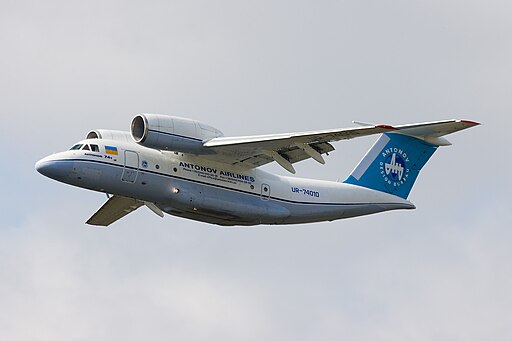
Antonov An-74
The Antonov An-74 is a multi-role transport aircraft developed by the Antonov Design Bureau in the late 1970s. It evolved from the An-72 series to operate in extreme climates, including Arctic and Antarctic regions. Distinguished by its overwing engine pods and rugged landing gear, the An-74 combines short takeoff and landing (STOL) capabilities with all-weather operability. Over four decades of service have seen it perform military, civilian, and scientific missions around the globe.
Design and Development
Origins and Concept
The An-74 concept emerged to address the Soviet Union’s requirement for a versatile airframe capable of supplying remote northern settlements. Leveraging the proven An-72 fuselage and wing structure, Antonov engineers focused on enhancing low-speed thrust and STOL performance. Relocating the turbofan engines above the wing led to the “Coandă effect,” whereby airflow is directed over the wing’s upper surface, increasing lift at low speeds.
Airframe and Structure
The An-74’s airframe shares a high-mounted, straight wing with pronounced dihedral, ensuring exceptional low-speed handling. The aluminum-alloy skin is reinforced at stress points to withstand operations from unprepared runways. Integral wing fuel tanks provide both structural support and extended range. Under the fuselage, a strengthened keel and central cargo bay ramp enable roll-on/roll-off loading of vehicles and large pallets.
Engine Integration
Equipped with two Lotarev D-36 turbofan engines mounted above the wing roots, the An-74 harnesses the Coandă effect to generate additional lift during takeoff and landing. Each D-36 produces 63.7 kN (14,330 lbf) of thrust, optimized for high-lift operation. The engine’s low bypass ratio trade-off offers robust performance in sub-zero temperatures, where icing and ingestion concerns are paramount.
Variants
The An-74 family encompasses multiple specialized versions:
- An-74T – Basic transport variant with reinforced cargo floor and minimalist avionics.
- An-74TK – Civilian passenger version accommodating up to 52 seats in a high-density layout.
- An-74TK-100 – Upgraded TK with modernized cockpit displays and environmental controls.
- An-74MP – Maritime patrol variant fitted with radar underglass and mission consoles.
- An-74P – Polar version equipped with ski undercarriage for snow and ice field operations.
- An-74TK-200 – Further avionics enhancements, extended-range tanks, and increased payload.
Technical Specifications
Dimensions
| Parameter | Value |
|---|---|
| Wingspan | 31.89 m |
| Length | 28.85 m |
| Height | 9.47 m |
| Wing Area | 90.4 m² |
| Fuselage Diameter | 3.8 m |
Weight
| Parameter | Value |
|---|---|
| Empty Operating Weight | 17,000 kg |
| Maximum Takeoff Weight | 32,500 kg |
| Maximum Landing Weight | 32,500 kg |
| Payload Capacity | 8,000 kg |
Performance
| Parameter | Value |
|---|---|
| Maximum Speed (Vne) | 900 km/h |
| Cruise Speed | 750 km/h |
| Stall Speed (Landing) | 155 km/h |
| Service Ceiling | 12,500 m |
| Range (with max fuel) | 4,250 km |
| Takeoff Run (MTOW) | 620 m |
| Landing Run | 540 m |
Powerplant
- Engines: 2 × Lotarev D-36 Series 3 turbofans
- Thrust per Engine: 63.7 kN (14,330 lbf)
- Specific Fuel Consumption (Cruise): 0.67 kg/(kg·h)
Avionics and Systems
- Dual-channel autopilot with automatic approach and go-around modes
- Weather radar housed within a ventral radome
- Satellite navigation (GLONASS/GPS) integrated with Flight Management System
- Redundant electrical system with auxiliary power unit (APU) for ground operations
- Environmental control system capable of minus 60 °C ambient operation
Cabin and Payload
- Cargo bay dimensions: 13.45 m × 2.45 m × 2.2 m (length × width × height)
- Rollerized floor for pallet transfer
- Tie-down fittings for 24 pallet positions (2.44 × 3.2 m pallets)
- Sidewall windows and individual passenger oxygen outlets in troop transport configuration
Landing Gear
- Tricycle configuration with dual wheels on main gear bogies
- Reinforced oleo-pneumatic shock absorbers
- Maximum tire pressure: 6.5 bar
- Ski attachments for polar operation variant
Fuel Capacity
- Wing tanks: 9,200 L total
- Optional auxiliary pods: 2,400 L each underwing
- Maximum ferry range configuration: 6,100 km
Operational History
Early Service
Following its maiden flight in June 1977, the An-74 entered Soviet military service in 1983. Early deployments focused on Arctic resupply missions and establishing year-round air links to remote research stations. Its STOL prowess allowed operations from ice runways under temperatures as low as −60 °C.
Civil and International Use
By the 1990s, civilian airlines adopted the TK and TK-100 versions for regional cargo and passenger routes in Siberia and northern Europe. Governments and research institutes in Canada, South Korea, and China procured An-74s for polar exploration and maritime surveillance duties. Several air forces employ the MP and TK-200 for coastal patrol and troop transport missions.
Notable Missions
- Annual Antarctic supply flights to the Argentinian and Chilean research bases.
- Arctic Search and Rescue exercises within the Russian Far East.
- Humanitarian aid deliveries following Alaska pipeline storms in 1997.
Operators
Major operators include:
- Russian Air Force and Arctic Rescue Service
- State airlines of Ukraine and Kazakhstan
- Chilean Air Force (Antarctic operations)
- South Korean Ministry of Oceans and Fisheries
- Private logistic firms serving remote mining sites in Canada
Maintenance and Upgrades
Structural Overhauls
Periodic checks of wing skin panels, fuselage frames, and landing gear struts follow a 2,000-hour or 24-month cycle. Improved corrosion-resistant alloys have become standard in refurbishments, extending airframe life by 20%.
Avionics Modernization
Recent retrofits replace analog gauges with glass cockpit suites from Western manufacturers. These upgrades include enhanced terrain awareness warning systems (TAWS) and digital flight data recorders, improving safety margins in IFR and low-visibility operations.
Engine Service
Full D-36 engine overhauls occur every 4,000 flight hours. Operators often install updated compressor blades with erosion-resistant coatings to reduce maintenance intervals in sandy or sea-salt environments.
Conclusion
The Antonov An-74 stands as a testament to adaptive design, merging STOL capability with all-weather versatility. Its unique overwing engines, combined with a reinforced structure and flexible payload options, allow it to tackle missions unreachable by conventional transports. Decades of incremental upgrades have kept the platform relevant, and ongoing avionics and materials improvements promise continued service well into the 21st century.
