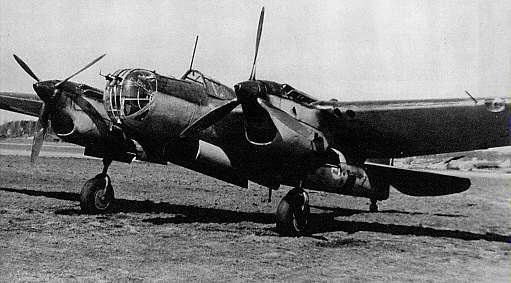
The Tupolev ANT-40, later designated as the SB (Skorostnoy Bombardirovshchik, or High-Speed Bomber), was a Soviet twin-engine medium bomber developed in the mid-1930s. It was one of the first all-metal, high-speed military aircraft of its class and represented a significant technological leap for the Soviet Union. The ANT-40 played a critical role in conflicts such as the Spanish Civil War, the Battle of Khalkhin Gol, and the early stages of World War II.
The aircraft emerged from an effort to design a bomber capable of outrunning contemporary fighter aircraft. At the time of its introduction, it was among the fastest bombers in the world, combining streamlined aerodynamics, metal construction, and powerful engines.
Design and Development Origins
Development of the ANT-40 began in 1933 under the supervision of Andrei Tupolev. Aerodynamic efficiency was a core focus, resulting in a low-wing monoplane structure with retractable landing gear and smooth skin panels. The engineers employed stressed-skin construction using aluminum alloys, marking a departure from mixed-material or fabric-covered aircraft common in earlier Soviet designs.
Initial prototypes were powered by imported Hispano-Suiza engines, but production models transitioned to domestically manufactured Klimov M-100 and M-103 engines. Testing revealed a need for refined engine cooling and structural reinforcement, leading to progressive improvements before entering mass production.
Airframe and Structural Characteristics
The ANT-40 featured a semi-monocoque fuselage with oval cross-sections to reduce drag and maximize internal space. The wings were built with two main spars and metal skinning, providing rigidity while keeping weight within acceptable limits. The tail assembly consisted of a conventional vertical stabilizer and horizontal tailplane with trim controls.
The crew compartment was divided into positions for the pilot, navigator/bombardier, and rear gunner. Glass panels in the nose granted visibility for bombing runs and navigation. The cockpit canopy was streamlined, enhancing airflow and reducing aerodynamic resistance.
Powerplant and Propulsion
The most widely used engines for production ANT-40 variants were:
-
Klimov M-100: A liquid-cooled V-12 delivering around 860 horsepower
-
Klimov M-103: An upgraded version with approximately 960 horsepower
-
Klimov M-105: Later installations brought power close to 1,100 horsepower per engine
Each engine drove a variable-pitch, three-bladed propeller. Engine nacelles were integrated into the wing structure and housed radiators, fuel systems, and oil coolers. Performance varied with engine type, but the aircraft remained competitive in speed and climb rate throughout the 1930s.
Performance Capabilities
At the time of its introduction, the ANT-40 could achieve a maximum speed of around 430 to 450 kilometers per hour depending on variant and altitude. Cruise speed typically ranged between 360 and 380 kilometers per hour. The operational range was approximately 1,200 kilometers with standard fuel loads and bomb payloads.
The aircraft could fly at service ceilings near 9,000 meters, though typical combat missions occurred at medium altitudes. Its acceleration and climb rate allowed crews to perform tactical bombing, reconnaissance, and rapid withdrawal operations with greater survivability than earlier biplane bombers.
Armament and Bombing Systems
The ANT-40 carried both defensive and offensive systems suited to its mission profile. The bomb load capacity was generally between 600 and 1,000 kilograms, depending on bomb type and range requirements. Internal bomb racks were located in the fuselage, and smaller ordnance could be mounted under the wings.
Defensive armament initially consisted of 7.62 mm ShKAS machine guns in nose, dorsal, and ventral positions. Later models incorporated heavier or twin-mounted guns to counter improved enemy fighters. The bombardier used a bombsight in the glazed nose for targeting, allowing precision during level bombing runs.
Crew Configuration
The typical configuration included three crew members:
-
Pilot in the forward cockpit with access to flight controls and basic instruments
-
Navigator and bombardier in the nose with navigation charts, bombsight, and forward-firing defensive armament
-
Rear gunner in a dorsal station with rotating gun mount and optional ventral armament
Some versions introduced a fourth crew position for radio operations or additional gun coverage. The internal layout placed priority on accessibility and field maintenance rather than crew comfort.
Landing Gear and Ground Operations
The ANT-40 used a retractable taildragger landing gear system, which was relatively advanced for its time. The main landing gear folded into the engine nacelles, reducing drag during flight. The tailwheel was fixed or semi-retractable depending on the production batch.
Landing gear components were reinforced to support operations from unpaved or semi-prepared airfields, a common requirement for Soviet military aviation. Maintenance crews could service wheels, brakes, and hydraulics through access panels in the nacelles.
Operational Use and Combat History
The ANT-40 saw its first combat service in the Spanish Civil War under the designation SB-2, where it demonstrated high-speed bombing capabilities and outperformed many interceptors of the era. It also participated in the Battle of Khalkhin Gol against Japanese forces and served extensively in the Winter War with Finland.
At the start of World War II, the aircraft was still in front-line use but increasingly vulnerable to newer enemy fighters. Large numbers were destroyed during Operation Barbarossa due to limited warning time, inadequate airfield defenses, and the rapid advancement of the Luftwaffe.
Despite losses, the ANT-40 continued to serve as a bomber, reconnaissance platform, and training aircraft. It remained operational in allied air forces such as China and Czechoslovakia.
Variants and Modifications
Numerous variants were developed to address mission requirements and improve performance:
-
ANT-40 RTs: Early prototypes with foreign engines
-
SB-2 with M-100 engines
-
SB-2M-103 with upgraded Klimov M-103 engines
-
SB-2M-105 with improved armament and M-105 powerplants
-
High-altitude and reconnaissance models with reduced armament and extended range
-
Export versions adapted to client nations’ standards
Each successive version addressed combat feedback and incorporated structural and mechanical refinements.
Dimensions and Technical Parameters
-
Length: 12.24 meters
-
Wingspan: 20.33 meters
-
Height: 3.3 meters
-
Wing area: 56.7 square meters
-
Empty weight: approximately 5,200 kilograms
-
Maximum takeoff weight: around 8,000 kilograms
-
Engines: 2 × Klimov M-100, M-103, or M-105 depending on version
-
Maximum speed: up to 450 km/h
-
Cruise speed: around 370 km/h
-
Range: up to 1,200 kilometers
-
Service ceiling: about 9,000 meters
-
Crew: 3 to 4
-
Bomb load: up to 1,000 kilograms
-
Defensive guns: 7.62 mm ShKAS, later upgraded configurations
Maintenance and Reliability
The ANT-40 required regular servicing due to the complexity of liquid-cooled engines and hydraulic systems. However, its metal airframe simplified structural repairs compared to earlier mixed-construction designs. Field depots stocked common engine and airframe components, and many systems were accessible through removable panels.
Crews learned to adapt operations to varying climates, from Spain’s heat to harsh Soviet winters. Engine cooling and radiator management required particular attention to prevent overheating or freezing.
Legacy and Influence
The Tupolev ANT-40 marked a pivotal step in Soviet bomber development, influencing later designs such as the Tupolev Tu-2. Although overshadowed by rapid advancements in aviation technology during World War II, it demonstrated the viability of high-speed bombers and contributed tactical insights for future designs.
Despite heavy losses in the early 1940s, the ANT-40’s success in the late 1930s validated Soviet emphasis on speed, metal construction, and aerodynamic efficiency. Surviving aircraft served into the mid-1940s and beyond in secondary roles.
Conclusion
The Tupolev ANT-40 was a groundbreaking design that elevated Soviet aviation standards. With its metal structure, twin-engine configuration, and advanced aerodynamics, it set the stage for more capable bombers in wartime and postwar service. Its operational record across multiple conflicts and international theaters underscores its importance as a milestone in military aviation history.