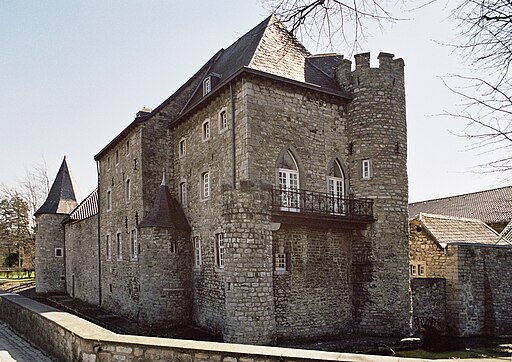
Burg Raeren is a well-preserved medieval moated castle located in the village of Raeren near Aachen, in the German-speaking region of eastern Belgium. Surrounded by a tranquil landscape of meadows, woodland, and gently flowing water, the castle stands as a distinctive example of fortified residential architecture typical of the late Middle Ages. Today, Burg Raeren is best known for housing a renowned pottery museum that highlights the village’s centuries-old ceramic tradition. Its striking stone structure, inner courtyard, and historic charm make it a notable cultural landmark that connects the present with the artistic and architectural heritage of the region.
Early Origins and Medieval Construction
The origins of Burg Raeren date back to the fourteenth century, when the site was established as a fortified residence for a local noble family. Unlike hilltop castles built for large-scale defense, Burg Raeren was conceived as a moated manor, relying on its surrounding water installations, thick stone walls, and compact layout for protection. Its construction included a main residential building, agricultural outbuildings, and defensive features adapted to the needs of a noble estate in a relatively peaceful but politically complex border region. The close proximity to Aachen and the shifting influences of regional powers meant that the estate had to combine domestic comfort with a practical degree of fortification.
Architectural Characteristics
The architecture of Burg Raeren reflects the transition from medieval defensive forms to early modern residential design. Its central structure is characterized by robust stone masonry, irregular yet functional geometry, and multiple wings enclosing an inner courtyard. The building is partially surrounded by a water-filled moat that enhances the castle’s atmosphere and provides insight into the practical considerations of medieval estate planning. Over time, modifications introduced larger windows, improved living spaces, and architectural refinements that aligned with evolving tastes. Nevertheless, the castle retains a distinctly medieval character in its overall silhouette, masonry techniques, and spatial organization.
Noble Families and Changing Ownership
Over the centuries, Burg Raeren changed hands among several noble families who shaped the estate through renovations, expansions, and administrative use. These families managed surrounding lands, collected dues, and oversaw local justice systems within their jurisdiction. The castle served not only as a residence but also as a center of rural authority, reflecting the feudal structures that shaped life in the region. As political landscapes evolved, particularly with the influence of the Duchy of Limburg, the Spanish and Austrian Netherlands, and later the Prussian administration, the castle’s role adjusted to accommodate new forms of governance and land management.
Integration into Regional Pottery Culture
From the sixteenth century onward, Raeren earned a significant reputation for its salt-glaze stoneware, which was exported across Europe. Although Burg Raeren itself was not directly involved in pottery production, the cultural and economic environment surrounding it profoundly influenced the estate’s later identity. The wealth generated by the pottery industry contributed to local prosperity and shaped the material culture of the region. By the twentieth century, when efforts began to preserve Burg Raeren as a heritage site, its transformation into a museum dedicated to Raeren pottery emerged as a natural extension of the village’s longstanding artisanal tradition.
Restoration and Conversion into a Museum
By the late nineteenth and early twentieth centuries, Burg Raeren required significant restoration due to aging structures and environmental wear. Preserving the castle’s architectural integrity became a priority, especially as interest in regional history and material culture gained momentum. Restoration efforts stabilized the masonry, repaired roofs and wooden elements, and revitalized the interior spaces. The conversion into the pottery museum further ensured that the estate would remain accessible and meaningful to the public. Museum installations were integrated carefully, using the existing rooms to showcase ceramics, historical artifacts, and interpretive displays without diminishing the building’s historic atmosphere.
The Pottery Museum and Cultural Significance
The museum within Burg Raeren has become one of the most important institutions dedicated to stoneware in Europe. Its collections include medieval and early modern ceramics from Raeren as well as examples from other pottery centers in the Rhineland. Exhibitions illustrate the development of regional ceramic styles, production techniques, trade routes, and the daily life of potters. The museum’s presence transforms the castle into a vibrant cultural space where history, craftsmanship, and architectural heritage converge. This combination enhances the castle’s role as both a historical monument and a cultural anchor within the German-speaking community of Belgium.
Surroundings and Landscape
The setting of Burg Raeren enhances its historical character. The moat encircling the castle is fed by local watercourses that contribute to the estate’s serene atmosphere. The surrounding countryside features narrow lanes, traditional houses, and rolling green landscapes typical of the Eifel foothills. This pastoral environment underscores the castle’s original function as a rural noble estate and allows visitors to imagine the rhythms of medieval and early modern life. Footpaths around the castle connect it to the village and the wider natural landscape, making it a rewarding destination for those who appreciate historical architecture within a peaceful rural context.
Visiting Burg Raeren Today
Modern visitors to Burg Raeren can explore a well-maintained heritage site that combines architectural beauty with educational depth. The museum’s exhibitions guide visitors through centuries of pottery craftsmanship, while the castle’s preserved spaces allow them to experience the living environment of historical nobility. Seasonal events, workshops, and cultural programs enrich the visit, offering hands-on experiences and insights into both history and ceramic arts. Together, these elements make Burg Raeren a distinctive cultural attraction that bridges the medieval past with contemporary appreciation of regional identity and artistic tradition.
