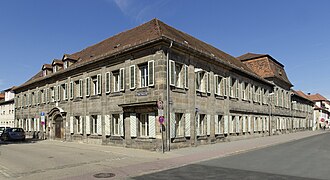
Egloffsteinsches Palais (Erlangen): A Refined Echo of Baroque Elegance
In the quiet elegance of Franconian towns, where history is not shouted but softly spoken through façades, courtyards, and cobblestone streets, one encounters buildings that seem to carry entire centuries within their walls. Among these, the Egloffsteinsches Palais (Erlangen) stands as a remarkable yet often overlooked testament to aristocratic life, architectural refinement, and the cultural ambitions of a region that has long balanced intellectual vigor with aesthetic sensitivity.
Unlike grand royal palaces that dominate guidebooks and tourist itineraries, this palais belongs to a more intimate tradition of noble urban residences. It does not overwhelm with scale but instead invites attention through proportion, harmony, and detail. It is a building that reveals itself slowly—through its façade, its historical context, and its quiet integration into the urban fabric of Erlangen.
In this extensive blog-style exploration, we will delve deeply into the story of the Egloffsteinsches Palais in Erlangen: its origins, its architectural features, the noble family that commissioned it, its relationship to the city’s development, and its enduring relevance today. This is not merely the story of a building—it is a journey into the cultural and social landscape of early modern Franconia.
Erlangen: A City of Order and Enlightenment
A Planned Baroque City
To understand the Egloffsteinsches Palais, one must first understand Erlangen itself. Unlike many German towns that evolved organically over centuries, Erlangen is notable for its planned urban layout. Much of the city’s development took place during the Baroque period, when rulers sought to impose order, symmetry, and rationality onto urban space.
This transformation was closely linked to the arrival of Huguenot refugees in the late 17th century, who were invited to settle in Erlangen by the Margraves of Brandenburg-Bayreuth. Their presence led to the expansion of the city and the creation of a new town characterized by straight streets, uniform façades, and a sense of architectural coherence.
Within this structured environment, buildings like the Egloffsteinsches Palais were not isolated statements but integral parts of a broader vision. They contributed to the city’s identity as a place of refinement, tolerance, and intellectual progress.
A Center of Learning
Erlangen is also home to the renowned Friedrich-Alexander-Universität Erlangen-Nürnberg, an institution that has shaped the city’s character for centuries. The presence of the university brought scholars, students, and cultural activity, creating an environment in which ideas flourished alongside architecture.
The Egloffsteinsches Palais exists within this context—a city where knowledge, culture, and design intersect in subtle but meaningful ways.
The Egloffstein Family: Nobility in Franconia
Origins and Influence
The Egloffstein family, whose name the palais bears, was a prominent noble lineage in Franconia. Their roots stretch back to the medieval period, and over time they established themselves as influential figures within the region’s political and social structures.
Like many noble families, the Egloffsteins maintained multiple residences, including rural estates and urban palaces. These urban residences were essential for participating in the life of the city, whether in governance, social events, or cultural patronage.
A Statement of Presence
The construction of the Egloffsteinsches Palais in Erlangen was both practical and symbolic. It provided a residence within a growing and increasingly important city while also serving as a visible expression of the family’s status.
In an era when architecture was a primary means of communication, the palais spoke volumes. Its design, location, and features conveyed wealth, taste, and alignment with contemporary trends.
The Birth of the Palais
Historical Context
The Egloffsteinsches Palais was constructed during the 18th century, a time when Baroque architecture dominated much of Europe. This was a period marked by artistic innovation, cultural exchange, and a growing emphasis on aesthetics as a reflection of power.
In Erlangen, the Baroque style found fertile ground, aligning perfectly with the city’s planned layout and the ambitions of its rulers and residents.
Architectural Intent
Unlike medieval castles, which were designed primarily for defense, the palais was conceived as a residence of comfort and elegance. Its purpose was not to repel invaders but to impress visitors, to host gatherings, and to provide a refined living environment.
This shift in purpose is reflected in every aspect of the building’s design, from its symmetrical façade to its carefully arranged interior spaces.
Architectural Features: Harmony and Detail
The Façade
The façade of the Egloffsteinsches Palais is a study in balance and proportion. It embodies the principles of Baroque architecture without resorting to excessive ornamentation. Instead, it achieves its effect through the careful arrangement of elements—windows, pilasters, and decorative details that create a sense of rhythm and cohesion.
The entrance serves as a focal point, drawing the eye and inviting entry. It is both functional and symbolic, marking the transition from the public street to the private world of the palais.
Interior Design
While detailed records of the interior may be limited, it is reasonable to imagine spaces characterized by high ceilings, large windows, and elegant decoration. Rooms would have been arranged to accommodate both private living and social interaction, reflecting the dual role of the palais as a home and a social venue.
Decorative elements such as stucco work, frescoes, and finely crafted furnishings would have contributed to an atmosphere of refinement and comfort.
Life Within the Palais
Social and Cultural Activity
The Egloffsteinsches Palais would have been a center of social activity, hosting gatherings that brought together members of the nobility, scholars, and other influential figures. These events were not merely social—they were opportunities for networking, discussion, and the exchange of ideas.
In a city like Erlangen, where intellectual and cultural life was vibrant, such interactions played a crucial role in shaping the community.
Daily Rhythms
Daily life in the palais would have been structured yet dynamic. Servants managed the household, ensuring that everything functioned smoothly, while the family members engaged in their various responsibilities and pursuits.
From managing estates to participating in city affairs, the residents of the palais lived lives that were both privileged and complex.
Erlangen in the 18th Century
A City in Transformation
During the 18th century, Erlangen was undergoing significant transformation. Its population was growing, its economy was developing, and its cultural life was flourishing.
The presence of noble families and institutions like the Friedrich-Alexander-Universität Erlangen-Nürnberg contributed to this growth, creating a dynamic environment in which architecture and culture evolved together.
Baroque Influence
The Baroque style that defines the Egloffsteinsches Palais was part of a broader movement that influenced not only architecture but also art, music, and philosophy. It was a style that emphasized grandeur, movement, and emotional impact, reflecting the aspirations of the time.
Transformation and Adaptation
Changing Times
As the political and social landscape of Europe changed, so too did the role of buildings like the Egloffsteinsches Palais. The decline of noble power and the rise of modern states led to new uses and new meanings.
The palais may have been repurposed for administrative, educational, or other functions, reflecting the evolving needs of the city.
Preservation
The survival of the palais into the modern era is a testament to the importance of preservation. Efforts to maintain and protect the building ensure that it remains a part of Erlangen’s cultural heritage.
The Palais Today
A Living Part of the City
Today, the Egloffsteinsches Palais continues to be part of the urban landscape, contributing to the character and identity of Erlangen.
It may no longer serve its original purpose, but it remains a symbol of the city’s history and cultural development.
A Quiet Landmark
Unlike more prominent landmarks, the palais does not draw large crowds. Yet for those who seek it out, it offers a rewarding experience—a chance to connect with history in a more intimate and reflective way.
Exploring Erlangen: Beyond the Obvious
Discovering Hidden Gems
Erlangen is a city that rewards exploration. While its main attractions are well known, it is the lesser-known sites like the Egloffsteinsches Palais that often leave the deepest impression.
These hidden gems provide a more nuanced understanding of the city, revealing layers of history that might otherwise go unnoticed.
A City of Balance
What makes Erlangen unique is its balance between past and present, between tradition and innovation. The palais is a perfect example of this balance, standing as a reminder of the city’s heritage while coexisting with its modern identity.
Why Egloffsteinsches Palais Matters
A Reflection of Its Time
The palais is more than just a building—it is a reflection of the values, aspirations, and lifestyle of the era in which it was built. It tells a story of refinement, ambition, and cultural engagement.
Preserving Cultural Identity
By preserving and appreciating such structures, we maintain a connection to the past and ensure that the stories they embody are not lost.
Final Reflections: The Quiet Power of Elegance
There is a particular kind of beauty in buildings that do not demand attention but reward it. The Egloffsteinsches Palais (Erlangen) is one such place. It stands quietly, gracefully, offering its story to those who are willing to listen.
In its proportions, its details, and its history, it captures something essential about the human desire to create, to express, and to endure. It reminds us that greatness is not always found in scale or spectacle but often in subtlety, balance, and intention.
