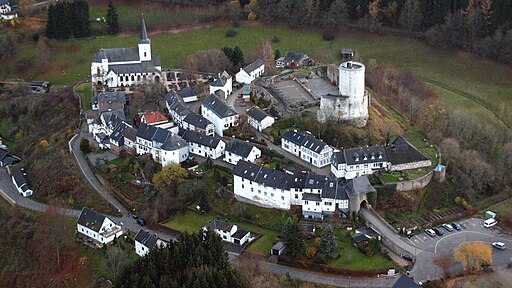
Reifferscheid Castle is a striking medieval fortress whose ruins still dominate the landscape of the northern Eifel region in Germany. Rising above the small village of Reifferscheid, the castle occupies a rocky hill spur that was carefully chosen for both defensive strength and symbolic authority. From this elevated position, the castle once controlled trade routes, agricultural lands, and political life in the surrounding valleys. Although today it survives mainly as a ruin, Reifferscheid Castle continues to convey a powerful sense of medieval ambition, regional power, and architectural ingenuity shaped by centuries of conflict and adaptation.
Geographic Setting and Strategic Importance
The location of Reifferscheid Castle was central to its historical importance. Built on a steep rocky outcrop overlooking the Olef Valley, the fortress benefited from natural defenses on several sides, reducing the need for extensive artificial fortifications. Dense forests, narrow access paths, and commanding views allowed its occupants to monitor movement across the region and respond quickly to threats or opportunities. This strategic position also helped the castle function as a center of administration and control, reinforcing the authority of its lords over surrounding settlements and farmland. The geography of the Eifel, with its rugged terrain and limited access routes, made castles like Reifferscheid vital instruments of medieval power.
Early History and Noble Foundations
The origins of Reifferscheid Castle date back to the High Middle Ages, when noble families sought to consolidate their influence through fortified residences. The castle became the seat of the Lords of Reifferscheid, a noble lineage that played a significant role in regional politics. These early lords were closely connected to larger feudal networks, balancing loyalty to powerful ecclesiastical and secular rulers while defending their own interests. The castle served not only as a military stronghold but also as a symbol of legitimacy and status, demonstrating the family’s ability to protect their lands and subjects.
Architectural Design and Fortifications
Reifferscheid Castle displayed many characteristic features of medieval fortress architecture, adapted to its rocky setting. Thick stone walls, defensive towers, and elevated curtain walls created a formidable barrier against attack. The keep, once the strongest and most important structure within the castle, functioned as both a final refuge and a visible sign of authority. Over time, the complex expanded to include residential buildings, storage areas, and defensive outer walls that reflected evolving military technology and changing needs. The layout of the castle illustrates how medieval builders blended practical defense with residential comfort, especially as periods of relative stability allowed for more elaborate living spaces.
Life Within the Castle Walls
Daily life at Reifferscheid Castle extended far beyond military concerns. The castle was a hub of administration, justice, and economic management for the surrounding region. Nobles, servants, craftsmen, and soldiers all lived and worked within its walls, creating a small but complex community. Food storage, water supply, and workshops were carefully planned to ensure survival during sieges and harsh winters. Religious practices also played a role, with chapels and devotional spaces reflecting the spiritual life of the inhabitants. The rhythms of castle life were shaped by seasonal cycles, feudal obligations, and the constant awareness of potential conflict.
Conflicts, Decline, and Destruction
Like many medieval castles, Reifferscheid faced repeated challenges during periods of political instability and warfare. Regional feuds, larger territorial disputes, and later conflicts such as early modern wars gradually weakened the castle’s military relevance. Advances in artillery reduced the effectiveness of traditional fortifications, making hilltop castles increasingly vulnerable. Over time, the costs of maintenance outweighed the benefits, and the castle fell into decline. Damage from warfare and neglect eventually led to its partial destruction, transforming it from a living stronghold into a ruin.
Preservation and Modern Significance
Today, Reifferscheid Castle stands as a protected historical site, valued for its cultural and architectural significance. Conservation efforts aim to stabilize the remaining structures while preserving the authentic character of the ruins. Visitors can explore the castle grounds, walk along surviving walls, and appreciate panoramic views that once served defensive purposes. The castle has become an important landmark for local identity, tourism, and historical education, connecting modern audiences with the medieval past of the Eifel region.
Cultural Legacy and Historical Meaning
Reifferscheid Castle represents more than the remains of stone walls and towers; it embodies the broader story of medieval society, power, and adaptation. Its rise reflects the ambitions of noble families seeking security and authority, while its decline illustrates the changing nature of warfare and governance. As a ruin, it invites reflection on the passage of time and the ways human structures are shaped, used, and eventually reclaimed by history. Reifferscheid Castle continues to stand as a testament to medieval resilience, regional heritage, and the enduring fascination with Europe’s fortified past.
