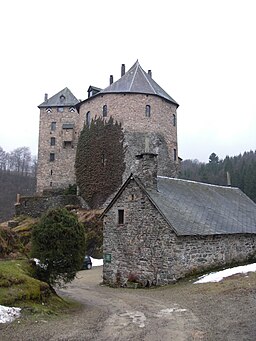
Reinhardstein Castle, also known as Burg Metternich, is one of the most evocative medieval fortresses in eastern Belgium, dramatically perched on a rocky spur above the Warche Valley in the Ardennes. Surrounded by dense forests and steep slopes, the castle appears almost carved from the landscape itself, embodying the defensive logic and aesthetic sensibilities of medieval military architecture. Although its present appearance reflects extensive restoration, Reinhardstein Castle preserves the atmosphere of a fortified residence that once played a crucial role in controlling territory, trade, and political influence in a contested border region.
Landscape and Strategic Position
The site of Reinhardstein Castle was carefully selected for its natural defensive advantages. The steep cliffs overlooking the Warche River made direct assaults difficult, while the surrounding forests limited access and visibility for approaching forces. From this elevated position, the castle’s occupants could oversee key routes connecting the Ardennes to neighboring regions, allowing them to monitor trade movements and military activity. This strategic placement was particularly important in a region frequently shaped by shifting borders, feudal rivalries, and external threats, making Reinhardstein a vital stronghold in the medieval defensive network.
Medieval Origins and Feudal Authority
Reinhardstein Castle was founded in the 14th century during a period of intense feudal competition. It served as the seat of local lords who sought to assert control over their lands while maintaining allegiance to higher-ranking nobles and ecclesiastical powers. The castle was both a military installation and an administrative center, where decisions affecting taxation, justice, and land management were made. Its presence reinforced feudal authority, projecting power not only through armed defense but also through its imposing silhouette, which symbolized order and dominance in the surrounding countryside.
Architectural Structure and Defensive Features
The architecture of Reinhardstein Castle reflects the military priorities of its time while adapting to the constraints of its rocky environment. Thick stone walls, narrow passageways, and elevated towers formed a layered defensive system designed to repel attackers and withstand sieges. The central keep served as the heart of the castle, offering both protection and living quarters for the lord and his household. Additional buildings, including stables, storerooms, and service areas, were integrated within the fortified enclosure, demonstrating how medieval castles functioned as self-sufficient complexes rather than purely military outposts.
Domestic Life and Social Organization
Life within Reinhardstein Castle was structured by hierarchy, routine, and the constant need for preparedness. The lord and his family occupied the most secure and comfortable quarters, while soldiers, servants, and craftsmen supported the daily functioning of the fortress. Food supplies were carefully managed, with storage facilities designed to sustain the inhabitants during prolonged periods of isolation. Religious observance was an integral part of daily life, reflected in the presence of chapels and devotional spaces. Despite its martial appearance, the castle was also a place of administration, hospitality, and social interaction, hosting guests, negotiating alliances, and reinforcing feudal bonds.
Decline and Period of Abandonment
Over time, Reinhardstein Castle lost its strategic importance as political conditions changed and military technology evolved. The rise of artillery reduced the effectiveness of medieval fortifications, while shifting power structures diminished the need for isolated hilltop strongholds. The castle gradually fell into disuse and was eventually abandoned, leading to centuries of decay. Stones were removed for local construction, roofs collapsed, and vegetation reclaimed much of the structure, transforming the once-formidable fortress into a romantic ruin that reflected both the passage of time and the changing nature of warfare.
Restoration and Twentieth-Century Revival
In the 20th century, Reinhardstein Castle underwent a remarkable revival through extensive restoration efforts. Dedicated individuals recognized the historical and cultural value of the site and worked to reconstruct large portions of the castle using traditional techniques and historical research. This restoration aimed not to modernize the structure, but to revive its medieval character as authentically as possible. As a result, Reinhardstein Castle today offers a rare opportunity to experience a medieval fortress that feels both historically grounded and architecturally complete.
Modern Role and Cultural Significance
Today, Reinhardstein Castle serves as a museum and cultural landmark, attracting visitors from around the world. Its restored halls, towers, and courtyards provide insight into medieval architecture, craftsmanship, and daily life. The castle also plays an important role in regional identity, highlighting the Ardennes’ rich historical heritage and its position at the crossroads of European history. Through guided tours, educational programs, and cultural events, Reinhardstein Castle bridges the gap between past and present, allowing modern audiences to engage directly with the legacy of the Middle Ages.
Enduring Legacy of Reinhardstein Castle
Reinhardstein Castle stands as a powerful example of how medieval fortresses evolved, declined, and were ultimately rediscovered by later generations. Its story reflects broader themes of feudal ambition, architectural adaptation, and historical preservation. Rising above the Warche Valley, the castle continues to command attention, not through military might, but through its ability to evoke the complexities of medieval life and the enduring human desire to preserve and understand the past.
