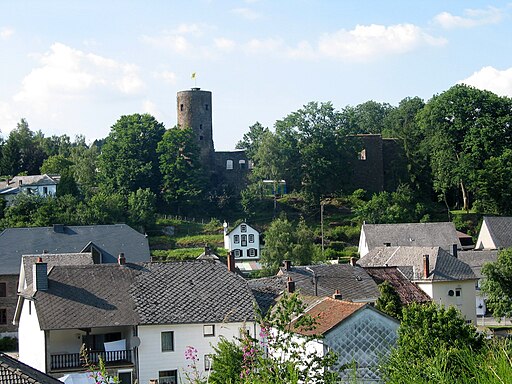
Burg Reuland is one of the most extensive and impressive castle ruins in Belgium, dominating the village of Reuland in the country’s eastern Ardennes region. Perched on a rocky hill above the Our Valley, the castle’s vast remains testify to centuries of political ambition, military adaptation, and regional power. Unlike many smaller fortresses, Burg Reuland developed into a large and complex stronghold, reflecting its long occupation and its importance within the shifting feudal landscape of medieval Europe. Even in ruin, the scale of the site conveys the authority once exercised from its walls.
Geographic Setting and Strategic Role
The strategic value of Burg Reuland was deeply tied to its location. Positioned near historic borders between powerful territories, the castle overlooked important routes linking the Ardennes to the Rhine region. The elevated site offered wide visibility over the surrounding valleys, while the natural contours of the hill strengthened its defenses. Forested slopes and steep approaches made direct attacks difficult, allowing the castle’s defenders to rely on both nature and architecture for protection. This advantageous setting made Burg Reuland a key stronghold in regional power struggles and border defense.
Origins and Early Development
The origins of Burg Reuland can be traced back to the early Middle Ages, when local nobles began constructing fortified residences to secure their lands. Initially modest in scale, the castle expanded steadily as its owners gained wealth and influence. Over successive generations, new walls, towers, and residential buildings were added, transforming the site into a formidable fortress. Each phase of construction reflected changing military needs and architectural styles, creating a layered structure that mirrored the evolving history of the region itself.
Architectural Scale and Defensive Complexity
Burg Reuland stands out for the sheer size and complexity of its fortifications. Multiple defensive walls enclosed different sections of the castle, creating zones that served military, residential, and administrative functions. Massive stone towers guarded entrances and vulnerable points, while elevated battlements allowed defenders to control the surrounding landscape. The castle’s layout reveals careful planning, with narrow access routes, protected courtyards, and reinforced gates designed to slow or repel attackers. This complexity underscores the castle’s role as a major defensive center rather than a simple noble residence.
Residential Life and Noble Authority
Beyond its military role, Burg Reuland was a center of noble life and governance. The residential quarters within the castle provided space for the lord’s household, guests, and administrative staff. Large halls served as venues for feasts, legal proceedings, and political negotiations, reinforcing the castle’s function as a seat of authority. Daily life within the walls was shaped by rigid social hierarchies, with servants, craftsmen, and soldiers supporting the noble family’s lifestyle. The castle thus functioned as both a fortress and a symbol of feudal order.
Political Conflicts and Changing Ownership
Throughout its history, Burg Reuland was drawn into regional conflicts and power struggles. Its strategic position made it a valuable prize, and ownership of the castle changed hands multiple times due to alliances, inheritance, and warfare. These shifts often led to periods of renovation or reinforcement, as new lords adapted the castle to their needs. However, repeated conflicts also brought destruction and strain, gradually undermining the castle’s ability to function as a secure stronghold.
Decline and Abandonment
The decline of Burg Reuland was a gradual process influenced by broader historical changes. Advances in military technology, particularly the increasing use of artillery, reduced the effectiveness of medieval fortifications. At the same time, political centralization and changing patterns of residence made large hilltop castles less practical. Maintenance became increasingly costly, and parts of the castle fell into disrepair. Eventually, Burg Reuland was abandoned, allowing nature and time to transform it into the ruin seen today.
Preservation and Archaeological Value
Despite its ruined state, Burg Reuland remains an important historical and archaeological site. Conservation efforts have focused on stabilizing the remaining structures while preserving their authentic character. The extensive ruins offer valuable insights into medieval construction techniques, defensive planning, and daily life. Archaeological studies continue to reveal details about the castle’s development and the people who lived and worked there, enriching our understanding of the region’s past.
Cultural and Regional Significance
Today, Burg Reuland is a prominent landmark that connects modern visitors with the medieval history of the Ardennes. Its imposing ruins serve as a reminder of the region’s role as a crossroads of cultures and political interests. The castle contributes to local identity and tourism, drawing visitors who seek to explore its vast grounds and imagine its former grandeur. Burg Reuland endures not merely as a relic of stone, but as a powerful symbol of resilience, transformation, and the enduring imprint of history on the landscape.
