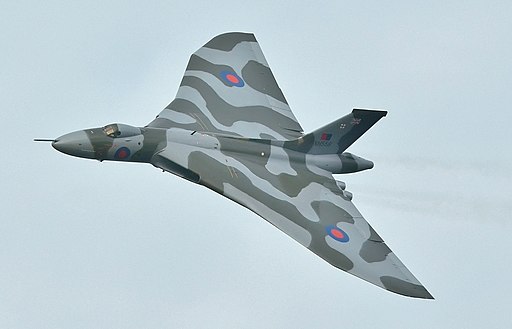
The Avro Vulcan was one of the most iconic and technically ambitious aircraft ever produced by the British aviation industry. As a key component of the United Kingdom’s nuclear deterrent during the Cold War, it represented a radical departure from conventional bomber design. Its distinctive delta-wing configuration, advanced systems, and high-altitude performance made it a symbol of technological innovation and strategic power, while its long service life demonstrated the adaptability of its original design in an era of rapid aerospace development.
Strategic Background and Development
The Avro Vulcan emerged from a late 1940s requirement for a high-altitude, long-range bomber capable of delivering nuclear weapons deep into hostile territory. This requirement was driven by the rapidly evolving geopolitical landscape following the Second World War, particularly the need to counter the growing influence and military capability of the Soviet Union. Traditional piston-engined bombers were no longer viable for this role, prompting the British government to invest heavily in jet propulsion and advanced aerodynamics.
Avro’s design team, led by Roy Chadwick and later Stuart Davies, pursued an unconventional approach centered on a large delta wing. This configuration promised excellent high-altitude efficiency, structural simplicity, and internal volume for fuel and weapons. Extensive wind tunnel testing and experimental aircraft development preceded the Vulcan’s first flight in August 1952, marking a major milestone in British aerospace engineering.
Delta Wing Design and Aerodynamic Principles
The Vulcan’s most defining feature was its large delta wing, spanning approximately 111 feet and covering an enormous surface area. This design allowed the aircraft to achieve both high-speed cruise and stable handling at altitude, while also providing sufficient lift for a heavy payload. The wing structure was thick at the root, enabling the integration of fuel tanks, landing gear, and structural reinforcements without excessive drag.
Aerodynamically, the delta wing offered several advantages, including delayed onset of shock waves at transonic speeds and reduced structural weight compared to conventional swept-wing designs. However, it also introduced challenges, particularly in low-speed handling and landing characteristics. These issues were addressed through careful shaping of the wing’s leading edge and the incorporation of sophisticated control systems, which allowed the Vulcan to operate safely from standard RAF runways.
Airframe Structure and Materials
The Vulcan’s airframe was constructed primarily from aluminum alloys, using a stressed-skin semi-monocoque structure. This approach provided a strong yet lightweight framework capable of withstanding the stresses of high-speed, high-altitude flight. The aircraft’s fuselage was relatively short and blended smoothly into the wing, reducing drag and contributing to its distinctive appearance.
Internal space was carefully managed to accommodate fuel, avionics, and weapons. The bomb bay was integrated into the center section of the wing, allowing the Vulcan to carry large nuclear weapons without significantly compromising aerodynamic efficiency. Structural reinforcement was concentrated in key load-bearing areas, ensuring durability throughout the aircraft’s operational life.
Powerplant and Propulsion System
The Avro Vulcan was powered by four turbojet engines, initially Rolls-Royce Avon units on early prototypes and later more powerful Olympus engines on production aircraft. The Olympus engines were among the most advanced turbojets of their time, providing high thrust and reliability at altitude. Each engine produced over 20,000 pounds of thrust in later variants, enabling the Vulcan to achieve impressive performance for a bomber of its size.
The engines were housed in pairs within the wing roots, minimizing drag and protecting them from foreign object damage. This configuration also simplified maintenance and contributed to the aircraft’s clean aerodynamic profile. Fuel efficiency at high altitude was a key consideration, allowing the Vulcan to maintain long-range capabilities despite the high fuel consumption typical of early jet engines.
Performance Characteristics
The Vulcan was designed for high-altitude penetration, with a service ceiling exceeding 50,000 feet. At these altitudes, it could cruise at speeds approaching Mach 0.9, making interception by contemporary fighters extremely challenging during its early service years. The aircraft’s maximum speed was approximately 645 mph, depending on altitude and configuration.
Operational range was in excess of 4,000 miles with aerial refueling, which later became a standard component of Vulcan operations. Maximum takeoff weight exceeded 200,000 pounds, reflecting the aircraft’s ability to carry heavy weapons and large fuel loads. Despite its size, the Vulcan demonstrated surprisingly agile handling characteristics, a testament to the effectiveness of its aerodynamic design.
Avionics and Navigation Systems
The Vulcan featured an advanced avionics suite for its era, designed to support long-range, all-weather operations. Navigation systems included inertial navigation equipment, radar-based position fixing, and radio aids, enabling precise route planning and execution over vast distances. These systems were continually upgraded throughout the aircraft’s service life to maintain operational relevance.
The bombing and attack systems were integrated with onboard radar, allowing accurate weapon delivery even in poor visibility. Electronic countermeasures were later added to enhance survivability against increasingly sophisticated air defense systems. These upgrades transformed the Vulcan from a pure high-altitude bomber into a more versatile platform capable of adapting to changing threats.
Weapons Capability and Payload
The Vulcan’s primary mission was the delivery of nuclear weapons, and its internal bomb bay was designed to accommodate a range of strategic payloads. Early configurations carried free-fall nuclear bombs, while later modifications allowed the aircraft to deploy stand-off weapons, extending its effective strike range and reducing exposure to enemy defenses.
In addition to nuclear armament, the Vulcan was capable of carrying conventional weapons for secondary roles. This flexibility became particularly important later in its service life, when the aircraft was adapted for conventional bombing missions. The total payload capacity was substantial, reflecting its role as a strategic bomber rather than a tactical aircraft.
Crew Layout and Operational Environment
The standard crew consisted of five personnel: two pilots, a navigator, a radar navigator, and an air electronics officer. The cockpit was arranged to facilitate close coordination among crew members, with emphasis on workload management during long and complex missions. While crew comfort was limited by modern standards, the Vulcan provided a relatively controlled environment suitable for extended operations.
Life support systems included pressurization, oxygen supply, and climate control, allowing sustained high-altitude flight. Over time, improvements were made to cockpit instrumentation and ergonomics, reflecting lessons learned from operational experience.
Operational Service and Combat Use
The Avro Vulcan entered service with the Royal Air Force in 1956 as one of the three V-bombers forming the backbone of Britain’s nuclear deterrent. For many years, it operated at high readiness levels, prepared to respond rapidly in the event of a strategic crisis. As air defense systems evolved, the Vulcan transitioned from high-altitude penetration to low-level flight profiles, demonstrating its adaptability.
One of the most notable operational uses of the Vulcan occurred during the Falklands conflict, where the aircraft conducted long-range conventional bombing missions. These operations highlighted the Vulcan’s exceptional range and the effectiveness of aerial refueling, underscoring its continued relevance decades after its introduction.
Legacy and Technological Impact
The Avro Vulcan remains one of the most recognizable military aircraft ever built, celebrated for its bold design and technological achievements. It represented a significant leap forward in aerodynamic thinking and jet bomber capability, influencing subsequent aircraft designs both in Britain and abroad.
Technically, the Vulcan demonstrated the viability of large delta-wing aircraft for long-range, high-altitude missions. Historically, it played a central role in maintaining strategic deterrence during a critical period of the Cold War. Its combination of innovation, performance, and longevity ensures its place as a landmark achievement in aviation history.
_Avro_Vulcan_-_Last_Flight_over_Farnborough_(cropped).jpg)