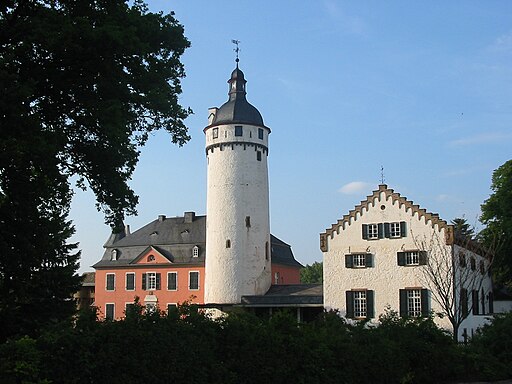
Burg Zievel is situated in the gently rolling landscape of the northern Eifel, near the village of Zievel, which today forms part of the town of Mechernich in North Rhine-Westphalia. The castle occupies a low-lying position that once took full advantage of surrounding wetlands and streams, making it a classic example of a water castle rather than a hilltop fortress. This location was not chosen for dramatic views but for strategic control of local routes and agricultural land. The surrounding countryside, shaped by forests, meadows, and small waterways, provided both natural protection and economic resources, allowing the castle to function as a secure residential and administrative center for centuries.
Origins and Medieval Development
The origins of Burg Zievel can be traced back to the High Middle Ages, when fortified noble residences began to appear throughout the Rhineland. Early structures on the site were likely modest wooden or mixed timber and stone constructions, gradually replaced by more permanent stone buildings as the importance of the estate grew. Over time, the castle developed into a fully enclosed complex with defensive walls, towers, and a surrounding moat fed by local water sources. These features reflected the constant need for protection during a period marked by feudal conflicts, shifting alliances, and regional power struggles among noble families and ecclesiastical authorities.
Architectural Character and Defensive Features
Architecturally, Burg Zievel exemplifies the functional elegance typical of Rhineland water castles. Rather than soaring walls or monumental keeps, the complex emphasized solidity, symmetry, and practicality. Thick masonry walls, limited exterior openings, and strategically placed towers offered defense without excessive ornamentation. The moat played a crucial role, acting as both a physical barrier and a symbolic marker of lordly authority. Within the castle grounds, residential buildings, storage areas, and service structures were arranged around an inner courtyard, creating a self-contained environment that supported daily life as well as defense.
Noble Ownership and Social Role
Throughout its history, Burg Zievel was closely tied to the fortunes of regional noble families who used it as a seat of power and a symbol of status. Ownership often changed through inheritance, marriage, or political maneuvering, each transition leaving subtle marks on the castle’s structure and function. Beyond its military role, the castle served as an administrative hub where rents were collected, disputes were settled, and agricultural production was managed. The surrounding estate supported local farmers, craftsmen, and servants, making the castle an integral part of the social and economic fabric of the region.
Transformation in the Early Modern Period
As the Middle Ages gave way to the early modern era, the defensive importance of Burg Zievel gradually diminished. Advances in artillery and changes in warfare reduced the effectiveness of traditional castle defenses, prompting a shift in focus from military strength to residential comfort. Windows were enlarged, interior spaces were adapted for more refined living, and decorative elements were introduced to reflect contemporary tastes. While the castle retained its historic form, its role evolved into that of a manor house, emphasizing administration and representation rather than defense.
Decline, Preservation, and Modern Significance
Like many historic castles, Burg Zievel experienced periods of decline as political and economic conditions changed. Maintenance became costly, and parts of the complex fell into disuse. Despite this, the core structure survived, benefiting from later efforts at preservation and restoration. Today, the castle stands as a valuable cultural monument, offering insight into medieval settlement patterns, noble life, and architectural adaptation over time. Its presence enriches the historical landscape of the Eifel region and serves as a tangible reminder of the layered history that has shaped this part of Germany.
Cultural and Regional Importance
Burg Zievel holds significance beyond its physical structure, embodying centuries of regional history and identity. It reflects the interaction between landscape, architecture, and social hierarchy that defined much of medieval and early modern life in the Rhineland. For visitors and historians alike, the castle offers an opportunity to explore how noble residences functioned within their local environments and how they adapted to changing political and technological realities. As part of the broader network of castles and manor houses in North Rhine-Westphalia, Burg Zievel contributes to a deeper understanding of the region’s past and its enduring architectural heritage.
