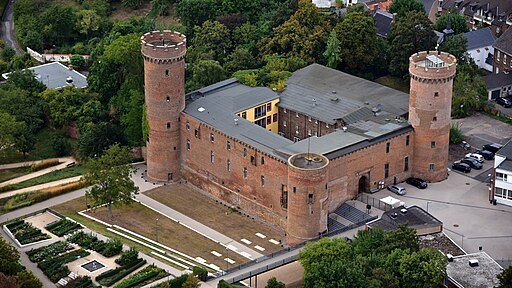
Zülpich Castle is located in the historic town of Zülpich in North Rhine-Westphalia, a settlement with roots reaching back to Roman times. The castle stands within an area that has long been strategically important due to its position between the Rhineland and the Eifel region. Over centuries, Zülpich developed from a Roman vicus into a fortified medieval town, and the castle formed an integral part of this defensive and administrative landscape. Its location allowed control over trade routes and agricultural land, while also providing a visible symbol of authority within the town’s walls.
Early Origins and Medieval Construction
The origins of Zülpich Castle lie in the Middle Ages, when the need for fortified residences and administrative centers increased as regional powers competed for influence. Early structures were likely tied closely to the town’s fortifications, serving both military and governmental functions. Over time, these early buildings were expanded and reinforced, evolving into a recognizable castle complex. Stone construction gradually replaced earlier materials, reflecting both technological progress and the growing importance of Zülpich as a regional center. The castle’s development mirrored the broader transformation of the town from a defensive settlement into a structured urban community.
Architectural Form and Defensive Elements
Architecturally, Zülpich Castle was designed to integrate seamlessly with the town’s defenses. Rather than standing as an isolated stronghold, it functioned as part of a larger fortified system that included walls, gates, and towers. Thick walls, controlled access points, and strategically placed vantage positions emphasized security and surveillance. At the same time, the interior spaces were organized to support residential and administrative needs, with halls, chambers, and storage areas arranged in a practical manner. This balance between defense and daily function reflects the dual role of the castle as both fortress and seat of authority.
Role in Governance and Urban Life
Throughout the medieval period, Zülpich Castle played a central role in the governance of the town and its surrounding territory. It served as the residence of local rulers or their representatives, as well as a place where legal matters were addressed and taxes collected. The presence of the castle influenced the daily life of the town, providing protection in times of conflict and stability during periods of peace. Markets, religious institutions, and civic buildings developed around this center of power, reinforcing the castle’s importance within the urban fabric of Zülpich.
Changes in the Early Modern Era
With the transition to the early modern period, the military significance of Zülpich Castle began to decline. Advances in warfare and changes in political organization reduced the need for heavily fortified urban castles. As a result, the castle underwent adaptations that prioritized administrative efficiency and residential comfort over defense. Structural modifications included the reconfiguration of interior spaces and the addition of architectural details that reflected contemporary styles. These changes illustrate how the castle remained relevant by evolving in response to new social and political realities.
Decline, Damage, and Preservation Efforts
Like many historic castles in the region, Zülpich Castle faced periods of decline due to war, economic hardship, and changing patterns of governance. Conflicts in the Rhineland left their mark on the town and its buildings, leading to damage and partial loss of original structures. Despite these challenges, efforts were made in later centuries to preserve what remained of the castle. Restoration and conservation initiatives sought to stabilize the surviving elements and integrate them into the modern townscape, ensuring that the castle’s historical presence was not entirely lost.
Cultural Significance and Legacy
Today, Zülpich Castle stands as an important reminder of the town’s layered history, linking its Roman origins with its medieval and early modern development. Even where only parts of the original structure survive, the castle continues to shape the identity of Zülpich as a place of historical continuity. Its legacy lies not only in stone and mortar but also in its role as a focal point of governance, defense, and community life over many centuries. As such, Zülpich Castle remains a valuable cultural landmark, offering insight into the evolution of urban castles in the Rhineland and their enduring influence on regional history.
