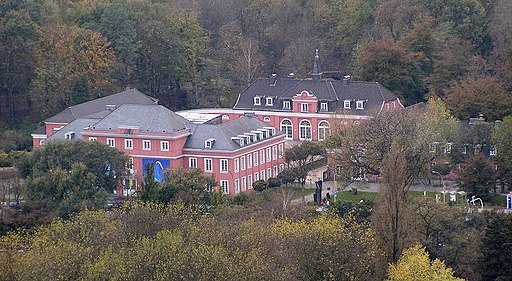
Schloss Oberhausen stands in a city that many people associate with industry, shopping, and the restless transformation of the Ruhr region. Yet the palace is a reminder that Oberhausen’s identity did not begin with factories and railways. It belongs to an older rhythm of landownership, aristocratic influence, and cultural ambition. What makes Schloss Oberhausen especially interesting is how naturally it bridges these eras. It is not a medieval fortress surviving against time, but a refined residence shaped by changing ideas of prestige and public life. Today, it feels less like a relic and more like a central character in Oberhausen’s story, quietly proving that the city has always been more complex than its industrial reputation suggests.
A Palace Built for Presence, Not Defense
Unlike castles that were designed to intimidate or withstand siege, Schloss Oberhausen carries the calm confidence of architecture meant to represent stability. Its purpose was not to defend territory with walls and moats, but to express status through proportion, symmetry, and setting. The building’s elegance lies in how it presents itself without excess. It has the balanced look of a residence built for comfort, ceremony, and administration, reflecting the era when noble families wanted their homes to be both private retreats and public symbols. This difference matters because it changes the emotional experience of visiting. You are not stepping into a place of military anxiety; you are stepping into a place designed to be admired, visited, and remembered.
That atmosphere still lingers. Even when modern life surrounds it, the palace feels composed. It invites you to slow down, to notice its geometry, and to imagine how people once used space as a language of power. In a way, Schloss Oberhausen is a lesson in how architecture communicates. The building is not loud, but it is deliberate, and that deliberate calm gives it a distinct personality compared to the more rugged historic sites in the region.
The Park as the Palace’s True Stage
One of the defining features of Schloss Oberhausen is that it does not stand alone. It belongs to its park, and the park is not just decoration. It is part of the palace’s identity and one of the reasons the site remains so meaningful today. The relationship between palace and landscape reflects a European tradition where noble residences were designed to be experienced through movement. You approach, you walk, you see the building from shifting angles, and you understand it not as a single façade but as a presence within a carefully shaped environment.
The park softens the palace’s form and gives it breathing space. In the Ruhrgebiet, where urban density and infrastructure often dominate the view, that openness feels almost luxurious. It creates a rare pocket of calm where the city seems to step back. This is part of why Schloss Oberhausen continues to matter. It is not only a historic building; it is one of the city’s most important public spaces. People come for walks, for events, for quiet moments, and in doing so they keep the palace alive as a lived-in landmark rather than a distant museum object.
From Aristocratic Residence to Public Cultural Space
Schloss Oberhausen’s story is not simply about its origins. Its real power comes from its transformation. Over time, the building shifted from being a private symbol of authority to becoming part of the public life of the city. That transition mirrors Oberhausen itself, a place defined by reinvention. The palace became less about exclusive ownership and more about shared identity.
This change is significant because it shows how historic architecture can remain relevant without being frozen in the past. Schloss Oberhausen did not survive by refusing change; it survived by accepting new roles. It became a space for exhibitions, culture, and civic memory. In doing so, it gained a new kind of importance. Instead of representing the authority of one family or one era, it became a place where the city can reflect on itself. That is a rare achievement for a former aristocratic residence, and it is one of the reasons Schloss Oberhausen feels unusually integrated into modern life.
The Building’s Quiet Sophistication
There is something subtly persuasive about Schloss Oberhausen’s design. It does not overwhelm you with massive towers or dramatic ornament. Instead, it wins you over through restraint. The façade, the layout, and the proportions all suggest a building that understands elegance as balance. This is especially striking in a region where much of the built environment is defined by practicality and postwar reconstruction. Schloss Oberhausen stands out not because it is flashy, but because it feels intentional in a way that modern buildings often do not.
The palace’s architecture also invites a different kind of attention. You start noticing small things: how windows are arranged, how the building sits in relation to pathways, how the structure seems to hold itself upright with a sense of dignity. It is the kind of place that rewards repeated visits because its beauty is not a one-time spectacle. It is a slow beauty, the kind that becomes clearer the longer you look.
Schloss Oberhausen and the Ruhr’s Hidden Layers
The Ruhrgebiet is often described through the language of industry, and for good reason. The region’s coal mines, steelworks, and labor history shaped modern Germany. But places like Schloss Oberhausen remind you that the Ruhr is layered. The industrial era did not erase what came before; it built on top of it.
Schloss Oberhausen represents the earlier world of land-based power and aristocratic networks. It shows that the region had its own centers of influence long before smokestacks dominated the skyline. This matters because it challenges the stereotype of the Ruhr as a place without older heritage. In reality, the Ruhr is full of historic estates, churches, and palaces, but many of them are overshadowed by the scale of industrial landmarks. Schloss Oberhausen is one of the clearest examples of how refined and historically rich the area can be when you look beyond the usual narrative.
A Palace That Feels Human in Scale
Another reason Schloss Oberhausen resonates with visitors is its scale. It is grand enough to feel special, but not so enormous that it becomes intimidating. That human scale makes it approachable. You can imagine people living there, walking through rooms, hosting guests, planning events, and carrying out daily routines. It feels like a residence rather than a monument.
This is an important distinction because many historic palaces feel distant. They were built to impress, and they still create a sense of separation between the visitor and the world they represent. Schloss Oberhausen, by contrast, feels closer. Its elegance is not untouchable. It feels like something the city can claim as its own. That sense of shared ownership is part of why the palace fits so naturally into Oberhausen’s identity today.
The Role of Art and Exhibitions
Schloss Oberhausen’s modern life is closely tied to culture. It has become a venue for exhibitions and artistic programs, and this role suits it perfectly. A palace is, in many ways, a container for storytelling. Its rooms and corridors naturally encourage movement, discovery, and reflection. When art is placed inside such a building, the experience becomes layered. You are not only engaging with the exhibition; you are also engaging with the atmosphere of the space itself.
This creates a distinctive cultural experience. Modern galleries can sometimes feel sterile, designed to remove all context so the artwork stands alone. Schloss Oberhausen offers the opposite. It provides context through its architecture, its history, and its setting. This makes exhibitions feel less like isolated events and more like conversations between past and present. It also reinforces the palace’s role as a living part of the city rather than a preserved shell.
The Palace as a Place for Memory
Cities like Oberhausen are often discussed in terms of change. The Ruhr’s story is full of economic shifts, redevelopment projects, and the constant challenge of redefining identity after industrial decline. In that context, Schloss Oberhausen becomes a stabilizing symbol. It is a place where memory can anchor itself.
This does not mean the palace represents a perfect past. Like any aristocratic residence, it carries the weight of social inequality and historical power structures. But it also offers continuity. It reminds people that Oberhausen’s history did not begin in the 19th century, and it provides a tangible connection to centuries of regional development. That connection is valuable, especially in a city that has had to reinvent itself repeatedly. Schloss Oberhausen becomes a way of saying that even in change, there are roots.
A Visit That Feels Like a Pause
Visiting Schloss Oberhausen often feels like stepping into a pause in the middle of the city. The park creates a buffer from urban noise, and the building’s calm design reinforces that sense of separation. Even if you are only there briefly, the experience tends to slow your pace. You start paying attention to light, to shadows on the façade, to the way the palace looks different from different angles.
This is one of the palace’s most underrated qualities. It is not just a place to learn facts. It is a place that changes your mood. It offers a quieter kind of beauty than many tourist sites, and that quiet beauty can be more memorable. In a region where much of the landscape is shaped by movement, infrastructure, and modern development, Schloss Oberhausen offers stillness.
Schloss Oberhausen as a Symbol of Modern Oberhausen
What makes Schloss Oberhausen truly significant is how well it represents the city today. Oberhausen is not defined by one era. It is a city where industrial heritage, postwar rebuilding, and modern cultural life all coexist. Schloss Oberhausen fits into that mosaic perfectly. It is historic, but not trapped in nostalgia. It is elegant, but not detached from everyday life. It is a landmark, but also a public space that people actually use.
In a sense, the palace embodies Oberhausen’s best quality: the ability to adapt without losing itself. It has moved from private residence to cultural center, from aristocratic symbol to civic asset. That journey mirrors the city’s own transformation from industrial powerhouse to a place searching for new identity through culture, community, and creativity.
Why Schloss Oberhausen Matters
Schloss Oberhausen matters because it offers something rare in the Ruhrgebiet: a clear and graceful link between the region’s pre-industrial past and its modern cultural future. It is a reminder that the Ruhr is not only a landscape of labor and industry, but also a landscape of art, architecture, and long historical continuity.
