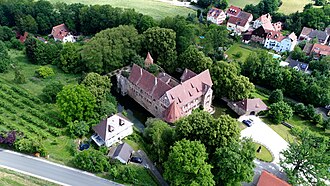
Nestled in the tranquil landscape of Upper Franconia in Bavaria, Schloss Kunreuth stands as one of the most fascinating and historically layered aristocratic residences in southern Germany. Unlike many castles that rose as imposing fortresses atop isolated hills, Schloss Kunreuth developed as a moated castle embedded within a village setting, blending defensive architecture with the rhythms of rural life. This unique positioning gives it a distinctive character that reflects both feudal authority and local integration.
Located in the municipality of Kunreuth, not far from Forchheim and within the broader region of Franconia, the castle has been continuously associated with noble lineage for centuries. Its long-standing connection to the Egloffstein family makes it not only an architectural monument but also a living symbol of aristocratic continuity in the region.
This article offers a comprehensive exploration of Schloss Kunreuth, examining its geographical context, historical development, architectural structure, cultural significance, and present-day relevance. Through an in-depth narrative, the castle emerges not merely as a building, but as a dynamic entity shaped by time, conflict, adaptation, and tradition.
Geographic Setting and Environmental Context
Schloss Kunreuth occupies a strategic yet unusually integrated position within the village of Kunreuth. Rather than dominating a distant hilltop, the castle sits amid the settlement, historically surrounded by a moat that provided defense while maintaining proximity to agricultural lands and village life. This arrangement reflects a transitional form of castle-building, where defensive concerns coexisted with administrative and economic functions.
The surrounding region of Upper Franconia is characterized by gently rolling hills, fertile valleys, and limestone formations typical of the Franconian Jura. The landscape is less rugged than the dramatic cliffs of Franconian Switzerland but equally rich in cultural history. Agricultural activity has shaped the terrain for centuries, and Schloss Kunreuth played a central role in overseeing and managing these lands.
Water was a crucial element in the castle’s design. The moat system, fed by local streams, served both defensive and symbolic purposes. It delineated the boundary between the noble residence and the surrounding village while also reinforcing the castle’s authority. Over time, as military threats diminished, the moat became more of a scenic and historical feature than a practical defense.
Today, the castle remains a focal point within the village, its presence harmonizing with the surrounding buildings rather than overshadowing them. This integration highlights a key aspect of its identity: Schloss Kunreuth is not isolated from its environment but deeply embedded within it.
Origins and Early History
The origins of Schloss Kunreuth can be traced back to the medieval period, likely the 14th century, when the need for fortified residences in Franconia was driven by political fragmentation and local conflicts. During this time, the region was part of the Holy Roman Empire, a complex network of territories ruled by various secular and ecclesiastical authorities.
The earliest documented references to Kunreuth and its castle suggest that it was established as a seat of local nobility, designed to assert control over the surrounding lands and provide protection against rival factions. The presence of a moat indicates that even in its earliest form, the castle was intended to be defensible against potential attacks.
The Egloffstein family became associated with the castle at an early stage and would remain its primary custodians for centuries. This continuity is remarkable, as many castles in the region changed hands multiple times due to inheritance disputes, warfare, or political realignment.
The early structure was likely more modest than the present complex, consisting of a fortified manor with basic defensive features. Over time, as the family’s wealth and influence grew, the castle was expanded and enhanced to reflect their status.
The Egloffstein Family and Dynastic Continuity
Few aspects of Schloss Kunreuth are as significant as its enduring association with the Egloffstein family. This noble lineage has played a central role in shaping the castle’s history, identity, and preservation.
The Egloffstein family is one of the oldest noble families in Franconia, with roots extending deep into the medieval period. Their holdings included multiple castles and estates throughout the region, forming a network of influence that contributed to their prominence within the local aristocracy.
Schloss Kunreuth became one of their principal residences, serving not only as a home but also as an administrative center for managing their lands. The family’s long-term stewardship ensured a level of continuity that is rare among historical estates.
Unlike many noble families that faced extinction or loss of property due to political upheavals, the Egloffsteins managed to retain their holdings through careful adaptation and strategic alliances. Their ability to navigate the shifting political landscape of the Holy Roman Empire, the rise of modern states, and the transformations of the 19th and 20th centuries is reflected in the preservation of Schloss Kunreuth.
The castle thus stands as a symbol of dynastic resilience, embodying the continuity of a family that has remained connected to its ancestral home for generations.
Architectural Evolution
The architectural development of Schloss Kunreuth reflects a gradual transformation from a fortified medieval residence into a more comfortable and aesthetically refined noble estate.
Medieval Foundations
The earliest phase of the castle was characterized by defensive features typical of medieval architecture. Thick walls, limited openings, and the surrounding moat provided protection against potential attackers. The layout was likely compact and functional, prioritizing security over comfort.
Renaissance and Early Modern Modifications
As the political situation in the region stabilized, the need for heavy fortification diminished. During the Renaissance and early modern periods, the castle underwent significant modifications that enhanced its residential qualities.
Larger windows were introduced to allow more light into the interior spaces, and decorative elements began to appear on the façades. These changes reflected a broader shift in architectural priorities, as castles across Europe transitioned into palatial residences.
Baroque Influences
The Baroque period brought further refinement to Schloss Kunreuth. Architectural details became more elaborate, with an emphasis on symmetry, proportion, and visual impact. Interior spaces were redesigned to provide greater comfort and accommodate the social functions of aristocratic life.
While the castle retained its overall structure, these modifications added layers of stylistic complexity, creating a building that embodies multiple historical periods.
Preservation of Original Elements
Despite these changes, many original features of the castle have been preserved. The moat, structural layout, and certain defensive elements remain visible, offering a tangible connection to the castle’s medieval origins.
This blend of old and new is one of the defining characteristics of Schloss Kunreuth, making it an important example of architectural continuity.
Role in Regional History
Schloss Kunreuth has been deeply intertwined with the history of Franconia, serving as both a witness to and participant in key historical developments.
During the medieval period, the castle was part of a network of fortified residences that defined the political landscape of the region. Local lords used these castles to assert their authority, collect taxes, and administer justice.
The castle also played a role in regional conflicts, although it appears to have avoided the extensive destruction experienced by some other fortifications. Its location within a village may have contributed to its relative stability, as it was less exposed than hilltop castles.
In later centuries, the castle became more closely associated with administrative and economic functions. It served as the center of a manorial system, overseeing agricultural production and local governance.
The transition from feudalism to modern state structures in the 19th century brought significant changes, but Schloss Kunreuth adapted to these shifts, maintaining its relevance within a changing society.
Cultural Significance
Schloss Kunreuth is not only a historical structure but also a cultural landmark that reflects the traditions and identity of the region.
Symbol of Aristocratic Heritage
The castle embodies the legacy of the Franconian nobility, representing a way of life that has largely disappeared but continues to influence regional culture.
Integration with Local Community
Unlike isolated castles, Schloss Kunreuth has always been closely connected to the surrounding village. This relationship has fostered a sense of shared heritage, with the castle serving as a focal point for local identity.
Architectural Heritage
The building’s layered architectural style provides valuable insight into the evolution of European architecture, making it an important subject for study and preservation.
Modern-Day Role and Preservation
Today, Schloss Kunreuth remains privately owned and is not fully open to the public. However, its exterior and surrounding grounds can be appreciated by visitors, and it continues to be an important part of the local landscape.
Preservation efforts have focused on maintaining the structural integrity of the building while respecting its historical character. The continued involvement of the Egloffstein family has been crucial in ensuring that the castle is preserved for future generations.
The castle also contributes to regional tourism, attracting visitors interested in history, architecture, and the cultural heritage of Franconia.
Architectural Layout and Features
Schloss Kunreuth is characterized by a multi-wing structure arranged around a central courtyard, typical of many aristocratic residences in the region.
The moat remains one of its most distinctive features, encircling the castle and adding both historical authenticity and visual appeal. Access to the castle is traditionally provided by a bridge, reinforcing its identity as a moated residence.
The façades display a combination of medieval and later stylistic elements, reflecting the building’s long history of adaptation. Interior spaces, while not widely accessible, are believed to retain historical features that illustrate the evolution of aristocratic living conditions.
Schloss Kunreuth in the Context of Franconian Castles
Franconia is renowned for its dense concentration of castles, each with its own unique history and architectural character. Schloss Kunreuth occupies a distinctive place within this landscape due to its village setting and continuous family ownership.
While many castles in the region have become ruins or museums, Schloss Kunreuth remains a living residence. This continuity provides a valuable perspective on how historical buildings can adapt to modern life without losing their identity.
Technical Specifications
| Feature | Description |
|---|---|
| Name | Schloss Kunreuth |
| Location | Kunreuth, Upper Franconia, Bavaria, Germany |
| Type | Moated castle (Wasserschloss) |
| Construction Period | Likely 14th century (medieval origins) |
| Architectural Style | Medieval core with Renaissance and Baroque modifications |
| Layout | Multi-wing complex with central courtyard |
| Defensive Features | Moat, thick walls, limited early openings |
| Ownership | Egloffstein family |
| Current Status | Privately owned, partially accessible exterior |
| Setting | Integrated within village environment |
| Region | Upper Franconia |
| Historical Function | Noble residence, administrative center |
| Preservation Status | Maintained historical structure with ongoing conservation |
Conclusion
Schloss Kunreuth represents a rare and valuable example of a historical estate that has maintained both its physical structure and its familial continuity over centuries. Its integration within the village, combined with its architectural evolution and cultural significance, makes it a unique and compelling subject of study.
