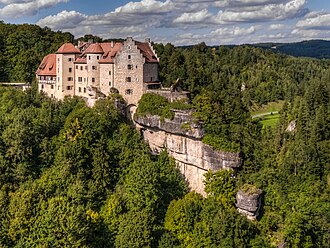
Perched dramatically atop a steep limestone cliff in the heart of Franconian Switzerland, Burg Rabenstein is one of the most visually striking and historically rich castles in southern Germany. Rising above dense forests and rugged valleys, the castle commands attention not only for its commanding position but also for its remarkable continuity as a cultural and historical landmark. Unlike many medieval fortresses that have fallen into ruin, Burg Rabenstein has endured through centuries of transformation, preserving its identity while adapting to the changing demands of time.
Located in the municipality of Ahorntal within the region of Franconian Switzerland, the castle is part of a landscape renowned for its high concentration of fortifications, caves, and natural formations. This region, characterized by its jagged rock outcrops and winding valleys, provided ideal conditions for medieval castle construction, combining natural defenses with strategic oversight of trade routes and settlements.
Burg Rabenstein is more than just an architectural relic; it is a living testament to the evolution of European society. From its origins as a medieval stronghold to its modern role as a cultural and tourist destination, the castle encapsulates the complex interplay between power, architecture, and landscape. This article offers a comprehensive exploration of Burg Rabenstein, delving into its history, architecture, cultural significance, and enduring legacy.
Geographic Setting and Natural Landscape
The location of Burg Rabenstein is one of its most defining features. The castle stands on a prominent rock formation that rises sharply above the Ailsbach Valley, providing both natural protection and breathtaking views of the surrounding countryside. The steep cliffs and dense forests that characterize the region create a dramatic setting that enhances the castle’s imposing presence.
Franconian Switzerland, despite its name, is not part of Switzerland but a region in northern Bavaria known for its scenic beauty and geological diversity. The area is rich in karst formations, including caves, sinkholes, and rock towers. These natural features have played a significant role in shaping human settlement and defensive strategies throughout history.
The castle’s elevated position allowed its inhabitants to monitor movement through the valley, making it an ideal site for controlling trade routes and asserting territorial authority. At the same time, the surrounding forests provided resources such as timber and game, supporting the castle’s economic sustainability.
One of the most notable natural attractions near Burg Rabenstein is the Sophienhöhle, a large stalactite cave located just below the castle. This cave, with its impressive formations and archaeological significance, adds another layer of interest to the site, linking natural history with human habitation.
Origins and Early Development
The origins of Burg Rabenstein date back to the early 12th century, making it one of the older castles in the region. It was likely founded by the noble family known as the Rabensteins, from whom the castle derives its name. The choice of location reflects the strategic priorities of the time, emphasizing defense and control over accessibility.
In its earliest form, the castle would have been a relatively simple fortification, consisting of a keep, defensive walls, and basic living quarters. The emphasis was on security rather than comfort, with thick stone walls and limited openings designed to withstand attacks.
The castle’s early history is closely tied to the feudal system, in which land was granted to nobles in exchange for military service. As a fortified residence, Burg Rabenstein served both as a home and as a symbol of authority, projecting power over the surrounding territory.
Over time, the castle was expanded and reinforced, reflecting the changing needs of its inhabitants and the evolving nature of warfare. These early developments laid the foundation for the more complex structure that exists today.
Medieval Conflicts and Decline
Like many castles in medieval Europe, Burg Rabenstein was not immune to the conflicts that shaped the region. Throughout the Middle Ages, it experienced periods of destruction, abandonment, and reconstruction.
The castle’s strategic importance made it a target during regional disputes, particularly those involving rival noble families and emerging territorial powers. These conflicts often resulted in damage to the castle’s structures, requiring costly repairs and modifications.
One of the most significant challenges faced by the castle was the gradual decline of the feudal system. As centralized authorities gained power and warfare evolved, the role of castles as defensive strongholds diminished. This shift led to periods of neglect, during which parts of the castle fell into disrepair.
Despite these challenges, Burg Rabenstein managed to survive, thanks in part to its continued use as a residence and its adaptability to changing circumstances.
Renaissance Transformation and Residential Use
The transition from a purely defensive fortress to a more comfortable residence marked a turning point in the history of Burg Rabenstein. During the Renaissance period, significant changes were made to the castle’s structure and layout, reflecting a broader shift in architectural and cultural priorities.
Windows were enlarged to allow more light into the interior spaces, and decorative elements were introduced to enhance the castle’s appearance. These modifications signaled a move away from the austere functionality of medieval architecture toward a more refined and livable environment.
The interior of the castle was also reconfigured to accommodate the needs of aristocratic life, with improved living quarters, reception rooms, and facilities for hosting guests. These changes transformed Burg Rabenstein into a residence that combined historical character with modern comfort.
The Schönborn Era and Baroque Influence
A significant chapter in the history of Burg Rabenstein began with its acquisition by the Schönborn family in the 17th century. This influential noble family played a crucial role in shaping the castle’s development during the Baroque period.
Under their ownership, the castle underwent further modifications that enhanced its aesthetic appeal and functionality. Baroque architectural elements were introduced, adding elegance and sophistication to the structure while preserving its historical core.
The Schönborn family’s influence extended beyond architecture, as they also contributed to the cultural and economic development of the region. Their stewardship ensured that Burg Rabenstein remained an important center of activity, rather than fading into obscurity.
Architectural Characteristics
Burg Rabenstein is a complex structure that reflects multiple phases of construction and adaptation. Its architecture combines elements of medieval fortification with later residential and decorative features.
Defensive Structures
The castle’s defensive features include thick stone walls, a keep, and strategically positioned towers. These elements were designed to provide protection against attacks while allowing defenders to monitor and control access to the site.
Residential Areas
The residential sections of the castle are more refined, with larger windows, decorative façades, and interior spaces designed for comfort. These areas illustrate the transition from fortress to residence, highlighting the changing priorities of its inhabitants.
Integration with Natural Rock
One of the most distinctive aspects of Burg Rabenstein is its integration with the natural rock formation on which it stands. Parts of the castle are built directly into the cliff, creating a seamless connection between architecture and landscape.
Courtyards and Access Points
The castle features multiple courtyards and access points, reflecting its layered development over time. These spaces served both practical and social functions, providing areas for movement, storage, and interaction.
Cultural and Historical Significance
Burg Rabenstein holds significant cultural and historical value, serving as a tangible link to the past. Its long history and well-preserved structure make it an important example of medieval and early modern architecture.
Symbol of Regional Identity
The castle is a symbol of Franconian heritage, representing the region’s rich history and architectural traditions. Its dramatic setting and enduring presence contribute to its iconic status.
Educational Value
As a historical site, Burg Rabenstein offers valuable insights into the evolution of castle architecture, the feudal system, and the cultural changes that shaped Europe.
Connection to Natural Heritage
The proximity of the Sophienhöhle enhances the castle’s significance, linking human history with natural history in a unique and compelling way.
Modern Use and Tourism
Today, Burg Rabenstein is a popular tourist destination, attracting visitors from around the world. Its combination of historical architecture, scenic views, and nearby attractions makes it a key site within Franconian Switzerland.
The castle hosts guided tours, cultural events, and exhibitions, providing visitors with an immersive experience that brings its history to life. The integration of modern amenities ensures that it remains accessible and relevant to contemporary audiences.
The surrounding area offers additional attractions, including hiking trails, wildlife experiences, and the exploration of caves such as the Sophienhöhle.
Preservation and Restoration Efforts
The preservation of Burg Rabenstein has been a continuous process, involving careful restoration and maintenance to ensure its longevity. These efforts have focused on maintaining the structural integrity of the castle while respecting its historical character.
Modern conservation techniques have been employed to address issues such as weathering and structural stability, ensuring that the castle can be enjoyed by future generations.
Burg Rabenstein in the Context of Franconian Castles
Within the broader landscape of Franconian Switzerland, Burg Rabenstein occupies a unique position. Its dramatic location, well-preserved structure, and integration with natural features distinguish it from many other castles in the region.
While some nearby castles exist only as ruins, Burg Rabenstein remains a living monument, offering a more complete and immersive experience of historical architecture.
Technical Specifications
| Feature | Description |
|---|---|
| Name | Burg Rabenstein |
| Location | Ahorntal, Upper Franconia, Bavaria, Germany |
| Type | Hill castle (Felsenburg) |
| Elevation | Approx. 470 meters above sea level |
| Construction Period | Early 12th century |
| Architectural Style | Medieval with Renaissance and Baroque modifications |
| Layout | Multi-level structure integrated into rock formation |
| Defensive Features | Thick walls, towers, elevated position |
| Notable Nearby Site | Sophienhöhle |
| Historical Owners | Rabenstein family; Schönborn family |
| Current Use | Museum, tourist attraction, event venue |
| Preservation Status | Well-preserved with ongoing restoration |
| Region | Franconian Switzerland |
Conclusion
Burg Rabenstein stands as a remarkable example of how history, architecture, and nature can converge to create a site of enduring significance. From its origins as a medieval fortress to its present role as a cultural landmark, the castle has evolved while maintaining its identity.
