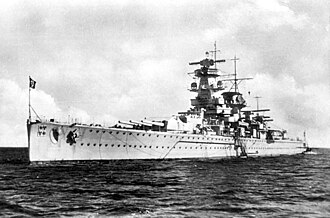
Admiral Graf Spee: The German Pocket Battleship That Challenged the Royal Navy
The Admiral Graf Spee was one of the most unusual and controversial warships of the Second World War. Officially classified by Germany as a Panzerschiff, or armored ship, she became widely known as a “pocket battleship”—a term that captured the extraordinary combination of heavy armament, long range, and relatively modest displacement that defined her design. Built during the interwar period under the restrictions imposed on Germany by the Treaty of Versailles, Admiral Graf Spee was intended to exploit a loophole in the post-World War I naval order: Germany was permitted to build ships of limited displacement, but those ships could be designed around exceptionally powerful guns and long-range operations. The result was a vessel capable of threatening merchant shipping across enormous stretches of ocean while possessing enough firepower to defeat many conventional cruisers. Her career was brief, but during the opening months of World War II she became one of Germany’s most famous commerce raiders. Her dramatic encounter with British cruisers at the Battle of the River Plate in December 1939, followed by her destruction outside Montevideo, turned Admiral Graf Spee into one of the enduring naval stories of the war.
The Birth of the Pocket Battleship
Germany’s answer to postwar naval restrictions
Admiral Graf Spee belonged to the Deutschland class, a group of ships created during an unusual period in German naval history. After World War I, Germany’s navy was severely restricted by the Treaty of Versailles. The treaty limited the size and types of warships Germany could possess and placed strict limits on the construction of new vessels. German naval designers consequently faced a difficult problem: how could a comparatively small warship carry enough firepower and possess enough range to threaten larger foreign cruisers?
The answer was the Panzerschiff. Instead of attempting to match foreign navies ship for ship, German designers emphasized a carefully chosen combination of characteristics. Admiral Graf Spee carried six 28 cm guns—approximately 11 inches—in two triple main turrets. These weapons gave her a level of striking power far beyond that normally associated with a ship of her size. At the same time, she used diesel engines rather than the steam turbines commonly found aboard many contemporary warships, giving her exceptional range. Her armor was sufficient to provide protection against many cruiser-caliber weapons, although she was not designed to stand toe-to-toe with a full-sized battleship. This combination made the ship extraordinarily well suited to commerce raiding.
A ship designed around speed, range and firepower
The concept behind Admiral Graf Spee was fundamentally different from that of a conventional battleship. A battleship was expected to fight other major warships in fleet actions, while the Panzerschiff could use its range and speed to choose engagements. Against a lightly armed merchant vessel, its heavy guns were overwhelming. Against a conventional cruiser, its 11-inch artillery provided a potentially decisive advantage. Against a faster or more heavily armed battleship, however, escape would be the preferred option.
This created a difficult problem for any navy attempting to defend merchant shipping. A cruiser sent to hunt the German raider needed enough firepower to defeat it, but increasing armor and armament generally made a warship more expensive and less numerous. Admiral Graf Spee therefore represented not merely a single German warship but a strategic challenge: how could a navy protect widely dispersed merchant shipping against a fast, long-range raider that could appear almost anywhere?
Construction and Characteristics
From Deutschland to Admiral Graf Spee
Admiral Graf Spee was built by Reichsmarinewerft Wilhelmshaven, with construction beginning in 1932. She was launched on June 30, 1934, and commissioned on January 6, 1936. She was named after Vice Admiral Maximilian von Spee, the German commander who led the East Asia Squadron during the opening months of World War I and was killed at the Battle of the Falkland Islands in December 1914.
Her construction represented the evolution of the original Deutschland design. Although the ships of the class were still constrained by treaty requirements, Germany increasingly pushed beyond those limitations in practice. Admiral Graf Spee incorporated improvements in armor, machinery, fire control, and general naval technology. Her relatively compact hull concealed a sophisticated propulsion arrangement based on large marine diesel engines, a feature that gave the ship an exceptionally long operational radius.
The ship displaced roughly 12,000 tons under treaty conditions and considerably more at full combat load. Her length was approximately 186 meters, while her beam measured around 21.7 meters. Despite her relatively modest displacement, the ship possessed the appearance and capabilities of something considerably larger, especially because of her enormous main gun turrets.
Diesel power and remarkable range
One of Admiral Graf Spee’s most important technological features was her propulsion system. Eight large MAN diesel engines drove two propeller shafts, allowing the ship to reach approximately 28 knots. More importantly, diesel propulsion gave her a very substantial range. This was an enormous advantage for a commerce raider expected to operate far from Germany and without the support of a network of friendly naval bases.
Long-range operations were central to the ship’s mission. A raider did not need to defeat an enemy fleet if it could disrupt commercial shipping. Every merchant vessel forced to alter its route, every convoy diverted to another area, and every warship assigned to search for the raider imposed costs on the enemy. Admiral Graf Spee’s ability to remain at sea for extended periods therefore formed a critical part of her combat effectiveness.
Armament and Combat Systems
The six 11-inch guns
The most recognizable feature of Admiral Graf Spee was her main battery of six 28 cm SK C/28 guns, mounted in two triple turrets. These weapons were the principal reason British cruisers could not treat the German ship as an ordinary raider. Their range and destructive power gave Graf Spee the ability to engage targets well beyond the effective range of many cruiser weapons.
Her secondary armament consisted of eight 15 cm guns mounted in individual positions. These weapons provided additional firepower against surface targets and merchant vessels, while smaller anti-aircraft weapons offered protection against aircraft. She also carried torpedo tubes, giving the ship another potential weapon in close-range engagements.
Perhaps equally important was her fire-control equipment. Admiral Graf Spee was equipped with sophisticated optical rangefinders and one of the early operational naval radar systems used by the German Navy. The combination of long-range guns, centralized fire control, optical equipment and radar enhanced her ability to detect and engage targets, although technology and operating conditions meant that radar was not yet the highly integrated system familiar from later decades.
Commerce Raiding in the Atlantic
The opening of World War II
When Germany invaded Poland in September 1939, Admiral Graf Spee was already positioned to begin commerce-raiding operations. Her commander, Captain Hans Langsdorff, had been given instructions consistent with Germany’s desire to disrupt Allied trade while avoiding unnecessary loss of life. This meant that the ship generally intercepted merchant vessels, stopped them, removed their crews, and then sank the ships rather than simply destroying them with their crews aboard.
Graf Spee’s operational cruise began before the outbreak of hostilities, and after the war started she moved into the South Atlantic. Her first confirmed wartime sinking was the British merchant ship Clement on September 30, 1939. Over the following weeks she captured or sank additional merchant ships while moving through the Atlantic and later into the Indian Ocean before returning toward the South Atlantic.
By December, Graf Spee had become a serious threat to Allied shipping. British naval authorities organized hunting groups in an effort to locate her. The Royal Navy and its allies had to distribute cruisers and other vessels over huge areas of ocean, because the German ship’s long range allowed her to move between widely separated shipping lanes.
The psychological effect of the raider
The danger posed by Admiral Graf Spee was greater than the tonnage of the merchant ships she destroyed. Commerce raiding worked partly through uncertainty. Merchant captains knew that a powerful German surface raider could be somewhere in the Atlantic, but they did not know where. Naval commanders consequently had to devote substantial resources to searching for her.
This was precisely the kind of strategic effect the German designers had envisioned. Graf Spee did not need to destroy dozens of merchant ships to force the Royal Navy to react. Her presence alone could alter British deployment patterns and require valuable cruisers to undertake lengthy patrols.
The Battle of the River Plate
The British force closes in
On December 13, 1939, Admiral Graf Spee encountered a British squadron commanded by Commodore Henry Harwood off the coast of South America. Harwood’s force consisted of the heavy cruiser HMS Exeter and the light cruisers HMS Ajax and HMS Achilles. The British ships were considerably different from one another, and Harwood had to use their combined capabilities to compensate for Graf Spee’s heavy main battery.
The battle began in the early morning. Graf Spee’s heavy guns initially concentrated on Exeter, which suffered severe damage. The British heavy cruiser was hit repeatedly and was eventually forced to withdraw. Ajax and Achilles continued the fight, maneuvering to divide Graf Spee’s attention and prevent the German ship from simply destroying one opponent and escaping.
The battle demonstrated both the strengths and limitations of the German design. Graf Spee possessed tremendous firepower, and her 11-inch guns could inflict devastating damage on cruisers. Yet she was not invulnerable. The British ships were able to damage her, and the battle consumed ammunition and placed strain on her crew and systems. Graf Spee ultimately broke off the engagement and headed toward the neutral port of Montevideo, Uruguay.
The decision to enter Montevideo
Langsdorff’s decision to seek refuge in Montevideo became one of the most consequential choices in the ship’s history. Graf Spee required repairs after the battle, and the neutral status of Uruguay provided a temporary haven. Under international law, however, her stay in port was subject to restrictions. British diplomatic pressure sought to ensure that the German ship could not remain indefinitely.
Meanwhile, the British attempted to create the impression that a much larger force was waiting outside the harbor. In reality, the Royal Navy’s available strength in the immediate area was limited. However, Langsdorff did not know precisely what forces might be assembling. Reports, rumors and intelligence contributed to an increasingly difficult situation for the German commander.
The German ship had already suffered damage in the battle, and some of the damage was more serious than initially apparent. With limited time available in Montevideo, Langsdorff faced a decision between attempting to fight his way out, remaining in port until internment became unavoidable, or taking the ship into the River Plate and destroying her.
The Scuttling of Admiral Graf Spee
December 17, 1939
On December 17, Graf Spee left Montevideo and moved into the River Plate estuary. Instead of attempting to fight the British force, Langsdorff ordered the ship to be scuttled. Explosives were detonated aboard the vessel, and the ship was deliberately destroyed to prevent her capture. The wreck burned spectacularly and became a global news story.
The scuttling was a remarkable conclusion to the career of a ship that had been designed specifically to avoid such a fate. Graf Spee had not been defeated in a conventional fleet battle. Her loss resulted from a combination of battle damage, operational limitations, diplomatic pressure, intelligence uncertainty and the commander’s judgment about the prospects of escape. The Royal Navy had succeeded in eliminating a dangerous commerce raider without having to sink her in combat.
The destruction also had an immediate psychological impact. Images of the burning warship circulated internationally, while the Battle of the River Plate became one of the first major naval actions of World War II to capture worldwide attention. For Britain, the episode became an early propaganda victory. For Germany, it was a reminder of the difficulties involved in sending surface raiders deep into waters dominated by a global naval power.
The fate of Hans Langsdorff
Three days after the scuttling, on December 20, Langsdorff died by suicide in Buenos Aires. He was buried in the German section of the La Chacarita Cemetery in Buenos Aires, Argentina.
Langsdorff’s actions remain the subject of historical discussion, particularly his decision to scuttle the ship rather than risk the lives of his crew in what he believed might be an unequal battle. He had also generally followed German instructions concerning the treatment of merchant crews during the raiding campaign. His command remains an example of the difficult decisions faced by naval officers when tactical circumstances, political considerations and the safety of their crews collide.
The Legacy of Admiral Graf Spee
A warship remembered far beyond its short career
Admiral Graf Spee spent only a few years in commissioned service, and her wartime commerce-raiding cruise lasted only a few months. Yet her reputation has lasted much longer. She remains one of the best-known German warships of World War II because her story contains nearly every element of a classic naval drama: an innovative ship, a long-range mission, merchant hunting, an unexpected enemy encounter, a desperate battle, diplomatic intrigue, and a spectacular final destruction.
Her story also illustrates the strengths and weaknesses of the German pocket-battleship concept. The ships were powerful for their size and possessed exceptional range, but their compromises were significant. Their armor and protection could not match those of true battleships, while their speed was not sufficient to guarantee escape from every modern capital ship. The design was therefore most effective when its commanders could control the circumstances of an engagement.
The River Plate battle exposed precisely this dilemma. Graf Spee could severely damage a heavy cruiser, yet she could not simply ignore multiple opponents attacking from different directions. The damage inflicted by the British, combined with ammunition expenditure and the uncertainty surrounding the forces outside Montevideo, ultimately turned a tactical victory into a strategic defeat.
Technical Specifications of Admiral Graf Spee
| Specification | Admiral Graf Spee |
|---|---|
| Nation | Germany |
| Navy | Reichsmarine / Kriegsmarine |
| Ship type | Panzerschiff (armored ship), commonly called a pocket battleship |
| Class | Deutschland class |
| Builder | Reichsmarinewerft, Wilhelmshaven |
| Laid down | October 1, 1932 |
| Launched | June 30, 1934 |
| Commissioned | January 6, 1936 |
| Named for | Vice Admiral Maximilian von Spee |
| Length | Approx. 186 m (610 ft) |
| Beam | Approx. 21.7 m (71 ft) |
| Draft | Approx. 7.3 m (24 ft) |
| Standard displacement | Approx. 12,000 tons |
| Full-load displacement | Approximately 16,000 tons |
| Propulsion | Eight MAN marine diesel engines |
| Propellers | Two shafts |
| Maximum speed | Approx. 28 knots |
| Main armament | 6 × 28 cm (11 in) guns |
| Main gun arrangement | 2 × triple turrets |
| Secondary armament | 8 × 15 cm (5.9 in) guns |
| Anti-aircraft armament | Multiple 10.5 cm and smaller-caliber weapons, revised during service |
| Torpedo armament | 8 × 533 mm torpedo tubes |
| Aircraft | Two Arado Ar 196 floatplanes |
| Aircraft launch system | Catapult |
| Crew | Approximately 1,000–1,100 personnel |
| Primary wartime role | Commerce raiding |
| Major action | Battle of the River Plate |
| Battle date | December 13, 1939 |
| Scuttled | December 17, 1939 |
| Location of loss | River Plate estuary, near Montevideo |
Published historical references differ somewhat in displacement and crew figures because German treaty displacement, operational displacement and wartime load were not identical measurements. The ship’s principal armament and combat history are more consistently documented. During the River Plate action, Graf Spee’s six 11-inch guns gave her a substantial advantage over the British cruisers, although the British force’s coordinated attack and the damage inflicted on the German ship ultimately contributed to Langsdorff’s decision to seek refuge and later scuttle her.
Conclusion
Admiral Graf Spee occupies a unique place in naval history because she was both a product of treaty restrictions and an attempt to turn those restrictions into an advantage. Her designers created a ship that combined unusually heavy artillery with long-range diesel propulsion, producing a warship capable of operating independently across vast stretches of ocean. As a commerce raider, she demonstrated how a relatively small number of powerful surface ships could force an opponent to devote enormous resources to protecting global trade.
Her dramatic campaign in 1939 confirmed both the potential and the limitations of the pocket-battleship concept. Graf Spee sank or captured numerous merchant vessels, forced the Royal Navy to hunt for her across the Atlantic, and inflicted serious damage during the Battle of the River Plate. Yet her own damage and the increasingly restrictive situation at Montevideo left Captain Hans Langsdorff with few attractive choices. His decision to scuttle the ship on December 17, 1939, ended one of the most famous naval episodes of the opening months of World War II.
The burning wreck of Admiral Graf Spee became an enduring image of the early naval war. Her story demonstrates that naval warfare is rarely determined by firepower alone. Intelligence, logistics, geography, diplomacy, morale, deception and command decisions can be just as important as the number and caliber of a ship’s guns. Graf Spee was designed to dominate individual encounters and evade stronger opponents, but at the River Plate she became caught in a situation where every advantage came with a corresponding limitation.
More than eight decades later, Admiral Graf Spee remains a fascinating warship precisely because of that contradiction. She was powerful without being a true battleship, fast without being exceptionally fast, heavily armed without possessing battleship-level protection, and successful as a raider without surviving her first major fleet action. Her short career nevertheless left an extraordinary mark on World War II naval history, making the name Admiral Graf Spee synonymous with the distinctive German pocket-battleship concept and one of the most dramatic naval confrontations of the early war.
