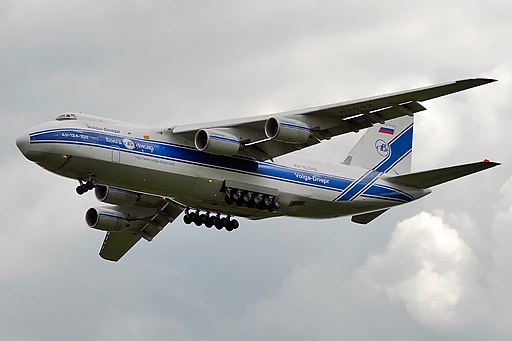
Antonov An-124 Ruslan
The Antonov An-124 Ruslan stands among the world’s largest strategic airlifters, designed to transport outsized and heavy cargo across intercontinental distances. Developed in the 1980s by the Ukrainian Antonov Design Bureau, it was conceived to support military logistics and commercial heavy-lift requirements. Its sheer scale—limited only by runway length and ground infrastructure—enables deliveries of locomotives, generators, helicopters, and even entire radar systems in a single sortie.
More than 50 airframes were built, and variants continue to serve in military and civilian fleets worldwide. The An-124’s high-wing configuration and cavernous cargo bay have made it a favorite for humanitarian relief, remote industrial projects, and aerospace component shipping.
Design and Development
Origins and Concept
The An-124 program launched as a response to the Soviet Union’s need for an airlifter capable of handling the largest payloads without relying on forward bases. Engineers scaled up the An-22’s proven architecture, reinforcing the wing box and fuselage frames and fitting more powerful engines. Early prototypes flew in 1982, and full-scale production ramped up by the mid-1980s to meet strategic airlift demands.
Structural reinforcements and a pressurized cargo hold set the Ruslan apart from its predecessors. A nose-tilt mechanism combined with a rear ramp allows simultaneous front and back loading, minimizing turnaround time on the ground.
Airframe and Cargo Handling
The fuselage spans nearly 69 meters in length, with a cross-sectional diameter of 6.4 meters—wide enough for standard ISO containers laid side by side. Twin nose doors tilt forward by 12 degrees to expose a 6-meter wide by 4-meter high opening. Beneath, the rear ramp hinges down to accommodate rolling stock and tracked vehicles.
The high-mounted wing features supercritical airfoils and automatic leading-edge slats, ensuring controlled lift at low speeds. Landing gear comprises 24 wheels arranged in bogies, distributing weight and enabling operation from semi-prepared runways up to 1,200 meters long.
Powerplant and Performance
Engine Configuration
Each An-124 is powered by four Progress D-18T turbofan engines, each delivering 229 kN of static thrust. These high-bypass turbofans were developed specifically for heavy-lift applications, featuring wide-chord fan blades and advanced heat-resistant alloys. Integrated full-authority digital engine control systems optimize fuel flow and maintain synchronous thrust on all four nacelles.
Engine nacelles incorporate thrust reversers and ejector flaps to reduce landing roll. Auxiliary power units allow ground operation of environmental and loading systems without main-engine usage.
Flight Characteristics
The Ruslan achieves a maximum cruise speed of 865 km/h at flight levels near 10,000 meters, with a practical range of 4,800 kilometers when fully loaded. It can climb to its service ceiling of 12,000 meters within 35 minutes, but typical loaded ascent profiles aim for 6,000–8,000 meters to balance fuel efficiency and climb rate.
Short-field performance is facilitated by double-slotted flaps and auto-deploy slats. At maximum takeoff weight of 402,000 kilograms, the An-124 requires approximately 1,750 meters of runway to clear a 15-meter obstacle.
Avionics and Systems
Cockpit and Navigation
The An-124 cockpit blends analog gauges with modern digital displays in later upgraded models. Dual radar altimeters, INS/GPS integration, and multi-mode weather radar support long-range missions over hostile terrain. An automatic flight control system offers altitude, heading, and speed hold, as well as CAT II ILS certification for low-visibility landings.
Communication suites include HF, VHF, UHF, and satellite links, ensuring continuous data and voice connectivity even in polar regions.
Cargo Handling Systems
Hydraulic power units drive the nose-tilt system, ramp operation, and winches. Four electrically driven rollers in the cargo floor facilitate lateral and longitudinal movement of heavy loads. Onboard cranes rated at 30 tons can position bulky equipment within the hold, minimizing reliance on external ground handling gear.
Environmental controls maintain temperatures from ‑50 °C at altitude to +40 °C on the ground, preserving sensitive payloads such as electronics and perishable goods.
Variants and Special Missions
- An-124-100M-150: Civil certification upgrade allowing a 150-ton payload.
- An-124-100M-150D: Digital cockpit retrofit with glass displays and improved avionics.
- An-124-100M-150I: Intelligence gathering platform equipped with SIGINT suites.
- An-124-150F: Firefighting variant carrying 60,000 liters of retardant in modular tanks.
- An-124-150V: Aerial refueling testbed with hose-and-drogue pods underwing.
Special-mission adaptations include space-rocket component haulers with shock-absorbing mounts and airborne command posts with secure communications racks.
Operational History
First deployed in 1986, the An-124 supported Soviet military maneuvers and Arctic expeditions. Post-Cold War demand surged in the commercial sector as oil rigs, mining camps, and aerospace programs required urgent heavy lift. The Ruslan earned acclaim for transporting entire locomotives across continents, delivering lunar landers to launch sites, and flying emergency power generators into disaster zones within days.
Civil operators like Volga-Dnepr Airlines pioneered commercial charters, while air forces in Russia, India, and Ukraine continue to rely on the type for strategic logistics and humanitarian aid drops.
Technical Specifications
| Parameter | Specification |
|---|---|
| Crew | 6 (2 pilots, navigator, flight engineer, 2 loadmasters) |
| Payload Capacity | 150,000 kg |
| Length | 68.96 m |
| Wingspan | 73.3 m |
| Height | 20.78 m |
| Wing Area | 628 m² |
| Empty Weight | 175,000 kg |
| Maximum Takeoff Weight | 402,000 kg |
| Powerplant | 4 × Progress D-18T turbofans, 229 kN each |
| Maximum Speed | 865 km/h |
| Cruise Speed | 800 km/h |
| Stall Speed (flaps down) | 290 km/h |
| Range (max payload) | 4,800 km |
| Service Ceiling | 12,000 m |
| Takeoff Distance (15 m obstacle) | 1,750 m |
| Landing Distance (15 m obstacle) | 1,530 m |
Future Prospects and Legacy
Ongoing programs explore re-engining with ultra-high-bypass turbofans to cut fuel burn by 25 percent and reduce noise footprints. Hybrid-electric taxi systems could eliminate APU use, saving time and emissions on the ground. Digital twin projects promise predictive maintenance, minimizing unscheduled downtime for fleets operating in extreme climates.
Enthusiasts track Ruslan flights via online spotter networks, while scale-model builders replicate its iconic nose-tilt stance. As global demand for outsized cargo lifts grows—from wind-turbine blades to humanitarian pre-positioning—the Antonov An-124 Ruslan continues to define the art and science of strategic air mobility.
