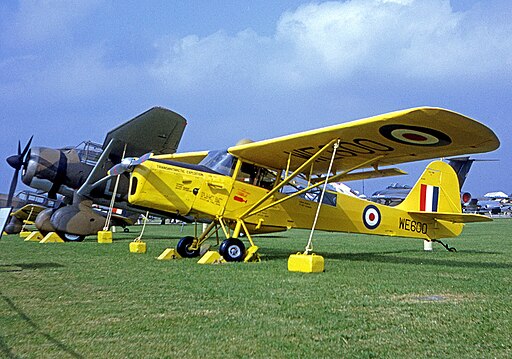
The Auster AOP.6: A Post-War British Air Observation Platform
The Auster AOP.6 was a British military observation and liaison aircraft developed shortly after the Second World War. It was designed as part of the long-running Auster series, which provided the British Army with reliable air observation posts (AOP) for artillery spotting, reconnaissance, and liaison duties. The AOP.6 was an evolutionary step forward, offering better performance, structural improvements, and modernized systems compared to earlier wartime Auster models.
Development History
The Auster Aircraft Company, which had been building light aircraft and liaison types throughout the 1940s, was tasked with creating a post-war air observation aircraft that could replace the widely used Auster AOP.5. The AOP.6 first flew in 1945 and entered service with the British Army in 1946.
Designed specifically for artillery observation, the AOP.6 combined the ruggedness required for frontline operations with a layout that provided excellent visibility for the observer. Unlike many wartime stopgap designs, it was purpose-built for its role, and its introduction marked a refinement of lessons learned during the conflict.
Design Characteristics
The Auster AOP.6 was a high-wing monoplane with a fixed tailwheel undercarriage, a configuration chosen for simplicity and short-field capability. Its high wing provided excellent downward visibility, an essential requirement for spotting artillery fall-of-shot and conducting low-altitude reconnaissance.
The cockpit featured two seats arranged in tandem, with the observer seated in the rear. Large glazed panels around the cabin gave wide fields of vision.
The airframe was of mixed construction, with fabric-covered metal structures that allowed ease of repair in field conditions. The aircraft was powered by a de Havilland Gipsy Major 7 engine, which provided a balance of reliability and sufficient power for observation missions.
The AOP.6 carried minimal equipment, emphasizing light weight and endurance over heavy armament or payload. Its role was strictly to observe and direct rather than engage in combat.
Operational Use
The Auster AOP.6 entered service with the Royal Artillery Air Observation Post units of the British Army and served throughout the late 1940s and 1950s. It was primarily used to direct artillery fire, perform liaison flights, and carry out general battlefield observation.
In addition to British service, the aircraft was exported to several countries, including Belgium, Jordan, and South Africa. Some were also used for civilian roles, such as training and private flying, once they were retired from military service.
The AOP.6 was eventually succeeded by later Auster variants and by more modern observation aircraft, but it remained a dependable and well-regarded platform during its operational life.
Technical Parameters of the Auster AOP.6
-
Role: Air Observation Post and liaison aircraft
-
Crew: 2 (pilot and observer in tandem)
Dimensions
-
Length: 24 ft 0 in (7.32 m)
-
Wingspan: 36 ft 0 in (11 m)
-
Height: 8 ft 10 in (2.69 m)
-
Wing area: ~174 sq ft (16.2 m²)
Weights
-
Empty weight: ~1,250 lb (567 kg)
-
Maximum takeoff weight (MTOW): 2,200 lb (998 kg)
Powerplant
-
1 × de Havilland Gipsy Major 7, four-cylinder inverted inline piston engine
-
Power output: 145 hp (108 kW)
-
Propeller: Two-bladed fixed-pitch wooden propeller
Performance
-
Maximum speed: 124 mph (200 km/h, 108 knots)
-
Cruise speed: ~104 mph (167 km/h, 90 knots)
-
Stall speed: ~45 mph (72 km/h, 39 knots)
-
Range: ~300 miles (480 km)
-
Service ceiling: ~13,000 ft (3,960 m)
-
Rate of climb: ~750 ft/min (3.8 m/s)
Other Features
-
Fixed tailwheel undercarriage suitable for grass and rough-field operations
-
Large glazed cockpit with extended downward visibility
-
Radio equipment for artillery coordination
Legacy
The Auster AOP.6 represents the transitional period of military aviation in the late 1940s, when piston-engined liaison aircraft still played a vital role in ground coordination before helicopters became the dominant observation platform.
Although simple by modern standards, the AOP.6 was well-suited to its mission, providing reliable service to the British Army and several foreign operators. Today, surviving examples are preserved by museums and private owners, keeping alive the history of an aircraft that was integral to post-war observation and training.
