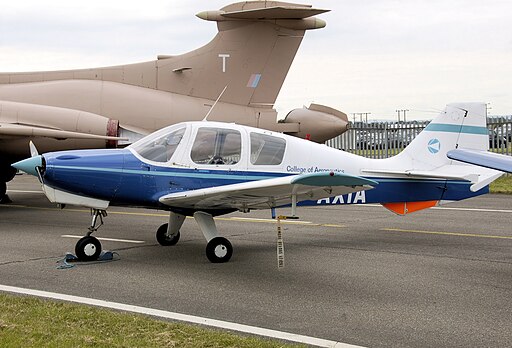
The Beagle Pup is a lightweight single-engine airplane developed in the United Kingdom during the 1960s as a cost-effective, accessible general aviation aircraft. It was conceived to serve private pilots, flying clubs, and training organizations that required a simple yet structurally sound aircraft with predictable handling characteristics. The design philosophy emphasized mechanical simplicity, low operating costs, and ease of maintenance while still delivering reliable performance for cross-country flying and basic aerobatic maneuvering. Its compact airframe and straightforward systems made it particularly attractive during a period when personal aviation was expanding rapidly across Europe.
Airframe Construction and Structural Layout
The Beagle Pup features an all-metal, stressed-skin construction primarily composed of aluminum alloy, providing a favorable balance between structural strength and weight efficiency. The fuselage adopts a semi-monocoque design with frames and stringers distributing aerodynamic and landing loads evenly throughout the airframe. The low-wing configuration improves roll responsiveness and offers improved visibility above the aircraft compared to high-wing trainers. The wing structure consists of a single main spar with auxiliary ribs and reinforced attachment points, allowing for relatively high load factors for an aircraft of its class. Fixed tricycle landing gear with oleo-pneumatic shock absorbers enhances ground stability and reduces pilot workload during takeoff and landing operations.
Powerplant and Propulsion System
The Beagle Pup is powered by a single four-cylinder, air-cooled, horizontally opposed piston engine, most commonly the Lycoming O-235 series. Engine output typically ranges between 100 and 115 horsepower depending on the specific variant, providing sufficient thrust for training and light touring roles. The powerplant drives a fixed-pitch, two-blade propeller optimized for climb efficiency and fuel economy rather than maximum cruise speed. Fuel delivery is carbureted, simplifying maintenance and troubleshooting, while the ignition system uses dual magnetos for redundancy and safety. The engine installation includes effective baffle cooling and straightforward access panels, reducing downtime during routine inspections.
Performance Specifications and Flight Characteristics
In standard configuration, the Beagle Pup has a maximum takeoff weight of approximately 770 kilograms, with an empty weight near 480 kilograms depending on installed equipment. Cruise speeds typically range from 95 to 105 knots, while maximum range extends to roughly 500 nautical miles with standard fuel capacity and conservative power settings. The service ceiling is approximately 13,000 feet, allowing the aircraft to operate comfortably in varied weather and terrain conditions. Takeoff distance over a 50-foot obstacle averages around 450 meters, while landing distance is slightly shorter due to effective flap design and stable low-speed handling. Flight characteristics are generally neutral and forgiving, with light control forces and minimal adverse yaw, making the aircraft suitable for ab initio pilot training.
Cockpit Layout and Avionics
The cockpit of the Beagle Pup is configured for two occupants in a side-by-side seating arrangement, promoting effective instructor-student communication during training flights. The cabin structure is relatively narrow but ergonomically efficient, with adequate headroom and forward visibility. Instrumentation follows a conventional analog layout, typically including airspeed indicator, altimeter, vertical speed indicator, magnetic compass, tachometer, oil pressure gauge, oil temperature gauge, and fuel quantity indicators. Avionics fit varies by aircraft age and owner upgrades but often includes basic VHF communication radios and navigation receivers. Electrical systems operate on a simple 12-volt configuration, minimizing complexity while supporting essential flight instruments and lighting.
Handling Qualities and Training Suitability
The Beagle Pup is widely regarded for its predictable stall behavior and stable approach characteristics, both critical for pilot training environments. Stalls occur with ample aerodynamic warning and minimal wing drop when properly coordinated, allowing student pilots to develop confidence in slow-flight regimes. Control harmony between pitch, roll, and yaw is well balanced, reducing the likelihood of overcontrol. The aircraft’s responsive ailerons and moderate power-to-weight ratio also permit limited aerobatic training within approved flight envelopes, enhancing its versatility beyond basic instruction. Ground handling is straightforward due to the tricycle gear configuration and effective nosewheel steering.
Maintenance, Reliability, and Operational Considerations
From a technical maintenance perspective, the Beagle Pup benefits from its uncomplicated systems architecture and widely available engine components. Routine servicing can be performed with standard tooling, and spare parts for the Lycoming engine remain readily accessible. The airframe’s corrosion resistance is adequate when proper inspection schedules are followed, though attention is required in high-moisture environments due to the aircraft’s age. Fuel consumption averages between 18 and 22 liters per hour, contributing to low hourly operating costs. These factors combine to make the aircraft economically sustainable for private owners and small flying clubs.
Legacy and Long-Term Operational Value
The Beagle Pup occupies a notable position in general aviation history as a practical and technically efficient light aircraft. While no longer in production, many examples remain airworthy and continue to serve in training and recreational roles. Its straightforward engineering, reliable performance envelope, and forgiving flight characteristics have allowed it to maintain relevance decades after its introduction. As an aircraft, the Beagle Pup represents a successful balance of engineering simplicity and functional capability, making it an enduring example of mid-20th-century light aircraft design.
