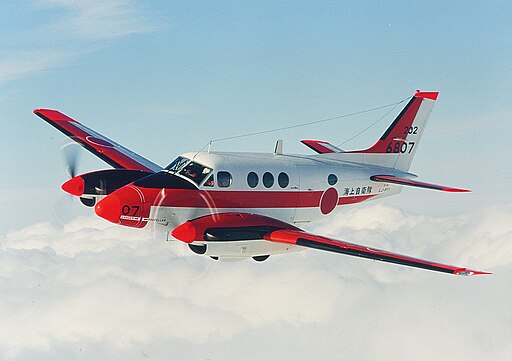
The Beechcraft King Air is one of the most successful and enduring business aircraft families ever produced, representing a benchmark in twin-engine turboprop performance, reliability, and versatility. Developed by Beechcraft in the early 1960s, the King Air emerged from the company’s ambition to transition from piston-powered executive transports to turbine propulsion. The first model, the King Air 90, flew in 1963 and entered service in 1964, marking a decisive shift in corporate aviation toward turboprop efficiency combined with cabin comfort.
Unlike many aircraft programs that evolve through complete redesigns, the King Air developed through incremental refinement. Over decades, successive variants—such as the 90, 100, 200, 300, and 350 series—expanded cabin size, increased power, improved avionics, and extended range while retaining the recognizable low-wing configuration and T-tail silhouette. This continuity allowed operators to benefit from proven aerodynamics and systems reliability while integrating modern technologies.
Airframe Architecture and Structural Design
The King Air features a low-wing monoplane configuration with retractable tricycle landing gear and a distinctive T-tail arrangement that enhances pitch authority and reduces aerodynamic interference from propeller wash. The airframe is constructed primarily from aluminum alloys using semi-monocoque techniques, providing strength, fatigue resistance, and manageable maintenance demands. The pressurized cabin allows high-altitude cruise operations, distinguishing it from smaller unpressurized turboprops.
In the widely operated King Air 350 variant, overall length measures approximately 46 feet 8 inches (14.2 meters), with a wingspan of 57 feet 11 inches (17.7 meters) and a height of about 14 feet 4 inches (4.37 meters). The wing area is approximately 310 square feet (28.8 square meters). The maximum takeoff weight for the 350 series is around 15,000 pounds (6,804 kilograms), while the operating empty weight is typically about 9,000–9,500 pounds depending on configuration, yielding a substantial useful load for passengers, baggage, and fuel.
The cabin cross-section is nearly rectangular, maximizing usable space. In executive configurations, seating typically accommodates six to eight passengers, although high-density or special-mission layouts can carry more. Large oval windows enhance natural lighting and passenger comfort. The structural design supports high cycle counts, making the aircraft well suited for charter, corporate shuttle, medical evacuation, and government missions.
Powerplant and Propulsion Systems
Most modern King Air variants are powered by two Pratt & Whitney Canada PT6A series turboprop engines, among the most widely used and respected turbine engines in aviation. In the King Air 350, the aircraft is equipped with PT6A-60A engines, each producing approximately 1,050 shaft horsepower (783 kW). These engines drive four-blade constant-speed, full-feathering propellers, typically manufactured by Hartzell.
The PT6A’s reverse-flow design contributes to compact installation and reliability. Engine controls allow precise power management, and automatic propeller feathering systems enhance safety in the event of engine failure. The aircraft’s fuel system includes multiple wing tanks with a combined usable fuel capacity of approximately 539 U.S. gallons (2,041 liters), supporting extended range missions.
The King Air’s twin-engine configuration provides redundancy and improved performance compared to single-engine turboprops. In the event of one engine failure, the aircraft can maintain altitude under many conditions, particularly at lighter weights, reinforcing its reputation for operational safety.
Performance Characteristics and Flight Envelope
The King Air family offers strong performance within the turboprop category. In the King Air 350, maximum cruise speed reaches approximately 312 knots (578 km/h) at optimal altitude, while typical cruise speeds are around 290–300 knots (537–556 km/h). The aircraft’s service ceiling is approximately 35,000 feet (10,668 meters), allowing it to operate above much of the weather and commercial traffic.
Range varies depending on payload and power settings but can exceed 1,800 nautical miles (3,334 kilometers) with long-range cruise profiles. Takeoff distance over a 50-foot obstacle is typically around 3,300 feet (1,006 meters), while landing distance is approximately 2,700 feet (823 meters), enabling operations from shorter regional runways and remote airstrips.
Climb performance is robust, with initial climb rates exceeding 2,700 feet per minute (13.7 m/s) under standard conditions. Pressurization systems maintain a comfortable cabin environment, with a typical cabin altitude of approximately 6,000 feet when cruising at 35,000 feet, contributing to passenger comfort during long flights.
Avionics, Systems, and Modernization
Modern King Air models are equipped with advanced glass cockpit avionics suites, such as the Collins Aerospace Pro Line Fusion system. These integrated flight decks include large multifunction displays, synthetic vision, touchscreen controls, digital autopilot, weather radar integration, traffic awareness systems, and advanced flight management systems. The avionics architecture enhances situational awareness and reduces pilot workload.
Flight controls are conventional, utilizing cable and pushrod linkages rather than fly-by-wire systems. This mechanical simplicity contributes to ease of maintenance and predictable handling. The King Air’s systems architecture includes redundant electrical buses, environmental control systems, anti-ice systems for wings and propellers, and de-icing boots, allowing safe operations in known icing conditions when properly equipped.
Many older King Air aircraft have undergone avionics retrofits, engine upgrades, and winglet installations to improve performance and fuel efficiency. The adaptability of the airframe to modernization has been a key factor in its longevity.
Operational Versatility and Global Presence
The King Air has found roles far beyond corporate transport. It serves in air ambulance operations, cargo transport, aerial survey, maritime patrol, military liaison, intelligence gathering, and flight inspection missions. Governments and armed forces around the world operate specialized versions for surveillance and reconnaissance, capitalizing on the aircraft’s endurance, stability, and short-field performance.
Its ability to operate from relatively short or unimproved runways gives it an advantage over many light jets, especially in remote regions. Operating costs are generally lower than comparable jets, particularly on shorter sectors, making it economically attractive for regional missions.
Enduring Legacy in Business Aviation
Over more than half a century of production, the Beechcraft King Air has established itself as a cornerstone of turboprop aviation. Thousands of units have been delivered worldwide, and production continues in updated forms under Textron Aviation, the current parent company of Beechcraft. The aircraft’s blend of turbine reliability, cabin comfort, runway flexibility, and upgrade potential has ensured its continued relevance even in an era increasingly dominated by light jets.
Technically, the King Air represents a mature and refined turboprop platform, balancing aerodynamic efficiency with structural durability and propulsion reliability. Its consistent evolution rather than radical redesign has preserved its core strengths while allowing integration of modern avionics and performance enhancements. As a result, the Beechcraft King Air remains one of the most recognizable and respected twin-turboprop aircraft families in the world, continuing to define standards in its class.
