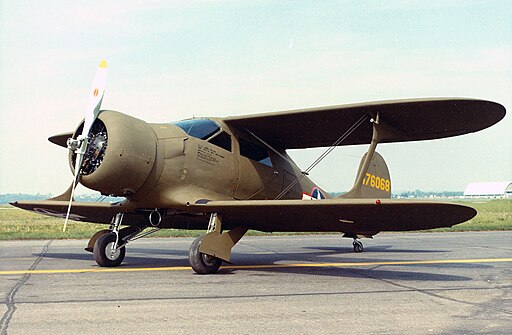
The Beechcraft Model 17 Staggerwing stands as one of the most iconic and elegant aircraft of the golden age of aviation, representing a milestone in design, performance, and luxury for its era. Introduced in the mid-1930s by the Beech Aircraft Corporation, the Staggerwing was conceived to combine speed, comfort, and advanced engineering into a single high-performance biplane. Its unique and instantly recognizable feature was the negative stagger wing arrangement—where the lower wing was positioned forward of the upper wing—an uncommon configuration that earned it the nickname “Staggerwing.” This innovative design choice improved pilot visibility and aerodynamic efficiency while contributing to its distinctive appearance. The Model 17 quickly became a favorite among wealthy private owners, business executives, and even military operators, symbolizing sophistication and cutting-edge technology in pre-war aviation.
Design and Structural Features
The Beechcraft Model 17 was a luxury biplane featuring a fabric-covered steel tube fuselage combined with wood and metal components in the wings. The staggered wing configuration significantly enhanced both aerodynamic performance and pilot visibility, allowing the cockpit to be placed aft without obstructing the pilot’s forward view. This feature also contributed to improved maneuverability and stability. The upper wing was shorter in chord than the lower wing, and both wings were braced with streamlined struts and cables, maintaining structural integrity while minimizing drag.
The aircraft was a low-wing monoplane in terms of cockpit placement but retained the biplane structure for lift and strength. The fixed landing gear, later models featured retractable gear, was robust and designed to handle rough airfields, with a tailwheel configuration typical of the era. The fuselage housed a spacious, well-appointed cabin that could seat up to four passengers in comfort, featuring luxury appointments and large windows for an enhanced travel experience. The cockpit, separate from the passenger cabin, was typically enclosed or partially enclosed to protect the pilot while maintaining excellent visibility.
The Staggerwing’s construction involved a combination of welded steel tubing for the fuselage frame covered by fabric, and wooden wing spars and ribs covered with fabric and plywood. This mixed-material approach offered a good balance between weight, strength, and ease of repair. The aircraft’s attention to aerodynamic refinement was also evident in the streamlined engine cowling, wheel pants, and smooth fuselage lines, all contributing to its impressive performance.
Powerplant and Performance
The Beechcraft Model 17 Staggerwing was powered by several engine variants throughout its production, with the most common being radial piston engines from the Pratt & Whitney and Wright Aeronautical families. Early models typically featured the Pratt & Whitney R-985 Wasp Junior radial engine producing approximately 450 horsepower, while later and more powerful variants were equipped with the Wright R-975 or Pratt & Whitney R-1340 Wasp engines, delivering between 450 and 600 horsepower depending on the version.
This powerful propulsion allowed the Staggerwing to achieve remarkable speeds for a biplane, with cruising speeds typically around 190 miles per hour (306 kilometers per hour) and maximum speeds exceeding 200 miles per hour (322 kilometers per hour). The aircraft’s service ceiling was approximately 20,000 feet (6,100 meters), providing excellent high-altitude performance for the time. Range capabilities varied, with some versions capable of flying over 700 miles (1,126 kilometers) on a full fuel load, making it suitable for long-distance business travel or even military liaison roles.
The retractable landing gear, introduced in later versions, was a significant advancement that reduced drag and further enhanced speed and fuel efficiency. The combination of aerodynamic design, powerful engines, and streamlined features made the Model 17 one of the fastest and most capable civil aircraft of its generation.
Flight Controls and Handling Characteristics
The Staggerwing employed conventional control surfaces including ailerons on both upper and lower wings, a large rudder, and elevators for pitch control. The dual ailerons provided excellent roll authority and responsiveness, important for the aircraft’s high-speed capabilities. The flight controls were cable-operated, with a control yoke in the cockpit managing roll and pitch, and rudder pedals controlling yaw.
Handling the Staggerwing required a degree of skill, especially during takeoff and landing due to its tailwheel configuration and high power output. However, it was praised for its stability and smooth flight characteristics once airborne, with a firm but responsive control feel. The negative stagger wing arrangement also contributed to balanced aerodynamic forces, making it relatively stable in turns and less prone to adverse yaw compared to other biplanes of the time.
The aircraft’s excellent climb rate and cruise performance allowed it to operate effectively in diverse environments, from short regional airfields to longer cross-country flights. Pilots valued the combination of precision control and robust construction, which made the Staggerwing both a pleasure to fly and dependable under various weather conditions.
Operational History and Legacy
The Beechcraft Model 17 Staggerwing was produced from 1932 until 1949, with approximately 785 aircraft built. It enjoyed considerable success among private owners, business executives, and even military operators. During World War II, several military variants were produced under the designation UC-43 for use as liaison and utility aircraft by the United States Army Air Forces and other allied services. The aircraft’s combination of speed, range, and rugged construction made it well-suited for these roles, providing fast and reliable transport for personnel and light cargo.
In the civilian market, the Model 17 was regarded as one of the most prestigious and desirable aircraft of its era. Its blend of luxury, performance, and distinctive styling has left a lasting impact on general aviation, influencing both aircraft design and public perception of what a personal aircraft could be. Many Staggerwings remain operational today, prized by collectors and enthusiasts for their historical significance and flying qualities.
Technical Specifications Summary
- Type: Single-engine, luxury biplane with negative stagger wings
- Crew: 1 pilot
- Capacity: Typically 3 passengers
- Length: Approximately 27 feet 4 inches (8.33 meters)
- Wingspan: Approximately 32 feet 2 inches (9.8 meters)
- Height: Approximately 7 feet 8 inches (2.34 meters)
- Wing Area: Around 270 square feet (25 square meters)
- Empty Weight: Approximately 3,400 pounds (1,542 kilograms)
- Maximum Takeoff Weight: About 5,200 pounds (2,359 kilograms)
- Powerplant: Pratt & Whitney R-985 Wasp Junior or Wright R-975 radial engines, 450-600 horsepower range
- Maximum Speed: Approximately 200 miles per hour (322 kilometers per hour)
- Cruise Speed: Around 190 miles per hour (306 kilometers per hour)
- Range: Approximately 700 miles (1,126 kilometers)
- Service Ceiling: Around 20,000 feet (6,100 meters)
- Landing Gear: Retractable tailwheel (on later models), fixed on earlier variants
- Construction: Steel tube fuselage with fabric covering; wood and fabric wings
The Beechcraft Model 17 Staggerwing remains a hallmark of pre-World War II aviation, embodying a perfect synthesis of style, speed, and engineering prowess. Its innovative negative stagger wing and luxurious cabin set new standards for business and personal aircraft, securing its place as one of the most revered classic aircraft ever built.
.jpg)