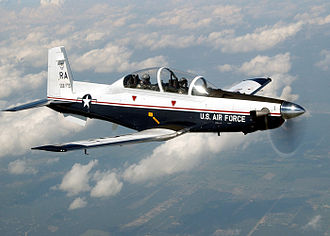
The Beechcraft T-6 Texan II represents one of the most important modern military training aircraft in service today. Designed as a primary trainer for future fighter and transport pilots, the T-6 Texan II bridges the gap between basic flight instruction and advanced jet training. Its role is crucial: it transforms inexperienced cadets into disciplined aviators capable of handling high-performance aircraft in demanding operational environments.
Developed in the late 20th century and entering service in the early 2000s, the aircraft is part of a broader shift in military aviation training philosophy. Rather than relying on multiple specialized aircraft types, modern training programs increasingly depend on versatile, highly capable platforms that simulate advanced systems early in the learning process. The T-6 Texan II embodies this philosophy, combining turboprop efficiency with advanced avionics and flight characteristics that resemble jet aircraft.
Its adoption by the United States Air Force, Navy, and numerous allied nations underscores its effectiveness. The aircraft’s lineage traces back to the Swiss-designed Pilatus PC-9, but its Americanized version includes significant structural, avionics, and systems upgrades tailored to the needs of modern Western air forces.
Development History and Design Evolution
The T-6 Texan II was developed by Beechcraft (now part of Textron Aviation) in response to the U.S. Joint Primary Aircraft Training System (JPATS) program. The goal of JPATS was to replace aging trainer fleets such as the T-37 Tweet and T-34 Mentor with a single, unified platform capable of serving multiple branches of the U.S. military.
The competition required an aircraft that was not only reliable and cost-effective but also technologically advanced enough to prepare pilots for 4th- and 5th-generation combat aircraft. Beechcraft partnered with Pilatus Aircraft, adapting the PC-9 into a more robust and capable design that met stringent U.S. military requirements.
Key modifications included structural reinforcement, improved ejection seats, upgraded avionics, and compatibility with U.S. training standards. The result was a trainer that retained the aerodynamic efficiency of the original design while incorporating the survivability and systems integration expected in modern military aviation.
The aircraft was officially designated the T-6A Texan II, honoring the legendary North American T-6 Texan used during World War II. Over time, additional variants such as the T-6B and AT-6 Wolverine were developed, expanding the platform’s capabilities beyond basic training into light attack and advanced instruction roles.
Airframe and Aerodynamic Characteristics
The T-6 Texan II features a low-wing monoplane configuration with a tandem two-seat cockpit, optimized for instructor-student interaction. Its airframe is constructed primarily from aluminum alloys, balancing durability with weight efficiency.
Aerodynamically, the aircraft is designed to provide predictable handling while still challenging student pilots. The wing incorporates a moderate aspect ratio and slight dihedral, contributing to stability without sacrificing maneuverability. The aircraft is capable of performing aerobatic maneuvers, including loops, rolls, and spins, making it ideal for teaching fundamental flight dynamics.
One of the defining characteristics of the T-6 is its ability to simulate jet-like handling. While it is powered by a turboprop engine, the aircraft’s control responsiveness, climb rate, and energy management closely resemble those of jet trainers. This allows students to develop skills that transfer directly to advanced platforms such as the F-16 or F/A-18.
The landing gear is retractable and tricycle-configured, providing stable ground handling and reducing drag during flight. The aircraft’s rugged construction enables operation from a variety of airfields, including those with less-than-ideal surface conditions.
Propulsion System and Performance
At the heart of the T-6 Texan II is the Pratt & Whitney Canada PT6A-68 turboprop engine, a proven and widely used powerplant known for its reliability and performance. The engine produces approximately 1,100 shaft horsepower, driving a four-blade constant-speed propeller.
The PT6A engine family is renowned for its reverse-flow design, which enhances efficiency and simplifies maintenance. In the T-6, this engine provides excellent acceleration, climb performance, and fuel efficiency. The aircraft can reach speeds of over 300 knots and climb at rates exceeding 3,000 feet per minute, making it highly responsive in training scenarios.
Fuel efficiency is another major advantage. Compared to jet trainers, the turboprop configuration significantly reduces operating costs, allowing for longer training sorties and more extensive pilot practice without excessive expense.
The engine’s reliability is critical in a training environment, where safety and availability are paramount. The PT6A has accumulated millions of flight hours worldwide, making it one of the most trusted engines in aviation.
Cockpit and Avionics Systems
The cockpit of the T-6 Texan II is designed to familiarize student pilots with modern glass cockpit technology from the earliest stages of training. Both front and rear cockpits are equipped with identical instrumentation, allowing instructors to monitor and override student inputs when necessary.
The aircraft features a digital avionics suite that includes multi-function displays (MFDs), a head-up display (HUD) in later variants, and hands-on throttle-and-stick (HOTAS) controls. These systems mirror those found in advanced fighter aircraft, enabling students to develop familiarity with complex avionics early in their training.
Navigation systems include GPS, inertial navigation, and tactical air navigation (TACAN), providing comprehensive situational awareness. Communication systems are fully compatible with military standards, supporting secure and encrypted communications.
The cockpit is also equipped with zero-zero ejection seats, meaning they can be safely used at zero altitude and zero airspeed. This is a critical safety feature in training environments where emergencies can occur during takeoff or landing.
Training Role and Operational Use
The T-6 Texan II serves as the primary training aircraft for multiple branches of the U.S. military, including the Air Force, Navy, and Marine Corps. It is also used by several allied nations, making it a cornerstone of global pilot training programs.
Training with the T-6 typically begins after initial screening in simpler aircraft. Students learn basic flight maneuvers, navigation, formation flying, and instrument procedures. The aircraft’s versatility allows it to cover a wide range of training scenarios, reducing the need for multiple specialized platforms.
One of the key advantages of the T-6 is its ability to simulate real-world combat conditions. Instructors can introduce complex scenarios involving navigation, communication, and decision-making under pressure. This prepares students for the challenges they will face in advanced training and operational units.
The aircraft’s reliability and relatively low operating cost make it ideal for high-tempo training environments. It can sustain multiple sorties per day, ensuring that training pipelines remain efficient and effective.
Variants and Specialized Versions
Over time, several variants of the T-6 Texan II have been developed to meet different operational requirements.
The T-6A is the baseline model used for primary training. It features a standard avionics suite and is optimized for basic flight instruction.
The T-6B introduces upgrades such as a glass cockpit with advanced displays and improved training capabilities. This version is commonly used by the U.S. Navy and Marine Corps.
The AT-6 Wolverine represents a significant evolution of the platform. Designed as a light attack and armed reconnaissance aircraft, it incorporates weapons systems, hardpoints for external stores, and enhanced survivability features. This variant demonstrates the flexibility of the T-6 design, extending its utility beyond training into operational roles.
International variants have also been developed, tailored to the specific needs of different air forces. These versions may include customized avionics, communication systems, and mission equipment.
Maintenance and Operational Efficiency
One of the defining strengths of the T-6 Texan II is its maintainability. The aircraft was designed with ease of maintenance in mind, featuring accessible components and modular systems that simplify repairs and inspections.
The PT6A engine contributes significantly to this efficiency, requiring relatively low maintenance compared to jet engines. Ground crews can perform routine servicing quickly, minimizing downtime and maximizing aircraft availability.
The aircraft’s systems are designed for reliability, reducing the likelihood of in-flight failures and ensuring consistent training schedules. This is particularly important in military training programs, where delays can have significant downstream effects.
Operating costs are also relatively low, making the T-6 an economical choice for both large and small air forces. Its fuel efficiency and durability allow for extensive training without excessive financial burden.
Global Operators and Strategic Importance
The T-6 Texan II is used by numerous countries around the world, including the United States, Canada, Greece, Israel, and Iraq. Its widespread adoption reflects its effectiveness and adaptability to different training doctrines.
For many nations, the T-6 serves as the foundation of their pilot training pipeline. It provides a standardized platform that ensures consistency in training outcomes, regardless of the specific aircraft pilots will eventually fly.
The aircraft also plays a strategic role in international cooperation. Joint training programs often use the T-6, facilitating interoperability between allied forces. This is particularly important in multinational operations, where coordination and communication are critical.
Comparison with Other Trainer Aircraft
In comparison to other trainer aircraft, the T-6 Texan II occupies a unique position. It offers a balance between simplicity and sophistication, making it suitable for both basic and intermediate training.
Compared to jet trainers such as the T-38 Talon, the T-6 is more economical and easier to maintain. However, it still provides many of the same training benefits, particularly in terms of avionics and flight handling.
When compared to simpler piston-engine trainers, the T-6 offers significantly greater performance and capability. This allows students to progress more quickly and develop skills that are directly applicable to advanced aircraft.
Its versatility and cost-effectiveness have made it a preferred choice for many air forces, replacing multiple older aircraft types with a single, unified platform.
Future Prospects and Modernization
As military aviation continues to evolve, the T-6 Texan II remains a relevant and valuable training platform. Ongoing upgrades and modernization efforts ensure that the aircraft keeps pace with technological advancements.
Future enhancements may include improved avionics, enhanced simulation capabilities, and integration with virtual training systems. These developments will further increase the effectiveness of the T-6 as a training tool.
The AT-6 Wolverine variant also highlights the potential for expanding the platform’s operational roles. In an era of asymmetric warfare, light attack aircraft offer a cost-effective solution for missions that do not require high-end fighter jets.
Given its proven track record and adaptability, the T-6 Texan II is likely to remain in service for decades to come, continuing to train the next generation of military pilots.
Technical Parameters Table
| Parameter | Value |
|---|---|
| Manufacturer | Beechcraft (Textron Aviation) |
| Role | Primary trainer / light attack (AT-6) |
| Crew | 2 (student + instructor) |
| Length | 10.16 m |
| Wingspan | 10.19 m |
| Height | 3.25 m |
| Empty Weight | ~1,900 kg |
| Maximum Takeoff Weight | ~2,948 kg |
| Engine | Pratt & Whitney Canada PT6A-68 |
| Power Output | ~1,100 shp |
| Maximum Speed | ~585 km/h (316 knots) |
| Cruise Speed | ~500 km/h |
| Range | ~1,600 km |
| Service Ceiling | ~9,450 m (31,000 ft) |
| Rate of Climb | ~3,100 ft/min |
| Armament (AT-6) | Machine guns, rockets, guided bombs |
| Avionics | Glass cockpit, HUD (T-6B), GPS, TACAN |
| Ejection Seats | Zero-zero capable |
