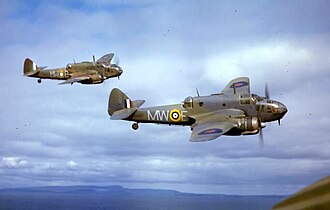
Bristol Beaufort: The RAF’s Torpedo Bomber of the Second World War
The Bristol Beaufort was one of the most important British twin-engined aircraft of the early and middle years of the Second World War. Designed primarily as a torpedo bomber and maritime reconnaissance aircraft, it emerged from the same Bristol design lineage as the Blenheim but was substantially larger, heavier and more capable. The Beaufort was built to operate over the sea, where its crews faced some of the most difficult conditions of the war while searching for enemy shipping, attacking warships and submarines, laying mines, and carrying out long-range reconnaissance. It served principally with the Royal Air Force and Royal Australian Air Force, while Australian production produced a locally adapted version in large numbers. Although the Beaufort was eventually overshadowed by more specialised aircraft, its wartime career was remarkably diverse, and its airframe provided the foundation for the Bristol Beaufighter, one of the most successful British heavy fighters of the conflict.
The Beaufort’s reputation has sometimes been shaped by its most dangerous role: low-level torpedo attacks. These missions required aircraft to approach enemy ships at relatively low altitude and speed, exposing crews to concentrated anti-aircraft fire and fighter interception. Yet the Beaufort was far more than a torpedo carrier. It became an important maritime strike aircraft in the Mediterranean, a major anti-shipping weapon in the Pacific, a minelayer, reconnaissance aircraft and, later, a training platform. Its development also illustrates how rapidly aircraft technology advanced during the war. The Beaufort entered service as a modern and useful machine, but increasing engine power, improved radar, longer-range fighters and specialised anti-shipping aircraft gradually changed the missions it was expected to perform.
The Origins of the Bristol Beaufort
Developing the Blenheim concept
The Beaufort originated from Bristol’s experience developing the Blenheim, a fast twin-engined aircraft that had begun life as a civilian machine before becoming one of Britain’s principal light bombers. Bristol designers recognised that the basic Blenheim configuration could be enlarged and modified to create an aircraft specifically suited to maritime operations.
The resulting design was considerably larger than the Blenheim and incorporated a spacious internal fuselage, retractable landing gear, twin radial engines and accommodation for a larger crew. The Air Ministry issued requirements for a modern torpedo bomber capable of operating over long distances, and Bristol’s design was selected for production.
The first prototype, designated Type 152, flew in October 1938. Although the prototype had been designed around the requirements of a maritime strike aircraft, the Beaufort was also intended to carry bombs and mines. This flexibility became one of its defining characteristics.
The aircraft entered RAF service in 1940, at a time when Britain urgently needed modern maritime aircraft. The Battle of the Atlantic was intensifying, German surface raiders threatened Allied shipping, and the Mediterranean was becoming another major maritime theatre. The Beaufort arrived in time to become an important component of Britain’s response.
A larger and stronger aircraft
Although the Beaufort shared a family resemblance with the Blenheim, it was substantially larger. Its broad fuselage accommodated the crew, torpedo equipment, bombs and fuel, while its structure was designed to withstand the stresses associated with carrying a heavy external weapon.
The aircraft normally operated with a crew of four: a pilot, navigator/bomb aimer, wireless operator and rear gunner. Depending on the mission and equipment fit, crew arrangements could vary.
Its large fuselage also became important in the later development of the Beaufighter. The Beaufort’s basic structure provided Bristol with a ready-made platform that could be transformed into a heavily armed fighter by replacing the maritime equipment with guns and cannon.
Design and Engineering
The Beaufort’s distinctive appearance
The Beaufort was recognisable by its long fuselage, twin-engine layout and large glazed nose. The aircraft’s proportions reflected its maritime role: it needed sufficient internal volume for fuel, crew and weapons while maintaining reasonable aerodynamic efficiency.
Its wings were relatively broad, and the twin engines were mounted in streamlined nacelles. The main landing gear retracted rearward into the engine nacelles, while the tailwheel remained exposed. The airframe was constructed principally from metal, with fabric used on certain control surfaces.
The aircraft’s design placed considerable emphasis on range. Torpedo bombers had to fly substantial distances to reach enemy shipping and still retain enough fuel to return safely. This made fuel capacity and engine reliability particularly important.
Bristol Taurus engines
Early Beauforts were powered by the Bristol Taurus, an air-cooled sleeve-valve radial engine. The Taurus was compact and potentially powerful, but it developed a reputation for reliability problems, particularly in the early stages of its service life.
Later Beaufort variants received improved versions of the Taurus, while Australian-built aircraft eventually used Pratt & Whitney Twin Wasp engines. The Australian decision to use American engines reflected both local manufacturing considerations and the need for greater reliability.
Engine performance was critical because the Beaufort was a relatively heavy aircraft. When carrying a torpedo, fuel and other equipment, it required substantial power merely to maintain useful performance. The aircraft’s speed was therefore modest compared with contemporary fighters.
The Beaufort Enters RAF Service
Early operational challenges
The first Beauforts entered RAF service with No. 22 Squadron in 1940. The aircraft’s arrival was important, but operational use revealed numerous challenges.
Torpedo bombing was inherently dangerous. To launch a torpedo successfully, the aircraft had to approach the target at low altitude and within a relatively narrow speed range. The crew then had to maintain a stable course long enough for the weapon to enter the water correctly. During this approach, the aircraft was extremely vulnerable.
Enemy warships could concentrate anti-aircraft fire on the approaching bomber, while fighters could attack from above. Even successful attacks could therefore result in severe losses.
The Beaufort’s relatively heavy construction helped it survive some damage, but armour and self-sealing fuel tanks could only do so much. The aircraft was being asked to perform missions at distances and altitudes where modern fighter protection was often unavailable.
The Battle of Britain and coastal operations
Although the Beaufort was not a major participant in the Battle of Britain itself, its maritime role became increasingly important during 1940 and 1941. Coastal Command needed aircraft capable of attacking German shipping and naval forces, while Britain’s strategic position depended heavily on maintaining sea communications.
Beauforts attacked German shipping in the North Sea and English Channel, conducted reconnaissance and laid mines. These missions complemented the work of other Coastal Command aircraft and formed part of Britain’s broader effort to disrupt enemy maritime logistics.
The Beaufort was particularly well suited to operations where a combination of range, payload and low-level performance mattered more than outright speed.
Torpedo Attacks and Maritime Strike
The Beaufort’s most famous mission
The aircraft is most closely associated with torpedo attacks. The Beaufort could carry a large aerial torpedo beneath its fuselage, turning it into a specialised maritime strike platform.
Torpedo attacks required exceptional precision. Crews had to identify the target, determine its speed and direction, approach from an appropriate angle and release the weapon at the correct height and distance. The aircraft then had to escape before enemy defensive fire became overwhelming.
The Beaufort’s crews developed considerable expertise in these operations. The aircraft’s ability to operate at low altitude and carry a substantial weapon made it particularly valuable against enemy shipping.
The attack on the Italian fleet
One of the most famous Beaufort operations occurred in the Mediterranean, where RAF Beauforts participated in attacks against Italian naval forces.
Beauforts operating from Malta became a significant threat to Axis shipping. Malta itself was strategically important because aircraft based there could attack supply routes between Italy and North Africa. German and Italian forces depended on these maritime routes to supply Rommel’s forces, making Allied torpedo-bomber operations an important part of the wider campaign.
Beaufort crews attacked Italian warships and merchant vessels, sometimes operating under extremely difficult conditions. The Mediterranean became one of the aircraft’s most successful theatres, and the type gained a reputation as a dangerous anti-shipping weapon.
The Beaufort in the Mediterranean
Malta and the Axis supply lines
The island of Malta was one of the most important bases in the Mediterranean war. From there, Allied aircraft could strike shipping carrying fuel, ammunition, vehicles and other supplies to North Africa.
Beauforts were particularly valuable because they could carry torpedoes and operate over substantial distances. They worked alongside other strike aircraft, submarines and surface forces to make Axis shipping increasingly difficult to protect.
The Beaufort’s role was not simply to sink ships. Even when attacks failed to destroy a vessel, forcing enemy ships to divert, delay their journeys or travel under stronger escort could disrupt the supply system. Maritime warfare was therefore a campaign of attrition in which reconnaissance, interception and repeated attacks were all important.
A dangerous but effective aircraft
The Mediterranean operations also highlighted the Beaufort’s vulnerability. German and Italian fighters could intercept Allied bombers, while ships defended themselves with anti-aircraft weapons.
The Beaufort’s survival depended on tactics, surprise and the skill of its crews. Attacks often required aircraft to fly close to the sea, making them difficult to detect under certain circumstances but leaving little room for error.
The aircraft’s relatively strong structure and substantial internal volume gave it some resilience, but the Beaufort was never designed to absorb unlimited punishment. Its crews frequently operated at the edge of what the aircraft could safely achieve.
The Bristol Beaufort in Australia
Australian production
One of the most significant chapters in Beaufort history occurred in Australia, where the aircraft was manufactured in large numbers. The Australian government established a major production programme because the country’s enormous distances and growing involvement in the Pacific War created an urgent need for long-range maritime strike aircraft.
Australian Beauforts were manufactured by a consortium of companies known collectively as the Department of Aircraft Production. Production involved several major Australian industrial centres, including factories associated with the government aircraft industry.
The Australian version initially followed British specifications but was progressively adapted to local conditions. The use of Pratt & Whitney R-1830 Twin Wasp engines was particularly significant because these powerplants offered greater reliability than the Taurus engines that had caused problems in early British aircraft.
Australian production ultimately exceeded 700 Beauforts, making the aircraft one of Australia’s most important indigenous wartime aircraft-production programmes.
The RAAF Beaufort
The Royal Australian Air Force used Beauforts extensively in the Pacific. Australian aircraft performed reconnaissance, anti-shipping strikes, bombing and maritime patrol missions over waters north of Australia.
The Pacific environment presented different challenges from those of the Mediterranean. Distances were enormous, tropical weather could be severe, and Japanese forces possessed capable fighters and naval forces.
The Beaufort’s ability to carry bombs or torpedoes gave Australian commanders flexibility. It could be used against ships when suitable targets were located or against land installations when maritime targets were unavailable.
The Australian Beaufort also became an important component of the country’s wartime training system, with large numbers of aircrew learning to operate the aircraft before moving into frontline squadrons.
The Beaufort in the Pacific
Fighting Japan
Australian Beauforts participated in operations against Japanese forces in areas including New Guinea and the waters around northern Australia. Their missions included attacks on Japanese shipping, reconnaissance and bombing of enemy positions.
In the Pacific, the aircraft faced many of the same difficulties encountered elsewhere: long distances, limited navigation references, tropical weather and enemy fighters. Nevertheless, the Beaufort proved adaptable.
The aircraft’s maritime strike capability was especially valuable because Japanese forces depended heavily on sea transportation. Disrupting shipping could weaken isolated garrisons and reduce the flow of supplies.
Beaufort crews therefore became part of the broader Allied campaign to isolate Japanese forces rather than simply destroy them in direct combat.
The Beaufort as a Bomber and Reconnaissance Aircraft
More than a torpedo bomber
Although torpedo attacks are the aircraft’s most famous role, the Beaufort could carry conventional bombs and was frequently employed as a bomber.
This versatility was particularly useful in theatres where suitable torpedo targets were not always available. A squadron could therefore attack ships, ports, airfields, supply facilities and other military objectives using the same basic aircraft.
Reconnaissance was another important role. Maritime patrol aircraft had to locate enemy ships before they could be attacked. A Beaufort crew might therefore spend hours searching a vast area of ocean, with no guarantee that a target would be found.
These missions demanded accurate navigation and careful fuel management. A crew that missed its target could still have flown hundreds of miles over open water and needed sufficient fuel to return to base.
The Beaufort and the Birth of the Beaufighter
Turning a bomber into a fighter
Perhaps the Beaufort’s greatest technological legacy was its contribution to the development of the Bristol Beaufighter.
The Beaufighter was essentially created by adapting the Beaufort airframe into a heavy fighter. Instead of a torpedo, bombs and maritime equipment, the new aircraft carried a powerful battery of forward-firing cannon and machine guns.
This transformation demonstrated the flexibility of the Beaufort’s basic structure. Its spacious fuselage, strong airframe and twin-engine arrangement made it suitable for a radically different mission.
The resulting Beaufighter became one of the most successful British aircraft of the war, serving as a night fighter, intruder, strike aircraft and anti-shipping platform.
The connection between the two aircraft is therefore one of the most interesting aspects of Bristol’s wartime engineering. The Beaufort was not merely a successful aircraft in its own right; it provided the foundation for a machine that would become famous worldwide.
Decline and Replacement
The arrival of more specialised aircraft
By the later years of the war, the Beaufort was increasingly replaced by newer and more specialised aircraft. Improved anti-submarine technology reduced the need for conventional torpedo bombers in some roles, while aircraft such as the Bristol Beaufighter, de Havilland Mosquito and American types offered superior performance for many strike missions.
The Beaufort nevertheless remained in service because it was reliable enough in its later configurations and because replacing large fleets took time.
In Australia, Beauforts continued operating until late in the war, with the type eventually being replaced by newer aircraft such as the Beaufighter.
Life for the Beaufort Crew
The human side of operations
Technical specifications alone cannot explain the significance of the Beaufort. The aircraft was operated by crews who faced extraordinarily demanding conditions.
A typical torpedo attack required the crew to maintain concentration under intense pressure. The pilot had to control the aircraft precisely, the navigator and bomb aimer had to manage navigation and weapon delivery, and the wireless operator or gunner had to watch for enemy aircraft and communicate with the rest of the crew.
The low-level nature of maritime strike missions made them particularly dangerous. A mechanical failure or navigation error could leave an aircraft hundreds of miles from land, while enemy fighters or anti-aircraft fire could turn an attack into a desperate fight for survival.
The Beaufort therefore developed a reputation among its crews as an aircraft that could be trusted, but whose missions were rarely easy.
Technical Specifications
The following figures represent a typical Bristol Beaufort Mk II configuration; specifications varied among marks, engine installations and operational loads.
| Specification | Bristol Beaufort |
|---|---|
| Type | Twin-engine torpedo bomber / maritime patrol aircraft |
| Country of origin | United Kingdom |
| Manufacturer | Bristol Aeroplane Company |
| First flight | 15 October 1938 |
| Entered service | 1940 |
| Crew | 4 |
| Engines | 2 × Bristol Taurus radial engines; Australian aircraft commonly used Pratt & Whitney Twin Wasp engines |
| Engine power | Approximately 1,130–1,200 hp each, depending on variant |
| Wingspan | 57 ft 10 in (17.63 m) |
| Length | 44 ft 2 in (13.46 m) |
| Height | Approximately 13 ft 10 in (4.22 m) |
| Wing area | Approximately 615 sq ft (57.1 m²) |
| Maximum speed | Approximately 265–270 mph (426–435 km/h), depending on variant |
| Cruising speed | Approximately 230 mph (370 km/h) |
| Service ceiling | Approximately 16,500–17,000 ft (5,030–5,180 m) |
| Range | Approximately 1,600–2,000 miles (2,575–3,220 km), depending on load |
| Armament | .303-inch machine guns; later aircraft received additional guns and cannon depending on role |
| Torpedo capacity | Normally 1 × aerial torpedo |
| Bomb load | Up to approximately 2,000 lb (907 kg), depending on configuration |
| Main roles | Torpedo bombing, maritime patrol, reconnaissance, bombing, minelaying |
| Major operators | RAF, RAAF and other Commonwealth forces |
| Major theatres | Atlantic, North Sea, Mediterranean, Middle East and Pacific |
| Production | More than 1,100 aircraft in Britain and Australia |
Conclusion
The Bristol Beaufort occupies an important place in the history of British and Australian military aviation. It was developed from the successful Blenheim family but transformed into a much larger aircraft designed specifically for the demanding requirements of maritime warfare. Its ability to carry torpedoes, bombs and mines made it a versatile strike platform, while its range allowed crews to operate far from their bases in search of enemy shipping.
The aircraft’s combat career was defined by difficult missions. In the Mediterranean, Beaufort crews attacked Axis shipping and warships, helping to disrupt the supply routes that sustained German and Italian forces in North Africa. In the Pacific, Australian Beauforts performed reconnaissance and strike missions against Japanese forces across vast areas of ocean and tropical territory. These operations demanded not only a capable aircraft but also highly trained crews who could navigate, attack and survive under exceptionally difficult circumstances.
The Australian production programme was particularly significant. More than 700 aircraft were constructed locally, creating an important domestic aircraft-manufacturing capability while giving the RAAF a substantial fleet of modern maritime aircraft. The Australian Beaufort’s use of Pratt & Whitney engines also demonstrated how the design could be adapted to local circumstances and available technology.
Perhaps the Beaufort’s greatest legacy, however, was the Beaufighter. By adapting the Beaufort’s airframe into a heavily armed fighter, Bristol created an aircraft that would become one of the most effective strike and night-fighter machines of the Second World War. The connection illustrates how military aviation development often proceeds through adaptation rather than entirely new designs.
The Beaufort itself was eventually overtaken by faster and more specialised aircraft, but it remained valuable throughout much of the war. Its story is one of adaptability: a machine designed as a torpedo bomber became a maritime patrol aircraft, conventional bomber, minelayer and reconnaissance platform, while its basic design ultimately gave birth to an entirely different class of combat aircraft.
For the crews who flew it, the Beaufort was more than an engineering project. It was the aircraft that carried them across hostile seas toward heavily defended ships, through uncertain weather and often against determined enemy opposition. Its achievements were therefore measured not simply in speed, range or bomb load, but in the ability of its crews to accomplish difficult missions with a machine that was asked to perform far beyond the narrow definition of a conventional torpedo bomber.
