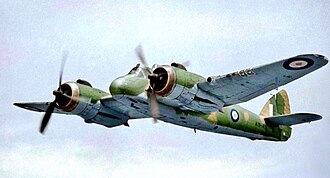
Bristol Beaufighter: Britain’s Formidable Night Fighter and Strike Aircraft
The Bristol Beaufighter was one of the most versatile and distinctive British combat aircraft of the Second World War. Developed by the Bristol Aeroplane Company from the earlier Bristol Beaufort, the twin-engined Beaufighter entered service at a moment when Britain urgently needed a heavily armed fighter capable of operating at night. What began as an expedient adaptation of an existing aircraft quickly developed into a remarkably successful machine that served as a night fighter, long-range fighter, strike aircraft, torpedo bomber and maritime patrol aircraft. Its combination of heavy cannon armament, considerable range, twin Bristol Hercules engines and, later, airborne radar made it especially valuable during a period when British night-fighting technology was evolving rapidly. The RAF Museum records that the Beaufighter prototype flew in July 1939, with production aircraft reaching the Royal Air Force the following year. Ultimately, 5,562 Beaufighters were produced, and the aircraft equipped 52 operational RAF squadrons.
Origins and Development of the Bristol Beaufighter
From Beaufort to Beaufighter
The Beaufighter’s story began with the Bristol Beaufort, a twin-engined torpedo bomber designed for the Royal Air Force. The Beaufort itself was a substantial aircraft intended primarily for maritime operations, but its airframe offered Bristol an opportunity to create a powerful fighter without starting an entirely new design from scratch. Bristol engineers adapted the Beaufort’s basic structure while incorporating considerably more powerful engines and a formidable forward-firing armament. This approach was particularly attractive because Britain was preparing for war and needed new combat aircraft quickly. The Bristol Beaufighter, officially designated Type 156, therefore combined the structural heritage of the Beaufort with the performance requirements of a heavy fighter.
The aircraft’s development also reflected a pressing operational problem. Britain’s existing night-fighter force needed an aircraft capable of carrying both heavy armament and the bulky radar equipment then becoming available. The Beaufighter’s relatively spacious fuselage made it unusually well suited to this task. Rather than designing a small single-seat fighter around conventional daytime interception, Bristol produced a two-seat aircraft in which the pilot and radar operator could concentrate on their respective tasks. This combination of a powerful aircraft and rapidly developing radar technology would make the Beaufighter one of Britain’s most important night-fighting aircraft during the early years of the war.
A Heavily Armed Fighter
One of the Beaufighter’s most impressive characteristics was its armament. Early versions carried four 20 mm Hispano cannon mounted in the lower forward fuselage, giving the aircraft an exceptionally concentrated forward punch. Later variants also carried machine guns in the wings, while Coastal Command aircraft could be equipped with rockets, bombs or torpedoes depending on their mission. The National Museum of the United States Air Force lists the Mk VI night-fighter configuration as having four 20 mm Hispano cannon and six .303-inch Browning machine guns.
This firepower was particularly effective against bombers. A night fighter did not necessarily need the speed of a modern single-seat interceptor if it could approach its target under radar guidance and deliver a devastating burst of cannon fire. The Beaufighter’s heavy armament therefore compensated, to some extent, for its considerable size and weight. Its design was not about achieving the absolute highest speed; instead, it emphasized endurance, weapons, radar-carrying capacity and the ability to absorb the equipment required for night operations.
The Beaufighter as a Night Fighter
Radar Changes the Battle
The Beaufighter became closely associated with the introduction of airborne interception radar into British night-fighting operations. During 1940 and 1941, radar technology was still relatively primitive compared with later systems, but it represented a revolutionary change in how fighter crews could locate enemy aircraft after dark. The Beaufighter could carry this equipment without sacrificing its fundamental fighting capability, making it an exceptionally practical platform for the technology.
The RAF Museum describes the Beaufighter as the first high-performance night fighter equipped with airborne interception radar and notes that it successfully operated against German night raids during the winter of 1940–41. Radar allowed the aircraft’s operator to guide the pilot toward an enemy bomber that might otherwise have been almost impossible to see against the night sky. Once the target was within visual or weapons range, the Beaufighter’s concentrated cannon armament could be brought into action.
This combination of radar and firepower was more important than raw speed. A night fighter had to locate an enemy, approach it without losing contact, and deliver an accurate attack in darkness. The Beaufighter’s two-person crew arrangement was particularly valuable because the pilot could concentrate on flying while the radar operator dealt with interception information. In this respect, the aircraft was not simply a heavily armed fighter; it was part of an emerging technological system that combined radar stations, airborne interception equipment, communications and trained crews.
Improving Through Experience
The first Beaufighters were not perfect. They were large and relatively heavy compared with many contemporary fighters, and their performance varied considerably between versions. Nevertheless, the design possessed substantial development potential. As more powerful engines, improved radar systems and new weapons became available, Bristol and its operators continued adapting the aircraft.
The Hercules-powered Beaufighter Mk VI became one of the most important versions, while the later TF Mk X developed the aircraft’s maritime strike capabilities. Different variants were tailored to the requirements of Fighter Command, Coastal Command and overseas operations. This adaptability helped keep the Beaufighter useful even as faster and more specialized aircraft appeared.
From Night Fighter to Strike Aircraft
Coastal Command and Maritime Warfare
The Beaufighter’s career extended far beyond the British night skies. Its ability to carry substantial weapons and its long-range capabilities made it highly useful to Coastal Command, where it was employed against enemy shipping and submarines. Rockets, bombs and torpedoes transformed the aircraft into a powerful strike platform.
This was one of the Beaufighter’s greatest strengths: it could change roles without becoming an entirely different aircraft. A machine that had been developed to intercept bombers could subsequently attack ships at low level, escort maritime operations and conduct offensive strikes. The heavy forward-firing cannon armament remained useful, while external stores dramatically increased the aircraft’s destructive potential.
The torpedo-carrying versions became particularly famous. The TF Mk X, often associated with the nickname “Torbeau,” combined fighter characteristics with torpedo-bomber capabilities. The aircraft could approach enemy vessels at low altitude, using its guns and other weapons to suppress defenses before delivering a torpedo. In maritime warfare, this gave the Beaufighter a flexibility that conventional torpedo bombers did not always possess.
Rockets and Ground Attack
The Beaufighter also became a formidable rocket-firing aircraft. Air-to-surface rockets allowed crews to attack locomotives, vehicles, fortified positions and shipping without relying solely on bombs. The aircraft’s substantial structure and powerful engines made it suitable for carrying external weapons while maintaining useful performance.
This made the Beaufighter particularly valuable in the Mediterranean, Middle East and Far East, where Allied forces frequently needed a long-range aircraft capable of striking ground and maritime targets. Its operational career consequently became geographically extensive. The RAF Museum notes that the aircraft earned a reputation not only in northwest Europe but also in the Middle and Far East.
Bristol Beaufighter in the Pacific
The Beaufighter’s reputation was not confined to Europe. Australian production and extensive Royal Australian Air Force use made the aircraft an important part of Allied air operations in the Pacific. Australian-built aircraft incorporated modifications appropriate to local conditions and operational requirements, eventually producing the DAP Beaufighter Mk 21.
In the Pacific, the aircraft was particularly well suited to low-level strike missions. Its heavy armament, ability to carry rockets and bombs, and relatively long range made it useful against Japanese shipping and ground targets. The combination of speed, firepower and ruggedness also helped crews operate in an environment where missions could involve long distances and attacks at low altitude.
The Australian-built Beaufighters demonstrate how adaptable the basic design had become. Rather than remaining tied to its original role as a British night fighter, the aircraft had evolved into a genuinely multi-purpose combat machine. Its continued production and use overseas reflected the fact that commanders could employ it for a variety of missions without requiring a completely different aircraft for every task.
Performance and Technical Characteristics
Engines and Flight Performance
The Beaufighter’s performance came from its twin radial engines, with later major versions using Bristol Hercules powerplants. The Hercules was an air-cooled, 14-cylinder radial engine that provided the power needed to move the aircraft’s considerable mass while carrying weapons, fuel and mission equipment. A Mk VI configuration, for example, used two Hercules engines rated at approximately 1,670 horsepower each. The National Museum of the United States Air Force gives a maximum speed of 337 mph and a service ceiling of 26,500 feet for its Mk VI night-fighter configuration.
The aircraft’s dimensions were substantial for a fighter. The TF Mk X measured approximately 41 feet 4 inches in length and had a wingspan of 57 feet 10 inches. Its empty weight was around 15,592 pounds, while maximum takeoff weight could reach approximately 25,400 pounds when configured to carry a torpedo. These figures underline an important point about the Beaufighter: it was a large aircraft that was expected to perform several demanding jobs at once.
A Practical Combat Design
The Beaufighter’s appearance was unmistakable. Its large radial engines dominated the forward portion of the wings, while the fuselage was relatively deep and substantial. The two-seat arrangement and distinctive tail gave it an imposing profile. Although it lacked the sleek appearance and exceptional speed of some later wartime fighters, its design was fundamentally practical.
The aircraft’s strengths were endurance, payload, firepower and versatility. These characteristics explain why the Beaufighter remained useful even as newer aircraft entered service. It did not have to outperform every opponent in every category. Instead, it had to deliver a particular combination of capabilities that could be adapted to changing operational circumstances.
Production and Legacy
By the end of its production run, thousands of Beaufighters had been constructed. The RAF Museum states that 5,562 examples had been produced by the time the final aircraft was delivered in September 1945. Production involved Bristol and other manufacturers, including shadow factories established to increase wartime output. Australian production added another chapter to the aircraft’s story.
The Beaufighter also had an unusually long postwar life for a wartime combat aircraft. Many examples were converted to target tugs after their operational combat careers ended. The last flight of a Beaufighter in RAF service took place on 17 May 1960, when a TT10 target tug conducted a final target-towing flight from Seletar.
Today, surviving Beaufighters are preserved in museums and collections as reminders of an era when aircraft design was changing at extraordinary speed. The RAF Museum’s Beaufighter TF Mk X RD253, for example, is preserved in London and represents one of the aircraft’s later and most versatile configurations.
Technical Specifications of the Bristol Beaufighter
The exact specifications varied considerably between marks, so the following figures use the Beaufighter TF Mk X as the representative late-war torpedo-fighter variant, with performance figures for related variants identified where appropriate.
| Specification | Bristol Beaufighter TF Mk X / representative data |
|---|---|
| Manufacturer | Bristol Aeroplane Company |
| Type | Twin-engine heavy fighter, night fighter and torpedo fighter |
| Crew | 2 |
| First flight | 17 July 1939 |
| Length | 41 ft 4 in (12.60 m) |
| Wingspan | 57 ft 10 in (17.63 m) |
| Height | 15 ft 10 in (4.83 m) |
| Wing area | 503 sq ft (46.7 m²) |
| Empty weight | 15,592 lb (7,072 kg) |
| Maximum takeoff weight | Approximately 25,400 lb (11,521 kg) with one torpedo |
| Powerplant | 2 × Bristol Hercules radial engines |
| Typical Hercules power | Approximately 1,670 hp each on major later variants |
| Maximum speed | About 337 mph (542 km/h) for Mk VI configuration |
| Service ceiling | About 26,500 ft (8,077 m) for Mk VI configuration |
| Primary armament | 4 × 20 mm Hispano cannon |
| Additional armament | Machine guns, rockets, bombs and/or torpedo depending on variant |
| Primary wartime roles | Night fighter, fighter-bomber, maritime strike, torpedo bomber |
| Total production | 5,562 according to RAF Museum records |
Conclusion
The Bristol Beaufighter occupies a special place in the history of military aviation because it succeeded not through one extraordinary characteristic but through an exceptional combination of useful qualities. It was powerful enough to carry heavy armament, spacious enough to accommodate early radar, rugged enough for low-level maritime attacks and adaptable enough to serve in radically different theatres of war. Its origins as a derivative of the Beaufort might suggest a temporary solution, yet the aircraft ultimately became one of the most versatile British combat aircraft of the Second World War.
Its importance was particularly evident during the early development of radar-equipped night fighting. The Beaufighter gave the RAF a practical platform on which emerging interception technology could be combined with devastating firepower. Later, its transformation into a torpedo fighter and strike aircraft demonstrated that the basic design had far greater potential than its original role suggested. From the skies over Britain to maritime battles and low-level attacks in the Mediterranean and Pacific, the “Beau” proved capable of adapting to the demands placed upon it.
The Bristol Beaufighter therefore deserves to be remembered not merely as a wartime aircraft, but as an example of effective engineering under pressure. It was born from an urgent requirement, developed from an existing airframe, continually improved through wartime experience and ultimately turned into a highly flexible combat platform. Few aircraft illustrate the rapid technological and operational evolution of the Second World War quite as clearly as the Bristol Beaufighter.
