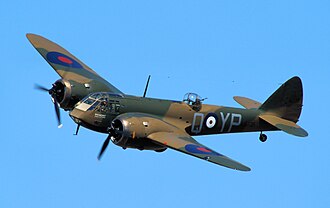
Bristol Blenheim: The Fast Bomber That Entered a New and Dangerous War
The Bristol Blenheim was one of the most important British military aircraft of the years immediately before and during the Second World War. Originally developed from a remarkably fast civilian aircraft, the Blenheim entered Royal Air Force service in 1937 as a high-performance light bomber and quickly became one of the principal aircraft of Britain’s expanding bomber force. When the prototype first appeared, its speed was impressive enough to attract national attention and persuade the British government that a modified version could serve as a modern bomber. Yet aviation technology was advancing so quickly that the qualities that had made the Blenheim revolutionary in 1935 were much less exceptional by the outbreak of war in 1939. The aircraft nevertheless became a remarkably versatile machine, serving as a bomber, reconnaissance aircraft, fighter, night fighter and coastal patrol aircraft in Europe, North Africa, the Middle East and the Far East. The RAF Museum notes that the Blenheim served with RAF Fighter, Bomber, Army Co-operation and Coastal Commands, while Bristol’s own museum history describes it as a versatile stop-gap that remained valuable despite being increasingly outclassed.
The Blenheim’s history is therefore a story of extraordinary technological change. It began life as an aircraft intended to demonstrate the future of commercial aviation, became a symbol of Britain’s pre-war rearmament, and then found itself fighting a war against aircraft that were often faster, better armed and more heavily protected. Its crews frequently paid a heavy price for this technological transition. During the early campaigns of the Second World War, particularly the fighting in France and the Low Countries in 1940, Blenheim units were ordered to undertake dangerous daylight attacks against German forces despite suffering from serious disadvantages. Yet the aircraft also achieved important successes, including pioneering work as a radar-equipped night fighter and extensive service across almost every major theatre of the war.
The Civilian Aircraft That Became the Blenheim
Lord Rothermere and the Britain First
The origins of the Blenheim lie not in a military specification but in the world of commercial aviation. In 1934, newspaper proprietor Lord Rothermere challenged the Bristol Aeroplane Company to create a fast modern aircraft capable of demonstrating the potential of British civil aviation. Bristol’s chief designer, Frank Barnwell, responded with the Type 142, a sleek twin-engined monoplane that first flew in April 1935. The aircraft was strikingly different from the biplane transports still common at the time, with a clean all-metal structure, retractable landing gear and powerful Bristol Mercury radial engines. Bristol Museums records that Rothermere was so impressed that he named the aircraft Britain First and presented it to the nation for evaluation as a potential military aircraft.
The Type 142’s performance immediately attracted the attention of the Air Ministry. The aircraft demonstrated that a well-designed twin-engined monoplane could achieve speeds previously associated with fighters while also offering a useful internal volume for passengers or equipment. The British government therefore ordered a military adaptation, designated the Type 142M, which became the basis for the Blenheim Mk I. This transformation was one of the most important episodes in British aviation development during the 1930s because it showed how rapidly civilian aircraft technology could be adapted to military purposes when national defence requirements changed.
The military version was structurally similar to the civil aircraft but modified for bombing operations. The cockpit arrangement was altered, the fuselage was adapted to accommodate a bomb aimer and additional crew equipment, and a bomb bay was incorporated into the lower fuselage. Defensive armament was also added. What emerged was still recognisably related to the Britain First, but it had become a purpose-built military aircraft.
A revolution in RAF bomber design
The Blenheim was among the first RAF bombers to combine a modern monoplane layout with retractable landing gear, twin radial engines and a relatively clean aerodynamic form. When it entered service, it was genuinely fast. Bristol Museums records that early Blenheims could reach around 250 mph, while the RAF Museum notes that the aircraft was faster than contemporary RAF fighters when it first entered service in 1937.
This speed was central to the aircraft’s appeal. During the early 1930s, British strategic thinking was heavily influenced by the idea that a fast bomber might be able to penetrate enemy airspace before fighters could intercept it. The Blenheim appeared to provide tangible evidence for that concept. Its performance was impressive enough to make it an important part of Britain’s RAF expansion programme.
The first production aircraft began reaching RAF squadrons on 10 March 1937, and more than 1,000 Blenheims were already in service by the outbreak of war.
Design and Engineering
A clean twin-engined monoplane
The Blenheim’s appearance reflected the transition from traditional biplane construction to modern monoplane design. Its mid-mounted wings were relatively thin and clean, while the two engines were mounted in streamlined nacelles. The landing gear retracted into the engine nacelles, reducing drag during flight. The aircraft was constructed primarily from metal, with fabric used on selected control surfaces.
The streamlined fuselage of the Mk I was one of its most distinctive characteristics. The cockpit had a relatively “stepless” appearance, with the pilot and other crew members positioned in a forward section above the fuselage. This arrangement contributed to the aircraft’s clean aerodynamic shape but created practical limitations, particularly in terms of visibility and crew accommodation. These shortcomings would eventually contribute to the development of the longer-nosed Blenheim Mk IV.
The aircraft was powered by two Bristol Mercury radial engines. The Mk I generally used Mercury VIII engines producing approximately 840 horsepower each, while later variants received more powerful engines. The use of air-cooled radial engines gave the Blenheim a robust powerplant arrangement suitable for military operations, although the engine nacelles and thick wings inevitably generated more drag than the cleanest later-war designs.
Speed as the original advantage
The Blenheim’s speed was revolutionary when the design first appeared. That advantage, however, had an expiration date. Fighter development accelerated dramatically during the late 1930s, and aircraft such as the Messerschmitt Bf 109 rapidly became capable of speeds far beyond those available to the Blenheim.
This transformation created one of the central problems of the aircraft’s wartime career. A bomber designed around the assumption that speed itself could provide protection suddenly found that enemy fighters could overtake it with ease. Bristol Museums notes that by the beginning of the war, technological advances had eliminated the Blenheim’s original speed advantage and left the aircraft under-armoured and under-armed.
The change was not the result of a flaw in the original concept. Rather, the aircraft had been designed at the leading edge of technology in the mid-1930s, and its opponents had caught up remarkably quickly.
The Blenheim Mk I
Britain’s early-war light bomber
The Blenheim Mk I was the first major production version and became one of the RAF’s principal light bombers before the war. More than 1,400 Blenheim Is were constructed, making the variant a major component of Britain’s expanding air force.
The aircraft typically carried a crew of three: pilot, navigator/bomb aimer and wireless operator/air gunner. Its bomb load was relatively modest compared with later medium and heavy bombers, but its speed and range made it useful for tactical bombing and reconnaissance missions.
Its armament originally consisted of a small number of machine guns, reflecting the belief that speed would be an important form of defence. As the aircraft became more vulnerable, additional defensive weapons were added to some variants. The Blenheim’s bomb bay was located within the fuselage, while additional weapons and equipment could be carried in external installations.
The Mk I was also adapted into the Blenheim IF, a long-range fighter and night-fighter variant. Some aircraft were equipped with four .303-inch Browning machine guns in a ventral gun pack, while later aircraft received airborne interception radar. This made the Blenheim one of the earliest British aircraft to carry operational airborne radar.
The Blenheim Mk IV
A longer nose and improved crew arrangement
The Blenheim Mk IV was the most important wartime version of the aircraft. Development addressed several shortcomings of the Mk I, particularly the cramped cockpit and limited forward visibility. The new aircraft received a longer nose with a more conventional glazed cockpit arrangement, creating additional space for the navigator and bomb aimer while improving visibility.
The Mk IV also introduced more powerful engines, with production aircraft commonly powered by Bristol Mercury XV radials. The RAF Museum gives the type a maximum speed of approximately 266 mph at 11,800 feet, a maximum altitude of about 22,000 feet and a maximum bomb load of 1,200 pounds.
The redesign made the aircraft more practical, but it could not completely overcome the fundamental problem of performance. The Blenheim Mk IV remained vulnerable to modern fighters, particularly when flying daylight missions without adequate fighter protection.
Nevertheless, almost 4,000 Blenheim IVs were built, with production spread across a number of factories. Bristol Museums records that the majority were produced at shadow factories in northern England, reflecting the enormous expansion of British aircraft manufacturing in the years immediately before and during the war.
The aircraft at the Battle of Britain
During the Battle of Britain, Blenheims performed several different tasks. Bomber Command aircraft attacked German invasion preparations, ports and other targets, while Blenheim night fighters operated against German bombers. The RAF Museum records that a Blenheim Mk IF achieved the first successful radar interception of an enemy bomber in July 1940.
This was a significant technological milestone. The aircraft itself was already approaching obsolescence as a conventional fighter, but its relatively spacious fuselage made it suitable for carrying the bulky radar equipment available at the time. The Blenheim thus became an important bridge between the early experiments with airborne radar and the much more capable radar-equipped night fighters that followed.
Its effectiveness as a fighter was nevertheless limited by its speed. Even with additional guns and radar, the Blenheim was fundamentally a bomber airframe. It could carry the necessary equipment, but it could not match the manoeuvrability or acceleration of dedicated fighters.
The Blenheim in France in 1940
A brutal test of the light bomber force
The Blenheim’s most difficult early-war experience came during the campaign in France and the Low Countries in 1940. RAF light bombers were ordered to attack German forces advancing rapidly across Western Europe. These missions frequently took place during daylight and often without sufficient fighter protection.
The results were devastating. The RAF Museum describes the losses suffered by Blenheim Mk IVs and Fairey Battles during the desperate attacks against German bridgeheads as among the worst suffered by the RAF in an operation of comparable size.
The problem was not a lack of courage among the crews. Blenheim crews were being asked to perform missions against heavily defended targets in an aircraft whose speed advantage had disappeared. German fighters could intercept them, while anti-aircraft fire added another layer of danger.
These operations exposed the limitations of Britain’s pre-war assumptions about light bombers. The Blenheim had been conceived during a period when speed seemed capable of providing protection. By 1940, that concept had become increasingly untenable.
Yet the Blenheim continued flying because Britain did not possess enough more modern aircraft to replace it immediately. It was therefore forced to carry out missions for which it was increasingly poorly suited.
North Africa and the Middle East
A more suitable environment
The Blenheim found a more sustainable role in North Africa and the Middle East, where it could perform reconnaissance, bombing and tactical support missions across enormous distances. Its range and twin-engined configuration made it useful for operations over the desert, where targets and bases could be widely separated.
The aircraft served with both British and Commonwealth forces and participated in campaigns across Egypt, Libya and the wider Mediterranean region. It was used to attack airfields, transport routes, supply columns and military installations while also conducting reconnaissance.
The harsh desert environment created its own challenges. High temperatures and dust placed additional stress on engines and mechanical systems, while long distances required careful management of fuel. Nevertheless, the Blenheim remained valuable because its versatility allowed squadrons to perform several missions without requiring an entirely different aircraft type for every task.
The Blenheim in the Far East
Fighting a different war
Blenheims also saw extensive service in the Far East, including operations against Japanese forces. Here again, the aircraft was confronted by a rapidly changing tactical environment.
Japanese fighters could be extremely dangerous to the relatively slow Blenheim, particularly when the bomber operated without adequate escort. The aircraft nevertheless remained in service because the British and Commonwealth forces in Asia faced severe shortages of modern equipment during the early years of the Pacific War.
The Blenheim’s ability to operate from relatively basic airfields and undertake long-range missions remained useful. It participated in bombing and reconnaissance operations in Burma and other areas, where crews faced difficult weather, long distances and limited logistical support.
Its eventual replacement in these theatres reflected the broader development of Allied air power. Newer aircraft offered greater speed, heavier armament and improved survivability, while dedicated fighter-bombers increasingly assumed the tactical missions for which the Blenheim had once been considered suitable.
The Blenheim as a Night Fighter
Early airborne radar
One of the most fascinating chapters in Blenheim history was its transformation into a night fighter. The aircraft’s relatively large fuselage could accommodate radar equipment and an additional crew member, making it an appropriate platform for early airborne interception systems.
Blenheim night fighters equipped with AI Mk III and AI Mk IV radar became some of Britain’s earliest operational radar-equipped fighters. Although their performance was mediocre compared with later aircraft, they gave RAF crews valuable experience in radar interception techniques.
The Blenheim’s contribution was therefore technological as much as tactical. It helped establish the procedures required for radar-controlled night interception, including the coordination between radar operators, pilots and ground controllers.
The concept would eventually mature into a sophisticated system involving radar stations, ground control, airborne radar and dedicated night-fighter aircraft. The Blenheim was one of the aircraft that helped prove the concept in operational conditions.
The Blenheim Mk V
An attempt to keep the design relevant
The final major British bomber version was the Blenheim Mk V, developed as a more heavily protected aircraft intended for ground attack and tactical bombing. It incorporated additional armour and structural strengthening, while different nose arrangements allowed the aircraft to carry either bombing equipment or additional forward-firing guns.
The modifications addressed some of the aircraft’s weaknesses but also increased weight. This produced a difficult compromise: more armour and armament improved survivability and offensive capability, but additional weight reduced performance.
The Mk V therefore arrived at a time when the basic Blenheim design was already being eclipsed by newer aircraft. It saw considerable service in the Middle East and Far East, but its combat losses were significant, and more capable American aircraft eventually replaced it in many of its roles.
Canadian Production and the Bolingbroke
Building Blenheims overseas
The Blenheim design was also manufactured in Canada as the Fairchild Bolingbroke. Canadian production was particularly important for training under the British Commonwealth Air Training Plan, although Bolingbrokes also performed coastal patrol and other duties.
The Canadian aircraft incorporated modifications suited to local requirements and represented one of the many ways in which the Blenheim design was adapted for different operational environments.
The existence of Canadian production also demonstrates the importance of the Blenheim to the broader British Commonwealth war effort. The aircraft was not simply a British RAF machine; it became part of an international industrial and operational network involving Britain, Canada and several other Allied air forces.
From Blenheim to Beaufighter
The aircraft’s most important legacy
Perhaps the most significant long-term legacy of the Blenheim was its relationship with the Bristol Beaufort and Bristol Beaufighter. The Beaufort was developed using substantial Blenheim design experience and common assemblies, while the Beaufighter evolved from the Beaufort into one of the most successful British twin-engined fighters of the war. Bristol Museums specifically notes this development lineage, describing the Beaufort as a development of the Blenheim and the Beaufighter as the later fighter evolution.
This lineage is important because it demonstrates that the Blenheim’s engineering was not a dead end. Its airframe and manufacturing techniques provided the foundation for aircraft with very different capabilities.
The Beaufighter in particular showed how the concept of a twin-engined aircraft with a substantial fuselage could be transformed into an effective heavy fighter. With more powerful engines, heavier armament and radar, it solved many of the problems that had limited the Blenheim as a fighter.
Why the Bristol Blenheim Matters
A victim of rapid technological change
The Blenheim is sometimes remembered primarily for its losses, but that interpretation overlooks how advanced it was when conceived. The aircraft was a genuine technological breakthrough in the mid-1930s. It was fast, modern and relatively sophisticated, and it provided the RAF with a substantial fleet of monoplane bombers at a crucial moment in the expansion of British air power.
Its rapid obsolescence was a consequence of the extraordinary pace of aircraft development during the late 1930s. Fighters became dramatically faster, engines became more powerful, armour and self-sealing fuel tanks improved, and aircraft designers learned how to build increasingly efficient all-metal monoplanes.
The Blenheim simply could not evolve quickly enough to remain competitive in every role. Nevertheless, it continued to provide useful service because it was available in large numbers and could be adapted to changing requirements.
Courage under difficult circumstances
The aircraft’s crews deserve particular recognition. Blenheim aircrews were frequently asked to fly into situations where the aircraft’s limitations were obvious. During the fighting in France in 1940, they faced German fighters and ground fire while attacking rapidly advancing forces. Later, crews operated in the deserts of North Africa and the jungles and mountains of Asia.
The Blenheim’s operational record is therefore inseparable from the men who flew it. Its shortcomings did not prevent crews from carrying out difficult missions, often under circumstances in which the aircraft’s survival depended more on tactics, weather, surprise and determination than on technical superiority.
Technical Specifications
The following figures refer primarily to the Bristol Blenheim Mk IV, the principal wartime production version. Exact specifications varied between subvariants, engine installations, equipment fits and operating conditions. The RAF Museum gives a maximum speed of 266 mph at 11,800 feet and a maximum altitude of approximately 22,000 feet for its representative Mk IV.
| Specification | Bristol Blenheim Mk IV |
|---|---|
| Type | Twin-engine light bomber / reconnaissance aircraft |
| Country of origin | United Kingdom |
| Manufacturer | Bristol Aeroplane Company |
| Designer | Frank Barnwell and Bristol design team |
| Prototype | Bristol Type 142 / Type 142M |
| First flight of civil prototype | April 1935 |
| First RAF deliveries | March 1937 |
| Crew | Normally 3 |
| Engines | 2 × Bristol Mercury XV radial engines |
| Engine power | Approximately 920–995 hp each, depending on rating |
| Configuration | Twin-engine, mid-wing monoplane |
| Wingspan | 56 ft 4 in (17.17 m) |
| Length | 42 ft 7 in (12.98 m) |
| Height | Approximately 9 ft 10 in (3.00 m) |
| Wing area | Approximately 469 sq ft (43.6 m²) |
| Maximum speed | Approximately 266 mph (428 km/h) |
| Cruising speed | Approximately 198 mph (319 km/h) |
| Service ceiling | Approximately 22,000–27,000 ft, depending on load and source |
| Range | Approximately 1,460 miles (2,350 km), depending on configuration |
| Maximum bomb load | Up to approximately 1,200 lb (544 kg) |
| Typical armament | .303-inch (7.7 mm) machine guns |
| Main roles | Light bomber, reconnaissance, fighter, night fighter, coastal patrol |
| Major operators | RAF and several Commonwealth and Allied air forces |
| Major theatres | Europe, North Africa, Middle East, Mediterranean and Far East |
| Production | More than 4,400 Blenheims and related aircraft, including major variants and Canadian production |
Conclusion
The Bristol Blenheim was an aircraft born from optimism about the future of aviation. Its civilian predecessor demonstrated that a twin-engined monoplane could achieve remarkable speed, and the military adaptation initially appeared to offer the RAF a bomber capable of outrunning enemy fighters. When the Blenheim entered service in 1937, it was genuinely modern and faster than many contemporary fighters. Yet only a few years later, the aircraft found itself fighting an entirely different generation of aircraft. The speed advantage that had made it famous had disappeared, while its relatively light armament and limited protection made daylight operations increasingly hazardous.
Despite these limitations, the Blenheim became one of Britain’s most widely used aircraft of the early Second World War. It flew bombing missions over Europe, attacked German invasion preparations, served in North Africa and the Middle East, operated in the Far East and performed reconnaissance and coastal duties. Its conversion into a night fighter was particularly significant because it became one of the earliest British aircraft to use airborne radar operationally. The RAF Museum records the first successful radar interception of an enemy bomber by a Blenheim Mk IF in July 1940, an achievement that helped establish the foundations of Britain’s later night-fighter system.
The aircraft’s most important legacy may ultimately have been industrial and technological rather than purely operational. The Blenheim provided the foundation for the Bristol Beaufort and, indirectly, the highly successful Beaufighter. Its production also demonstrated Britain’s ability to manufacture thousands of modern twin-engined aircraft through an expanding network of factories and shadow production facilities.
The Bristol Blenheim was therefore neither simply a successful bomber nor simply an obsolete one. It was both, depending on the moment in its history. In the mid-1930s it represented the leading edge of British aircraft design; by 1940 it was struggling to survive against fighters that had caught and surpassed it. Yet its crews continued to use it effectively, and its adaptability allowed it to remain useful long after its original performance advantage had vanished.
That combination of innovation, rapid obsolescence and operational persistence makes the Blenheim one of the most revealing aircraft of the Second World War. It captures the extraordinary pace of aviation development during the 1930s and demonstrates how an aircraft designed for one technological era could be forced to fight in another. Its story is ultimately not just about an aeroplane, but about the speed at which military aviation changed—and about the people who continued to fly these machines while that transformation was taking place.
.jpg)