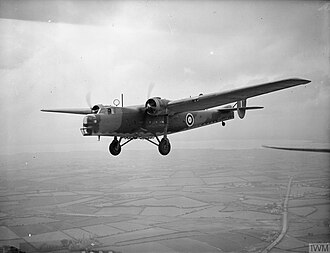
Bristol Bombay: The Unusual Transport-Bomber of the Royal Air Force
The Bristol Bombay was one of the most distinctive British aircraft of the years immediately before and during the Second World War. Designed to combine the functions of a military transport and a bomber, the large twin-engined aircraft was intended primarily for service in the Middle East and India, where the Royal Air Force needed an aircraft capable of moving troops and supplies over long distances while retaining the ability to carry bombs and defensive armament. At a time when military aircraft were rapidly moving toward streamlined monoplane designs, the Bombay represented an interesting compromise between two very different requirements. It had a spacious fuselage for transporting personnel and cargo, a strong high-mounted wing, fixed landing gear and twin radial engines, while its design also incorporated machine-gun positions and external bomb racks. The result was an aircraft that looked somewhat ungainly compared with the sleek bombers that followed it, but which proved surprisingly useful in the demanding conditions of the Middle East and North Africa. The Imperial War Museums’ collections contain official RAF photographs of the Type 130 Bombay operating in North Africa during the Second World War.
The Bombay’s story is particularly interesting because it was already approaching obsolescence when it entered service. The prototype first flew in 1935, but production aircraft did not begin reaching the RAF until 1939. During those four years, aviation technology had advanced at extraordinary speed. Aircraft such as the Bristol Blenheim, Vickers Wellington and Armstrong Whitworth Whitley were introducing much more sophisticated aerodynamic and operational concepts, while the next generation of fighters and bombers was already taking shape. Nevertheless, the Bombay’s unusual combination of transport capacity, short-field capability and long-range endurance meant that it could perform missions for which faster bombers were not necessarily the ideal solution. It became particularly valuable as a transport aircraft and later played a notable role in the evacuation of Allied troops from France in 1940, as well as supply and reinforcement operations in the Middle East.
The Origins of the Bristol Bombay
Replacing the Vickers Valentia
The Bombay originated with Air Ministry Specification C.26/31, which called for a new monoplane capable of replacing the aging Vickers Valentia biplane in overseas service. The requirement was unusual because the aircraft was expected to combine several roles. It needed to transport troops and cargo, but it also had to retain the ability to operate as a bomber. The proposed aircraft therefore had to be large enough to carry approximately two dozen troops or an equivalent cargo while possessing enough range and defensive equipment to operate in potentially hostile territory.
This requirement reflected the particular strategic circumstances of the British Empire during the interwar period. The RAF had extensive responsibilities far beyond Europe, and aircraft operating in India, the Middle East and Africa frequently had to perform tasks that would later be divided among several specialised aircraft types. A single aircraft that could transport troops one day, carry supplies the next and conduct bombing missions when necessary offered considerable flexibility.
Bristol’s response was the Type 130, a large twin-engined monoplane designed by the company’s engineering team. Its development was influenced by Bristol’s earlier experience with large monoplane structures, particularly the lessons learned from the Type 92 Bagshot. The Bagshot had suffered from inadequate wing rigidity, including dangerous aileron-reversal effects caused by wing flexing. Bristol responded by developing much stronger monoplane wing structures, and this experience influenced the Bombay’s unusually robust wing.
A heavily built but remarkably strong wing
One of the Bombay’s most important technical features was its wing. The original design used a complex structure with seven spars, incorporating high-tensile steel components and Alclad webs. This made the wing exceptionally strong, but it also made it heavy. The construction philosophy reflected Bristol’s determination to avoid the structural problems that had affected earlier large monoplanes.
The aircraft was deliberately designed for dispersed manufacture. Its fuselage was divided into several sections that could be produced independently, while the wing consisted of a central section and two outer assemblies. This approach was intended to make the aircraft easier to manufacture at different facilities and was particularly useful once British aircraft production expanded dramatically before and during the war.
The decision to use such a substantial structure had consequences. The Bombay was a large aircraft, but much of its weight was tied up in its airframe. That reduced the proportion of its total weight that could be devoted to useful payload. Nevertheless, structural strength was valuable for an aircraft expected to operate from relatively rough airfields and to perform transport duties under demanding conditions.
From Type 130 to Bombay
The prototype takes to the air
The Type 130 prototype, serial K3583, made its first flight on 23 June 1935. It was powered by two Bristol Pegasus III radial engines producing approximately 750 horsepower each and initially used two-bladed propellers. The aircraft was subsequently displayed publicly, including an appearance at the Hendon Air Pageant.
Testing demonstrated that the basic concept was sound, and the Air Ministry eventually ordered production aircraft. However, the production version differed in several important respects from the prototype. The engines were upgraded to much more powerful Bristol Pegasus XXII radials, while three-bladed Rotol variable-pitch propellers replaced the earlier propellers. The production aircraft also abandoned the wheel spats fitted to the prototype.
The aircraft officially became known as the Bombay in 1937. The production version was designated the Bombay Mk I by the Air Ministry and Type 130A by Bristol. Although 80 aircraft were initially ordered, the final 30 were cancelled, leaving only 50 production aircraft. The limited production run is one reason the Bombay is relatively obscure today.
Production delays
Ironically, one of the reasons for the Bombay’s relatively late arrival was Bristol’s success with another aircraft. The company’s Filton facilities were heavily occupied producing the Bristol Blenheim, which had become a major priority for the RAF. Consequently, Bombay production was transferred to the new Short and Harland facility at Belfast, jointly associated with Short Brothers and Harland and Wolff.
The new factory had to be established and the complex Bombay wing had to be put into production before aircraft could be delivered in quantity. The first production aircraft did not arrive until 1939, by which time the aircraft was competing against newer designs and the international situation had changed dramatically.
This delay illustrates one of the great difficulties of interwar aircraft procurement. A design could be entirely appropriate when its specification was issued but substantially less competitive by the time it reached operational units. The rapid evolution of engines, aerodynamics and military doctrine during the 1930s meant that four or five years could transform the meaning of “modern” in military aviation.
Design and Configuration
A transport with bomber characteristics
The Bombay had a high-mounted wing and a large fuselage designed to provide a substantial internal volume. The cockpit was positioned relatively high, while the cargo and passenger compartment extended through much of the fuselage. The aircraft’s transport function was therefore central to its design rather than being a secondary modification.
Unlike later military transports, however, the Bombay did not have a rear loading ramp. Personnel and cargo were handled through doors in the fuselage, and the aircraft’s internal arrangements reflected the limitations of transport aviation during the 1930s.
When employed as a troop carrier, the Bombay could carry up to 24 troops in addition to its operating crew. Its ability to carry personnel over considerable distances made it useful in the Middle East, where the distances between airfields could be enormous and conventional road or rail transport was slow.
The aircraft also had the ability to carry bombs externally. Up to eight 250-pound bombs, giving a total nominal bomb load of approximately 2,000 pounds, could be mounted on racks beneath the fuselage. This arrangement allowed the aircraft to switch between transport and bombing roles without requiring an entirely different airframe.
Defensive armament
The production Bombay carried Vickers K machine guns in forward and rear positions. The rear gun position was particularly important because the aircraft was relatively slow and lacked the ability of a modern bomber to escape enemy fighters through sheer speed.
Some configurations could also accommodate additional Vickers K guns in fuselage-side positions. The aircraft’s defensive armament was therefore respectable for its period, although it was never intended to engage enemy fighters directly. The Bombay’s survival depended more on its ability to operate at suitable altitudes, use its range effectively and take advantage of the absence of enemy fighters than on its defensive firepower.
The prototype had used a Lewis gun and a Scarff-ring arrangement, but production aircraft introduced more modern Vickers K equipment. The transition illustrates the rapid development of British aircraft armament during the second half of the 1930s.
Performance and Power
Bristol Pegasus engines
The production Bombay was powered by two Bristol Pegasus XXII nine-cylinder air-cooled radial engines. Each produced approximately 1,010 horsepower for takeoff, giving the large aircraft a total takeoff power of roughly 2,020 horsepower. The engines drove three-bladed Rotol variable-pitch propellers.
The Pegasus was a proven engine family with a strong reputation for reliability. Air-cooled radial engines were particularly appropriate for overseas operations because they did not depend on liquid-cooling systems that could be vulnerable to battle damage. Their mechanical simplicity and ruggedness were valuable characteristics for aircraft expected to operate far from major maintenance centres.
Even with two powerful engines, however, the Bombay was not fast. Its maximum speed was approximately 192 mph (309 km/h) under favourable conditions, while its cruising speed was around 160 mph (257 km/h). Some period performance figures give a lower maximum speed when the aircraft was operating at its full 20,000-pound loaded weight.
That relatively modest speed was one of the principal reasons the aircraft became obsolete so quickly as a bomber. Modern fighters were already approaching or exceeding 300 mph by the beginning of the Second World War, making a large aircraft travelling below 200 mph extremely vulnerable if caught in daylight without fighter protection.
Range and endurance
The Bombay’s relatively slow cruising speed was partly compensated for by its useful range. With its normal fuel arrangement, the aircraft could cover approximately 880 miles, while additional fuselage-mounted fuel tanks could increase this figure to around 2,230 miles.
This extended-range capability was particularly valuable in the Middle East and Africa. The vast distances involved in imperial communications made endurance more important than it might have been for an aircraft operating exclusively from European bases.
The Bombay could therefore perform a role that was becoming increasingly important to British forces: moving personnel, equipment and supplies between widely separated bases without depending entirely on surface transport.
The Bombay in the Second World War
Service in France and the evacuation
Although the Bombay is most strongly associated with the Middle East, it also played a brief but important role during the crisis of 1940. No. 271 Squadron operated Bombays in Britain and used them during the evacuation of British forces from France. The aircraft’s ability to carry troops gave it an opportunity to perform a transport mission at a moment when every available aircraft was being pressed into service. Its Bombays were withdrawn from the unit by the end of June 1940.
This episode demonstrated one of the Bombay’s most valuable characteristics: versatility. An aircraft that had been designed for colonial transport and secondary bombing duties suddenly became part of one of the most urgent evacuation operations in British military history.
The Bombay was never the fastest or most glamorous aircraft involved in the evacuation, but its ability to carry personnel made it useful. In such circumstances, speed was less important than the simple ability to transport soldiers out of a collapsing battlefield.
The Middle East and North Africa
The Bombay’s principal wartime theatre was the Middle East and North Africa. No. 216 Squadron became particularly associated with the aircraft, operating it as both a transport and bomber. The Imperial War Museums’ photographic collection includes images of Bombays at Heliopolis, Cairo, and records the aircraft’s association with No. 216 Squadron’s operations in North Africa.
The aircraft’s ability to carry supplies and personnel was especially valuable in the Western Desert. Airfields could be isolated, roads were vulnerable to attack or simply inadequate, and military formations could move considerable distances during campaigns. Air transport provided commanders with a way of maintaining links between bases and forward units.
The Bombay could also conduct bombing missions when required. Its relatively modest bomb load meant that it could not compete with dedicated heavy or medium bombers, but the ability to carry bombs gave commanders another option.
The aircraft’s combination of transport and bomber capabilities was particularly useful during the early years of the war, when resources were limited and specialised aircraft were not always available in sufficient numbers.
Special Operations and Supply Missions
Supporting distant operations
The Bombay’s long-range capability also made it useful for missions beyond ordinary troop transport. No. 117 Squadron, for example, borrowed four Bombays from No. 216 Squadron in 1941 and used them for long-distance flights from Khartoum, an important point on the air route linking West Africa with Egypt.
Such operations reveal why an aircraft that looked obsolete as a frontline bomber could remain valuable as a transport. A modern bomber might have been considerably faster, but speed was not always the decisive factor when an aircraft’s mission involved moving supplies between remote airfields.
The Bombay’s endurance, robust construction and relatively simple mechanical systems made it appropriate for these long-distance support missions. Its operational value was therefore increasingly concentrated in transport rather than bombing as the war progressed.
A difficult environment
The Middle Eastern environment imposed severe demands on aircraft and crews. High temperatures, dust, long distances and basic airfield facilities could all affect reliability and performance. Aircraft engines had to operate effectively in hot conditions, while crews had to maintain equipment far from major industrial centres.
The Bombay’s radial engines and sturdy airframe were well suited to this environment. Its relatively low landing and takeoff speeds compared with many faster aircraft were also useful when operating from less-developed airfields.
Its limitations remained obvious, however. Against determined enemy fighter opposition, the Bombay was extremely vulnerable. It was not an aircraft that could survive through speed or high-altitude performance alone. Its continued use therefore depended on the tactical situation and the availability of more modern aircraft for frontline roles.
Why the Bombay Became Obsolete
The rapid rise of the modern bomber
By the beginning of the Second World War, the Bombay had been overtaken by aircraft with far better performance. The Bristol Blenheim, for example, was dramatically faster and was specifically designed as a bomber rather than as a combined transport-bomber. Later aircraft such as the Wellington offered greater range, bomb-carrying capacity and survivability.
The Bombay’s fixed undercarriage, large wing structure and relatively slow speed were increasingly obvious disadvantages. Its high-wing configuration and transport-focused fuselage gave it considerable internal volume but could not compensate for its aerodynamic limitations.
The aircraft therefore transitioned naturally toward transport duties. This was not necessarily a failure. Military aircraft often remain valuable after their original role becomes obsolete, particularly when their airframe offers capabilities that newer aircraft lack.
The importance of versatility
The Bombay’s greatest legacy was arguably its ability to perform several jobs. It could carry troops, transport supplies, conduct bombing missions and support long-range operations. This flexibility helped extend its operational usefulness despite its outdated performance.
The aircraft’s story therefore illustrates an important principle of military aviation: an aircraft does not need to be the best machine in any single category to be valuable. A specialised bomber might carry more bombs, and a specialised transport might carry more cargo, but the Bombay could perform both tasks with the same basic airframe.
The Bombay’s Legacy
An overlooked British transport
The Bristol Bombay is often forgotten when the great aircraft of the Second World War are discussed, yet it deserves attention as an important transitional design. It belonged to the generation of aircraft that bridged the gap between the fabric-covered biplane transports of the 1920s and the specialised, all-metal military transports that would emerge during and after the war.
Its design was also influential in a broader engineering sense. The strong wing structure developed for the Bombay was part of Bristol’s continuing effort to master advanced monoplane construction. The company’s later transport designs would benefit from lessons learned through projects of this kind. The Bombay itself was not produced in large numbers, but the engineering experience behind it contributed to Bristol’s wider evolution as an aircraft manufacturer.
Its relative obscurity is largely a consequence of its small production run and its position between more famous aircraft. It did not achieve the mass-production success of the Dakota, the combat reputation of the Wellington or the technological importance of the Blenheim. Nevertheless, it filled a genuine operational need during the difficult early years of the war.
Remembering an unusual aircraft
Only a small number of Bombays were produced, and the type disappeared from frontline service as more capable transports became available. That scarcity makes surviving documentation and photographs particularly valuable. The Imperial War Museums’ collection provides an important visual record of the aircraft in Middle Eastern service, including photographs from Heliopolis and North Africa.
The Bombay deserves to be remembered not as a failed bomber but as an adaptable military transport that happened to retain a secondary bombing capability. Its unusual configuration reflected the strategic needs of the British Empire in the 1930s, when a single aircraft was often expected to perform multiple roles across enormous geographical distances.
Technical Specifications
The following figures refer to the production Bristol Type 130A Bombay Mk I. Performance figures can vary according to aircraft weight, altitude, fuel load and configuration; some contemporary figures give a lower maximum speed and service ceiling when the aircraft is operating at its maximum loaded weight.
| Specification | Bristol Bombay Mk I |
|---|---|
| Type | Medium-range bomber and military transport |
| Manufacturer | Bristol Aeroplane Company; production by Short & Harland |
| Country of origin | United Kingdom |
| Designer | Bristol Aeroplane Company design team |
| Prototype designation | Bristol Type 130 |
| Production designation | Type 130A / Bombay Mk I |
| First flight | 23 June 1935 |
| First production deliveries | 1939 |
| Crew | Typically 3–4, depending on mission |
| Troop capacity | Up to 24 troops |
| Engines | 2 × Bristol Pegasus XXII |
| Power | Approximately 1,010 hp (753 kW) each |
| Propellers | Three-bladed Rotol variable-pitch |
| Wingspan | 95 ft 9 in (29.18 m) |
| Length | 69 ft 3 in (21.11 m) |
| Height | Approximately 19 ft 6 in (5.94 m) |
| Wing area | Approximately 1,340 sq ft (124.4 m²) |
| Empty weight | Approximately 13,800 lb (6,260 kg) |
| Maximum loaded weight | Approximately 20,000 lb (9,072 kg) |
| Maximum speed | Approximately 192 mph (309 km/h) |
| Cruising speed | Approximately 160 mph (257 km/h) |
| Service ceiling | Approximately 25,000 ft (7,620 m) |
| Normal range | Approximately 880 miles (1,420 km) |
| Extended range | Approximately 2,230 miles (3,580–3,590 km) with auxiliary tanks |
| Armament | Vickers K machine guns in forward and rear positions |
| Bomb capacity | Up to 8 × 250 lb bombs |
| Maximum bomb load | Approximately 2,000 lb (907 kg) |
| Primary wartime role | Transport, supply and secondary bomber |
| Principal operator | Royal Air Force |
| Major theatre | Middle East and North Africa |
| Other notable service | Evacuation of Allied troops from France in 1940 |
| Production | 50 production aircraft completed |
Conclusion
The Bristol Bombay was an unusual aircraft created for an unusual requirement. It was expected to serve simultaneously as a troop carrier, cargo aircraft and bomber, and its design reflected the strategic realities of British aviation during the 1930s. Its large high-wing airframe, spacious fuselage, powerful radial engines and defensive armament gave it the versatility required for operations across the Middle East and other distant theatres. Yet by the time it entered service in 1939, the rapid development of military aviation had already left it behind the latest generation of bombers.
That apparent contradiction is what makes the Bombay so interesting. It was obsolete in one sense but highly useful in another. Its speed was insufficient for modern bomber operations, but its ability to carry troops and supplies over long distances remained valuable. In France in 1940, Bombays helped evacuate British personnel during the desperate final stages of the campaign, while in the Middle East they supported long-distance transport and supply missions. No. 216 Squadron’s extensive use of the aircraft demonstrates that it could remain an effective tool even after more modern designs had appeared.
The Bombay’s limited production also makes its career particularly remarkable. Only 50 production aircraft were completed, with the original order for 80 reduced as priorities changed. The aircraft was therefore never numerous enough to become one of the defining British aircraft of the war. Nevertheless, its contribution should not be judged solely by production numbers. It fulfilled a specialised role at a time when Britain urgently needed aircraft capable of operating across enormous distances and from relatively primitive airfields.
Ultimately, the Bristol Bombay represents a transitional chapter in British military aviation. It was conceived when transport and bomber roles could still be combined in a single versatile aircraft, but it entered service just as the rapid development of specialised aircraft was making that approach increasingly outdated. Its rugged construction, substantial range and flexible payload nevertheless allowed it to survive operationally long enough to make a genuine contribution to Britain’s war effort.
The Bombay may never achieve the fame of the Spitfire, Lancaster or Wellington, but its story is valuable precisely because it illustrates the less glamorous side of military aviation: the transport aircraft, supply machine and improvised bomber that keeps distant forces connected. In the harsh conditions of the Middle East and North Africa, those capabilities could be every bit as important as raw speed or firepower. The Bristol Bombay was an unconventional aircraft, but for the missions it was asked to perform, its versatility made it a surprisingly effective one.
