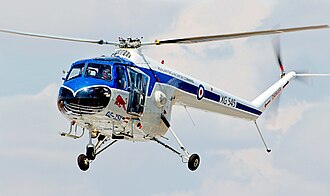
Bristol Sycamore: The Pioneering British Helicopter That Helped Define the Modern Rotary-Wing Era
The Bristol Sycamore, officially designated the Bristol Type 171, occupies a particularly important place in the history of British aviation. Developed in the years immediately following the Second World War, it was among the earliest practical helicopters produced in Britain and became the first British-designed helicopter to enter service with the Royal Air Force. Conceived under the direction of Austrian-born helicopter pioneer Raoul Hafner, the Sycamore was an ambitious attempt to transform rotary-wing aircraft from experimental machines into useful tools for transportation, rescue, communications and military operations. Its development began in 1944, the first prototype flew in July 1947, and the aircraft received a British civil Certificate of Airworthiness in April 1949—the first British helicopter to achieve that distinction. Production continued until 1959, with approximately 178–180 aircraft built depending on whether prototypes and production totals are counted separately.
The Sycamore arrived at a pivotal moment. During the war, helicopters had demonstrated that they could perform tasks impossible or impractical for conventional fixed-wing aircraft, particularly casualty evacuation, observation and operations in confined terrain. Britain now had to determine whether the helicopter could become a practical part of everyday aviation. The Sycamore provided an important answer. Although it was relatively slow and modest by modern helicopter standards, it could take off and land vertically, hover, carry passengers or equipment and operate from locations inaccessible to conventional aircraft. These capabilities made it particularly valuable for search and rescue, communications, transport and operations in mountainous or jungle environments. Its contribution to the development of British military helicopter operations was therefore considerably greater than its relatively small production run might suggest.
The Origins of the Bristol Sycamore
Raoul Hafner and Bristol’s Helicopter Programme
The story of the Sycamore is closely connected with Raoul Hafner, one of the most important pioneers of British helicopter development. Hafner had conducted rotary-wing research before the Second World War and subsequently became associated with Bristol’s new helicopter department. In June 1944, work began on a four-seat helicopter intended for both civil and military applications. Bristol’s designers were particularly interested in producing a machine with durable mechanical components because early helicopters suffered from considerable reliability problems. The resulting Type 171 was not derived from an existing production helicopter; according to the RAF’s historical research, it represented a completely individual Bristol development reflecting Hafner’s ideas about helicopter design.
One of Hafner’s central objectives was to create a helicopter that would be relatively fast while maintaining a level fuselage during normal forward flight. Instead of relying on hydraulic assistance for the controls, the Sycamore used carefully designed rotor characteristics to produce manageable control forces. The rotor head was tilted forward by approximately five degrees, allowing the fuselage to remain comparatively level in cruising flight. This was an unusual design philosophy and contributed to some distinctive handling characteristics during takeoff and hovering. Nevertheless, Hafner believed that optimizing the aircraft for the cruise condition was more important than designing solely around the relatively brief periods spent hovering or transitioning into flight.
The Name “Sycamore”
The aircraft’s name was chosen in reference to the seeds of the sycamore tree. These seeds descend through the air in a rotating motion, an evocative natural example of aerodynamic autorotation. The connection was particularly appropriate for a helicopter, whose rotating rotor system allows it to generate lift and, under certain circumstances, descend safely using autorotation after an engine failure. The name also gave the aircraft a memorable identity at a time when many experimental and military helicopters were known primarily by technical designations.
The First Flight
Prototype Testing Begins
The first Type 171 prototype, VL958, was powered by a 450-horsepower Pratt & Whitney Wasp Junior radial engine because Bristol did not yet have a suitable engine of its own available for the project. It made its maiden flight on 27 July 1947, marking a major milestone for the British helicopter industry. The second prototype followed during 1948, while a third prototype incorporated substantial improvements and became the basis for subsequent production development.
The choice of a radial piston engine reflected the technological environment of the period. Turbine engines suitable for helicopters were still in their infancy, and the practical helicopter turbine would not become widespread until later. The radial engine was comparatively heavy and mechanically complex by modern standards, but it was well understood, reliable and capable of providing the power required by the Sycamore.
The third prototype was particularly important because it introduced the Alvis Leonides engine, which became the standard powerplant for production Sycamores. The Leonides was a powerful air-cooled radial engine producing around 550 horsepower in early configurations. This gave the Sycamore a useful improvement in performance and helped turn the experimental Type 171 into a practical aircraft capable of performing demanding operational duties.
Britain’s First Helicopter Certificate of Airworthiness
On 25 April 1949, the Sycamore became the first British helicopter to receive a Certificate of Airworthiness. This was a landmark achievement because it demonstrated that a British-designed rotary-wing aircraft had progressed beyond experimental status into an aircraft considered sufficiently mature for regulated civil operation. The achievement also helped establish Bristol as a serious participant in the emerging helicopter industry. (Wikipedia)
The certification was more than a bureaucratic milestone. Early helicopters presented engineers and aviation authorities with unfamiliar problems involving rotor dynamics, vibration, control systems and mechanical reliability. The Sycamore’s certification reflected years of development work intended to make the aircraft sufficiently dependable for real-world operation.
Design and Engineering of the Sycamore
A Three-Bladed Main Rotor
The Sycamore used a three-bladed main rotor combined with a conventional tail rotor. The main rotor blades were constructed from wood, a material widely used in early helicopter rotor systems because of its relatively favorable strength-to-weight characteristics and established manufacturing techniques. The rotor system incorporated design features intended to reduce control forces and manage centrifugal loads efficiently. The RAF’s historical description specifically highlights Hafner’s use of tie-bars to carry blade centrifugal forces rather than relying on the flapping hinges for that purpose.
The rotor system was central to the aircraft’s character. Unlike many later helicopters, which would benefit from advanced metal and composite rotor blades as well as increasingly sophisticated control systems, the Sycamore relied on comparatively traditional technology. Yet this simplicity should not be mistaken for a lack of innovation. Designing a reliable rotor system was one of the greatest challenges facing helicopter engineers, and the Sycamore’s system represented a considerable achievement for its era.
A Compact and Practical Cabin
The Sycamore’s cabin was designed to accommodate passengers, crew or equipment depending on the particular variant. The aircraft could be configured for transport, communications, ambulance work and rescue operations, making it a remarkably flexible platform. The fuselage was relatively compact, but its cabin could be rapidly adapted for different missions.
Later variants incorporated features particularly useful for rescue and utility work, including improved access arrangements and equipment such as rescue winches. The ability to hover beside a casualty or operate above a confined landing area gave the Sycamore a capability that fixed-wing aircraft could not duplicate. This was especially important for mountain rescue and maritime search-and-rescue operations.
The Bristol Sycamore Enters RAF Service
Search and Rescue
The Sycamore entered RAF service in 1953, and search and rescue quickly became one of its most important roles. The RAF operated several variants, including the HR.12, HR.13 and HR.14, which were specifically associated with rescue operations. The RAF Museum notes that the Sycamore equipped nine RAF squadrons and that crews helped pioneer helicopter techniques that subsequently became standard in air-sea rescue and troop transport.
Search and rescue was an ideal application for the aircraft’s capabilities. A fixed-wing aircraft needed a runway and generally could not remain stationary above a specific point, whereas the Sycamore could hover, descend into confined spaces and operate from small clearings. A rescue helicopter could therefore reach people who were stranded in locations that would otherwise have been extremely difficult to access.
The aircraft’s rescue equipment could include a winch, allowing personnel to be raised from ships, cliffs or other locations without requiring the helicopter to land. These operations helped establish procedures that would later become fundamental to military and civilian helicopter rescue organizations.
Operations in Malaya
The Sycamore also played an important role during the British campaign against communist guerrillas in Malaya between 1948 and 1960. Jungle terrain created enormous logistical challenges, with roads and conventional landing strips often unavailable or impractical. Helicopters could transport personnel and supplies directly into clearings and other remote locations.
The RAF Museum emphasizes the value of Sycamores and Westland Dragonflies in this environment, particularly their ability to carry patrols into jungle areas and evacuate casualties from small clearings. The helicopter’s ability to remove wounded personnel rapidly from difficult terrain provided an important medical and morale advantage.
These operations demonstrated that helicopters were not merely specialized rescue machines. They could fundamentally change how military forces operated in terrain where conventional transport was restricted. The Sycamore was part of this important transition from experimental rotary-wing aviation to the practical use of helicopters as routine military transport assets.
International Operators
Australia
The Sycamore attracted considerable interest outside Britain. Australia became one of its most important overseas users, with the Royal Australian Navy and Royal Australian Air Force employing the aircraft in transport, rescue and utility roles. Australian service demonstrated that the helicopter’s capabilities were valuable in large countries where distances and difficult terrain could make conventional transportation challenging.
The aircraft’s ability to operate from relatively small areas also made it attractive for naval operations. Search-and-rescue duties could be conducted from coastal locations and ships, while utility missions benefited from the helicopter’s ability to reach areas without conventional infrastructure.
Belgium and West Germany
The Sycamore was also exported to Belgium and West Germany. The German military received the Sycamore Mk.52, while Belgian forces operated the type in Africa, including the Congo. These international users provided additional evidence that the aircraft could function effectively in different geographical and operational environments.
West German use was particularly significant because the postwar German armed forces were developing new military aviation capabilities within the changing security environment of the early Cold War. The Sycamore provided valuable experience with helicopter operations before more advanced types became available.
Bristol Sycamore Variants
Early Marks
The earliest aircraft were the Mk.1 prototypes powered by the Pratt & Whitney Wasp Junior. The Mk.2 introduced the Alvis Leonides engine and became the basis for the production family. The Mk.3 incorporated further changes, including a shortened nose, wider cabin and modifications intended to improve the aircraft’s utility. Various early production aircraft were assigned ambulance, communications and search-and-rescue roles.
The Mk.3A was developed for British European Airways and included improvements such as additional baggage capacity. This demonstrated that Bristol continued to see potential for civil applications even while military versions were becoming increasingly important.
The Mk.4 and HR.14
The Mk.4 represented the principal later production configuration and incorporated modifications developed from operational experience. Changes included taller landing gear, four cabin doors and a revised pilot position. Military customers received versions under different designations, including the RAF’s HR.14, the Royal Australian Navy’s Mk.51 and the German Mk.52.
The RAF HR.14 became particularly associated with search-and-rescue and communications work. One preserved HR.14, XJ918, served with No. 275 Squadron and later had a long career that included service in the Far East and specialist RAF communications duties. The RAF Museum’s records show that No. 275 Squadron operated Sycamores from several locations while providing search-and-rescue coverage across Britain.
The Sycamore and the Development of Helicopter Operations
A New Kind of Aviation
The importance of the Bristol Sycamore cannot be measured solely by speed, payload or production numbers. Its greatest contribution was demonstrating what helicopters could actually do. The aircraft could carry people and supplies without a runway, rescue casualties from inaccessible terrain and support operations in places where conventional aircraft were ineffective.
The RAF’s experience with the Sycamore helped establish techniques that would become standard in subsequent generations of helicopters. Pilots and crews gained practical knowledge about hovering, confined-area operations, winching, casualty evacuation and helicopter logistics. These lessons were particularly important because the helicopter was still a relatively new technology during the Sycamore’s early service life.
The Beginning of a Bristol Helicopter Family
The Sycamore also established the foundations for Bristol’s continuing involvement in helicopter development. Its successor in the company’s military helicopter lineage was the larger Bristol Belvedere, which adopted some of the design philosophy and engineering experience developed through the Sycamore programme.
The Sycamore therefore represented the beginning of a new chapter for Bristol. The company had already established an international reputation for fixed-wing aircraft, but its helicopter division demonstrated that Bristol could also compete in the rapidly emerging rotary-wing field.
Performance and Technical Characteristics
Modest Speed but Excellent Utility
A later Sycamore powered by an Alvis Leonides engine could achieve a maximum speed of approximately 124–127 mph, with a normal range of roughly 260–270 miles depending on configuration. The aircraft’s relatively low speed might seem unimpressive today, but it was sufficient for the missions for which the helicopter was intended.
The aircraft’s real advantage was not speed. It was the ability to stop, hover and land almost anywhere. A Sycamore could approach a rescue site at low altitude, remain stationary while personnel were recovered, and then depart without needing a runway. For military transport, the same capability allowed troops and supplies to bypass difficult terrain.
Its maximum takeoff weight was approximately 5,600 pounds, with useful payload capacity depending on fuel, equipment and mission configuration. The aircraft could carry several people in addition to the pilot, although exact seating arrangements varied between variants.
Reliability and Mechanical Engineering
Reliability was a major consideration throughout the Sycamore’s development. Helicopters contain numerous highly stressed moving components, and the failure of a rotor-system component can have catastrophic consequences. Bristol therefore devoted considerable attention to the endurance of the aircraft’s mechanical systems. The RAF’s historical account specifically notes the importance Hafner placed on mechanical durability and rotor-system design.
This emphasis was particularly important for an aircraft intended for rescue and military operations. A helicopter that could theoretically reach an inaccessible location but could not be trusted mechanically would have limited practical value. The Sycamore helped demonstrate that helicopters could become dependable operational aircraft rather than remaining fragile experimental machines.
Production and Retirement
Approximately 178 Sycamores were built, although some historical references give a total of 180 depending on how prototypes are counted. Production continued through the 1950s, and the aircraft remained in service with some operators well into the 1960s and, in individual cases, beyond.
The Sycamore’s eventual replacement was driven largely by technological progress. Turbine-powered helicopters offered major advantages in power-to-weight ratio, reliability and operational flexibility, while newer designs could carry larger payloads and fly more effectively in demanding conditions. The Sycamore had nevertheless accomplished what it needed to do: establish the helicopter as a practical component of British military aviation.
Bristol Sycamore Technical Specifications
The figures below are representative of the later Bristol Sycamore Mk.4 / RAF HR.14 family. Exact dimensions, weights and performance varied somewhat between marks and equipment configurations.
| Specification | Bristol Sycamore |
|---|---|
| Manufacturer | Bristol Aeroplane Company |
| Designer | Raoul Hafner |
| Type | General-purpose utility helicopter |
| First flight | 27 July 1947 |
| RAF introduction | 1953 |
| Crew | Typically 1–2 |
| Passenger capacity | Up to approximately 4 passengers, depending on configuration |
| Length | Approximately 46 ft 2 in (14.07 m) |
| Overall length with rotor | Approximately 48 ft 7 in (14.8 m) rotor diameter |
| Height | Approximately 12 ft 2 in (3.7 m) |
| Main rotor | Three-bladed |
| Rotor diameter | Approximately 48 ft 6¾ in (14.8 m) |
| Engine | 1 × Alvis Leonides radial engine |
| Typical engine power | Approximately 520–550 hp (388–410 kW) |
| Maximum speed | Approximately 124–127 mph (200–204 km/h) |
| Cruising speed | Approximately 91 mph (146 km/h) |
| Normal range | Approximately 265–270 miles (426–431 km) |
| Service ceiling | Approximately 15,500 ft (4,725 m), depending on variant |
| Maximum takeoff weight | Approximately 5,600 lb (2,540 kg) |
| Empty weight | Approximately 4,000–4,050 lb (1,800–1,837 kg) |
| Primary roles | Search and rescue, transport, communications, ambulance, observation |
| Special equipment | Rescue winch on dedicated SAR variants |
| Major military operators | Royal Air Force, Royal Australian Navy, Royal Australian Air Force, Belgian Air Force, German forces |
| Production | Approximately 178–180 aircraft |
| Production period | 1947–1959 |
Conclusion
The Bristol Sycamore was one of the aircraft that helped turn the helicopter from an intriguing technological experiment into a practical aviation tool. Its achievements were particularly significant because it arrived at a time when engineers, pilots and military planners were still learning how rotary-wing aircraft could best be used. Rather than attempting to compete directly with fixed-wing aircraft in speed or range, the Sycamore exploited the helicopter’s greatest advantage: the ability to take off and land vertically, hover and operate in places where runways were unavailable.
Under Raoul Hafner’s direction, Bristol developed an aircraft that combined unusual rotor-system engineering with a practical cabin and versatile mission capability. Its first flight in 1947 and subsequent certification in 1949 represented major milestones for British helicopter aviation. When the Sycamore entered RAF service in 1953, it became an important instrument for search and rescue, communications and transport, while operations in Malaya demonstrated its usefulness in difficult jungle terrain.
The aircraft’s international career further demonstrated its value. Australia, Belgium and West Germany all employed the Sycamore, while British civilian operators also explored its potential for passenger and utility work. Its relatively small production run concealed an important historical achievement: the aircraft helped develop the operational procedures, maintenance practices and pilot skills that would become fundamental to the helicopter age.
Today, surviving Sycamores are valuable reminders of the early postwar period of rotary-wing development. The aircraft’s wooden rotor blades, radial engine, compact cabin and distinctive appearance belong to an era very different from today’s turbine-powered helicopters, yet many of the missions for which it was developed—search and rescue, casualty evacuation, transport and access to remote terrain—remain central to helicopter operations.
The Bristol Sycamore should therefore be remembered not simply as an early British helicopter, but as a pioneer of practical rotary-wing aviation. It proved that a helicopter could be more than an experimental curiosity: it could become a dependable working aircraft capable of saving lives, carrying people and supplies, and opening areas previously difficult to reach. In doing so, the Sycamore helped lay the foundations for Britain’s increasingly important helicopter industry and for the generations of rotary-wing aircraft that followed.
:::
