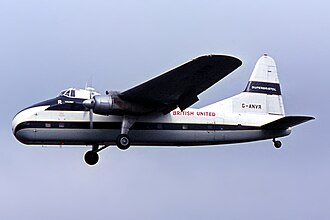
Bristol Freighter: The Rugged British Workhorse That Put Cars in the Sky
The Bristol Freighter, officially designated the Bristol Type 170, was one of the most distinctive transport aircraft produced in Britain after the Second World War. With its box-like fuselage, high-mounted cockpit and unmistakable clamshell nose doors, the aircraft looked less like a conventional airliner and more like a flying delivery truck—and that was precisely the point. Bristol designed the Freighter around the practical demands of moving bulky cargo, vehicles, people and equipment rather than around conventional passenger-airliner styling. Its unusual nose allowed vehicles and large items to be driven or loaded directly into the aircraft, eliminating many of the handling difficulties associated with traditional side-loading cargo aircraft. The prototype flew for the first time on 2 December 1945, and the aircraft subsequently found customers among airlines, air forces and specialist operators around the world. A total of 214 Bristol 170 Freighters and related Wayfarer aircraft were built between 1945 and 1958.
The Bristol Freighter became particularly famous through its association with Silver City Airways, which transformed the aircraft into one of the world’s earliest successful vehicle air-ferry aircraft. Instead of requiring motorists to leave their cars behind and travel separately by ship or aircraft, the Freighter could simply swallow the vehicle through its nose, carry it across the English Channel and unload it at the destination. This created an entirely new form of short-distance air travel and helped establish the concept of the air ferry. Yet the Freighter was much more than a car carrier. It served as a conventional freighter, passenger aircraft, military transport, medical evacuation aircraft and general-purpose utility machine. Its long operational career and remarkable versatility make the Type 170 one of the most interesting British transport aircraft of the postwar era.
Origins of the Bristol Freighter
A Postwar Transport Designed for Practicality
The Bristol Type 170 originated during the final years of the Second World War, when Bristol was considering what kinds of aircraft might be commercially useful after the enormous wartime demand for military production disappeared. The initial design was developed as a private venture, partly to maintain productive work within the company as wartime programmes wound down. Bristol engineers envisioned a relatively inexpensive and uncomplicated transport aircraft that could carry substantial loads while operating from comparatively basic airfields. The British Air Ministry subsequently became interested because such an aircraft could have useful military applications, particularly in remote areas such as the Far East. The military requirement emphasized the ability to transport equipment including a three-ton truck, which strongly influenced the aircraft’s unusual configuration.
The designers approached the problem with practicality rather than elegance. The fuselage had a large, unobstructed rectangular interior, allowing cargo to occupy as much of the available space as possible. Instead of placing the flight deck directly in front of the cargo compartment, Bristol raised the cockpit above the forward portion of the fuselage. This created a clear path through the nose and into the cargo hold. Large clamshell doors opened at the front, meaning that vehicles could be driven directly into the aircraft with the assistance of a ramp. For freight operators, this was an extraordinarily useful feature because it reduced the need for specialized loading equipment and allowed bulky cargo to be handled quickly.
The aircraft was also deliberately designed for economical manufacture and maintenance. Contemporary descriptions emphasize the use of straightforward construction, relatively few expensive machined components and systems that did not require elaborate specialist tooling. Its fixed undercarriage was another example of the design philosophy. Although retractable landing gear could have reduced aerodynamic drag, a fixed arrangement simplified construction and maintenance while making the aircraft better suited to the rugged short-haul work for which it was intended.
The First Bristol 170
Prototype and Certification
The first prototype, registered G-AGPV, made its maiden flight from Filton on 2 December 1945. Although the aircraft had been conceived during the war, development and production progressed too slowly for it to participate in the conflict itself. Instead, the Type 170 entered a postwar aviation environment in which airlines, governments and military organizations were looking for affordable ways to move people and goods across increasingly interconnected routes. The second prototype, G-AGVB, was developed in passenger configuration and became known as the Wayfarer. It first flew on 30 April 1946.
The aircraft achieved an important milestone when it received its British civil Certificate of Airworthiness in May 1946. Aerospace Bristol describes the Bristol 170 as one of the first new British commercial aircraft to fly after the war, while historical references note that it received the first postwar Certificate of Airworthiness for a new British aircraft. This certification opened the door to commercial operations and helped demonstrate that a rugged military-inspired transport could have a viable civilian future.
The Bristol 170 could be produced in several configurations. The Freighter retained the large cargo doors and was optimized for freight and vehicle transportation, while the Wayfarer was designed as a passenger aircraft without the same cargo-loading arrangement. This dual-purpose philosophy gave Bristol access to several markets without requiring the company to develop a completely new aircraft for each application.
The Distinctive Freighter Design
Clamshell Nose Doors
The most famous feature of the Bristol Freighter was its nose. Instead of loading cargo through a side door or rear ramp, the front of the aircraft opened outward through large clamshell doors. With the cockpit positioned above the cargo compartment, the entire forward fuselage effectively became a loading entrance. A ramp could be placed against the opening, allowing cars, trucks and other wheeled loads to enter under their own power.
This arrangement was particularly revolutionary for vehicle transportation. Cars could be driven directly into the aircraft, secured inside and then driven out at the destination. The concept eliminated much of the conventional handling required when transferring vehicles between ships, trains, trucks and aircraft. It also allowed the aircraft to operate as a genuine short-distance vehicle ferry rather than merely as a cargo aircraft that happened to be capable of carrying automobiles.
The Freighter’s square-section fuselage was not particularly aerodynamic, but it maximized usable internal volume. This was a deliberate compromise. The aircraft did not need to compete with sleek long-range airliners; it needed to move awkward loads efficiently. Its relatively modest cruise speed was therefore acceptable because the real advantage was the ability to transport cargo from one usable airfield to another with minimal ground handling.
High Cockpit and Unobstructed Cargo Space
The elevated cockpit was another defining characteristic. Pilots occupied a flight deck above the main cargo area, reached through a ladder. This arrangement freed the lower fuselage for cargo and made the loading system possible. It also gave the aircraft its distinctive appearance, with the cockpit appearing almost perched on top of the broad forward fuselage.
The interior was intentionally simple. Without conventional passenger seating, partitions and other airline-style fittings taking up valuable space, the cargo compartment could accommodate vehicles, machinery, livestock and military equipment. This flexibility was one reason the Freighter remained useful for so many different operators and missions.
The Bristol Freighter and Silver City Airways
The Birth of the Air Ferry
The Bristol Freighter’s most famous civilian role came through Silver City Airways, which recognized that the aircraft could revolutionize travel between Britain and continental Europe. The airline began operating car-ferry services across the English Channel, allowing motorists to take their own vehicles with them rather than relying on conventional sea ferries.
The first vehicle-carrying flight took place in July 1948, operating between Lympne in Kent and Le Touquet in France. This was the beginning of an extremely successful business model. The Freighter could carry cars and passengers on short international journeys while avoiding the lengthy process of loading vehicles onto ships.
The service became so successful that Silver City developed an extensive network of short-haul air-ferry operations. According to Bristol Owners Heritage Trust, the airline had completed approximately 125,000 ferry flights by 1958, carrying around 215,000 vehicles and 750,000 passengers. These figures demonstrate how important the Freighter became to the development of cross-Channel air travel.
The aircraft’s rugged construction also suited the intense operating schedule. BAE Systems notes that in 1954 the Silver City Freighter fleet averaged approximately 2,970 takeoffs and landings per aircraft during the year—more than eight flight cycles per day. Such utilization illustrates the aircraft’s reputation as a hard-working machine rather than a delicate or highly specialized transport.
The Bristol Wayfarer
Passenger Transport
The Bristol Wayfarer was the passenger-oriented member of the Type 170 family. Instead of focusing on vehicles and freight, it offered conventional seating and was intended for airline passenger operations. The second prototype became a Wayfarer and was used for route-proving work, including services to the Channel Islands. BAE Systems records that the prototype carried more than 10,000 passengers in under six months during one period of route-proving activity.
The Wayfarer demonstrated that the underlying airframe could be adapted to passenger transportation without abandoning the basic philosophy of simplicity and ruggedness. Although the aircraft could not compete with larger postwar airliners for long-distance passenger travel, it was well suited to short regional routes and specialist operations.
The passenger version also reinforced the Bristol 170’s unusual versatility. The same basic design could carry freight one day and people another, depending on how the operator configured the aircraft. This flexibility was particularly valuable in the immediate postwar period, when aviation companies were experimenting with new routes and business models.
Military Service Around the World
Transport and Utility Operations
Although the Bristol Freighter is best remembered for civilian air-ferry operations, military customers also recognized its usefulness. Several air forces acquired the aircraft for transport and utility duties. Operators included the Royal Australian Air Force, Royal Canadian Air Force, Royal New Zealand Air Force and Pakistan Air Force, while other aircraft were supplied to countries including Argentina and Burma.
Military users valued the same qualities that attracted commercial freight operators: a large unobstructed cargo compartment, rugged construction, relatively straightforward maintenance and the ability to transport equipment that might have been difficult to load into a conventional transport aircraft. The Freighter could also be used for troop transport and medical evacuation. Some configurations could accommodate large numbers of troops, while casualty evacuation versions could carry stretchers and medical personnel.
The aircraft also saw service during the Berlin Airlift of 1948–49, when Allied forces maintained vital supplies to West Berlin by air after Soviet restrictions cut off normal land routes. The Freighter’s ability to handle bulky cargo made it useful in this demanding operation and further strengthened its reputation as a practical transport aircraft.
The Development of the Superfreighter
More Space for Cars
The success of the original Freighter naturally led operators to ask whether the aircraft could carry even more vehicles. Bristol responded with the Type 170 Mk 32 Superfreighter, an enlarged version designed especially with Silver City Airways’ vehicle-ferry operations in mind.
The Superfreighter featured a longer fuselage and increased fin area. Its extended cargo compartment allowed it to carry three cars instead of the two accommodated by earlier air-ferry versions, while passenger capacity increased to approximately 20 in the standard vehicle-ferry configuration. One Superfreighter was even converted into an all-passenger aircraft known as the Super Wayfarer, capable of carrying up to 60 passengers.
The Superfreighter first flew on 16 January 1953. Its development demonstrated that the original Type 170 concept had been commercially successful enough to justify further investment. Rather than replacing the Freighter with a completely new aircraft, Bristol refined the existing formula by increasing capacity while preserving the essential nose-loading arrangement.
Engines and Performance
Bristol Hercules Power
The Bristol Freighter’s performance came from two Bristol Hercules radial engines. Later Mk 31 aircraft, for example, were equipped with Hercules 734 engines producing approximately 1,980 horsepower each. These 14-cylinder sleeve-valve radials drove four-bladed propellers and provided enough power for the aircraft to operate with a substantial payload.
A representative Mk 31 had a maximum cruise speed of approximately 193 mph (311 km/h) at 10,000 feet, while economical cruise speed was around 163 mph. With a maximum payload, its range was approximately 820 miles, while carrying maximum fuel could extend the range to around 1,730 miles depending on configuration and operating conditions. These figures were not spectacular by the standards of later transport aircraft, but they were entirely appropriate for the Freighter’s short-haul mission.
The aircraft’s relatively low speed was also less important on its typical missions. A vehicle ferry traveling a short distance across the Channel did not need jetliner performance. Reliability, ease of loading and fast turnaround were more valuable. The Freighter’s design consequently prioritized operational efficiency over aerodynamic refinement.
Production and Long Service Life
214 Aircraft Built
Production of the Bristol Type 170 family continued until 1958, with a total of 214 Freighters and Wayfarers built. The aircraft was produced in several marks, including the Mk I, Mk II, Mk 21, Mk 31 and Mk 32 Superfreighter. Improvements generally involved stronger structures, more powerful engines, increased weights and modifications to suit changing customer requirements.
The Freighter’s service life was remarkable. Its combination of rugged construction and relatively simple systems meant that individual aircraft could remain useful for decades after leaving the factory. Some were sold from one operator to another and continued performing cargo and specialist duties long after newer aircraft had entered service.
One of the last Bristol Freighters continued flying into the twenty-first century. BAE Systems records that the final Freighter flight took place in 2004, when an aircraft was flown to the Reynolds-Alberta Museum in Canada. This brought an end to an operational career lasting nearly six decades.
The Bristol Freighter Today
A Rare Aviation Survivor
Today, surviving Bristol Freighters are highly significant examples of postwar British aviation engineering. Their unusual configuration makes them immediately recognizable, while their history connects several important developments in transportation: postwar cargo aviation, military airlift, regional passenger services and the emergence of commercial vehicle ferrying.
A particularly important example is preserved at Aerospace Bristol, where the museum has undertaken a major conservation project involving a Bristol Freighter that was returned to its birthplace from New Zealand. The museum describes the aircraft as the only surviving example of its type in Europe and has been documenting its conservation and reassembly.
The aircraft is valuable not simply because it is rare but because it represents an unusual design philosophy. Modern cargo aircraft generally use sophisticated loading systems, large rear ramps or side cargo doors, while the Freighter’s front-opening fuselage provided an elegantly simple solution to a difficult problem. Its design reminds us that useful engineering does not always require complexity; sometimes the most effective solution is simply to make the cargo compartment accessible.
Bristol Freighter Technical Specifications
The following specifications are representative of the Bristol Freighter Mk 31, one of the principal later production variants. Specifications varied between marks and individual configurations, particularly for passenger and vehicle-ferry aircraft.
| Specification | Bristol Freighter Mk 31 |
|---|---|
| Manufacturer | Bristol Aeroplane Company |
| Type | Twin-engine cargo and utility transport |
| First flight | 2 December 1945 |
| Crew | Typically 3 |
| Length | 68 ft 4 in (20.83 m) |
| Wingspan | 108 ft (32.92 m) |
| Height | 21 ft 6 in (6.56 m) |
| Wing area | 1,487 sq ft (138 m²) |
| Empty weight | Approximately 27,000 lb (12,247 kg) |
| Maximum takeoff weight | Approximately 44,000 lb (19,958 kg) |
| Engines | 2 × Bristol Hercules 734 |
| Engine power | Approximately 1,980 hp (1,476 kW) each |
| Propellers | Four-bladed |
| Maximum cruise speed | Approximately 193 mph (311 km/h) |
| Economical cruise speed | Approximately 163 mph (262 km/h) |
| Range with maximum payload | Approximately 820 miles (1,320 km) |
| Range with maximum fuel | Approximately 1,730 miles (2,785 km) |
| Maximum payload | Approximately 12,500 lb (5,670 kg) |
| Passenger capacity | Approximately 15–23 depending on configuration |
| Typical cargo | Freight, vehicles, machinery and livestock |
| Special feature | Forward clamshell cargo doors |
| Total Type 170 production | 214 aircraft |
| Production period | 1945–1958 |
| Major derivative | Bristol Superfreighter Mk 32 |
Conclusion
The Bristol Freighter was an aircraft that succeeded because it solved a practical problem exceptionally well. It was never intended to be the fastest or most glamorous aircraft in the sky. Instead, Bristol created a rugged transport with a large, unobstructed cargo compartment, a raised cockpit and enormous nose doors that made loading exceptionally simple. Those characteristics transformed the Type 170 into a remarkably versatile aircraft capable of carrying freight, vehicles, passengers, livestock, troops and medical casualties.
Its greatest claim to fame came through Silver City Airways and the development of commercial air-ferry services. By allowing motorists to take their own cars across the English Channel, the Bristol Freighter created a new form of international travel and demonstrated that air transport could compete with traditional sea routes for specialized short-distance journeys. The aircraft’s ability to operate at an extraordinary tempo also demonstrated the durability of its basic design. Thousands of flights and hundreds of thousands of passengers and vehicles passed through the air-ferry system built around the Freighter.
Yet the aircraft’s legacy extends beyond civilian aviation. Military operators around the world valued it as a transport and utility aircraft, while its participation in the Berlin Airlift demonstrated that its rugged design could be applied to demanding strategic operations. The later Superfreighter showed that the original concept could be enlarged and refined without losing its fundamental character.
Perhaps the most appropriate way to remember the Bristol Freighter is as a flying workhorse. Its boxy shape, fixed landing gear and unconventional nose may have looked old-fashioned even when it was new, but every major design feature served a purpose. The Freighter placed practicality ahead of appearance and flexibility ahead of specialization. That philosophy allowed it to survive for almost sixty years and made the Type 170 one of the most memorable British transport aircraft of the postwar period.
For aviation historians, the Bristol Freighter is therefore far more than an unusual-looking cargo plane. It represents an important moment when British aircraft designers were exploring what commercial aviation could become after the war. Its contribution to air-ferry travel, military transport and specialist cargo operations ensured that this unconventional aircraft earned a permanent place in aviation history.
